Hello. This blog is on an official hiatus of indeterminate length. I hope one day to return to this project, but currently don’t have the time to be a very good garblogger. Please enjoy the archives. Also, someone sent me this link today, which cracked me up. What better way to go out than with a classic Oscar sketch? Hasta luego, trashies!
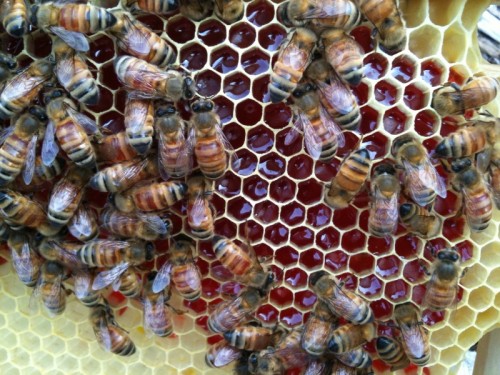
Hey trashies, I know it has been a while, but have you been following this crazy story about the secret pot farm hidden underneath Dell’s Maraschino Cherries Company in Brooklyn? You may remember that back in 2010, Brooklyn rooftop beekeepers complained that their honey had turned bright red and way too sweet thanks to bees feasting on the super sweet discarded cherry waste discarded by the same factory.
We posted about it here in 2012, along with links to a similar phenomenon in France where beekeepers documented blue and green honey later traced to M&M factory waste; and I even tasted some mildly affected honey during a tour of Eco Brooklyn’s show house.
It turns out, that in addition to possible illegal dumping — allegations police investigated after bee keepers complained — the factory served as a front to a local marijuana farm. And as you may have read, the owner of the factory shot himself when investigators found his pot plants. A tragic end to a fascinating story. Inquiries continue to determine whether the dumping of cherry waste has contributed to polluting the water in Red Hook, a neighborhood already shouldering more than its fair share of industrial strain on the local environment.
Nice detective work, bees! Someone needs to make a movie out of this one.
I have been meaning to share for a more than a week now the latest update from Rolando Politi, New York legend and founder of the trash worship movement. Rolando has long supported an all-woman waste picker’s collective in India and shares, along with these lovely photos, the news that you, too, may support their work by purchasing a flower made from salvaged materials.
Women making flowers
From Rolando:
The co-op in seemapuri is known as “kabad se jugad” (waste improvs) . Right now initial start up funds have all been spent for tools, supplies and rent. KSJ has decided to continue on the risky road of being all independent and self sustaining by the export sales of their unique flowers and mobiles! The price for one flower is $30 (includes export shipping) but if you order multiples, the cost is only $25 each. To order please send mail to recycleandpray@gmail.com. Specify the quantities and your shipping instructions.
Bindi bulbs
You need not pay until you receive the parcel in good order! They make a great surprise gift for your loved ones. We ship anywhere in the world and a card from sender can be included! The number of women involved is directly proportional to the number of orders received and just one order for three flowers is enough for one women salary for one month!
From time to time, my day job takes me to Nairobi, a city I did not love upon first visit, but have come to appreciate over time. Both the weather and social climate can feel cool at first and take some getting used to.
I should note that in addition to reserved Kenyan culture, security threats add to the chilly atmosphere. Sporadic fire bombings in markets, the horrific attack on Westgate Mall last year and a general sense of terror linger, and have left a legacy of tedious and not very reassuring security all over the city. Armed private security staff stand guard at every mall, hotel and office building entrance, metal detectors abound and before any car may enter a parking lot, the trunk must be popped and a mirror run under the perimeter of the vehicle, presumably in search of hidden explosives.
A few years ago, I got stuck in Nairobi for 10 days when a volcano erupted in Iceland and sent up a cloud of ash that drifted East and grounded all flights crossing over Europe. The forced safari pushed me to really get to know the city, and everything it had to offer. That’s how I discovered the chaotic warmth of Kenyatta market, a bustling open air bazaar comprised of food and clothing stalls and, of course, informal barber shops and hair braiding salons.
Front and center when you enter Kenyatta sit several cobblers, racks of shoes before them. A couple of weeks ago, while having a lovely lunch of grilled chicken and goat ribs, I noticed that my colleague, Lynda, had on a stunning pair of shoes. “Where did you get those?!” I asked. So she took me to Kenyatta and we marched straight over to the cobblers.
Lynda’s shoes
The shoe guys had a nice little set up with an old singer sewing machine, that reminded me of a very early everydaytrash.com dispatch from Malawi. Lynda showed me the big bag of cloth scraps from which we could select fabric.
Picking out fabric scraps
Once we had made our choices, we browsed the finished shoes on the cobbler’s rack and selected styles. Then he traced my foot. Two days later, I had two new pairs of shoes, including a pair modeled after Lynda’s with the same batik print. What I love about these shoes is that they recycle fabric remains (likely a deal the cobblers have set up with dressmakers in the market) and that the reuse is so one of a kind. My shoes, though identical in style and print to Linda’s, have their own asymmetrical charm as the fabric scraps are laid out slightly differently on my shoes than on hers.
Making my shoes
Next time I need to figure out a way to upcycle fabric scraps without the use of toxic shoe glue. In the meantime, I can’t wait to wear my new kicks!
Since Iran has been thoroughly eliminated from the competition, and the U.S. has safely passed to the next round, I have through the weekend to watch some good soccer without worrying about the fate of my nations. And that means more time to wonder what happens to all the World Cup trash. This piece on Brazilian catadores sorting tourist trash for recyclable materials warmed by heart.
Even more fascinating, however, is the Pimp My Carroça project, which I discovered via this fabulous CityLab article about street artists making trash cans look like backpacks worn by squat men. From what I can gather, the name translates roughly as “pimp my trash cart” and involves raising the visibility of Brazil’s trash pickers and the challenges they face using creative art projects.
Both the first article and the art collective note that Brazil boasts one of the world’s highest rates of can recycling, thanks in large part to the catadores.
To tell the story of this community, French filmmaker Rémi Pinaud (in collaboration with Pimp My Carroça) hopes to complete his project O Cafofo, or The Castle, a fictional film about a trash picker and his two daughters whose home in a high rise housing project in São Paulo comes under threat when the city starts “cleaning up” to host the World Cup.
I love World Cup season. No matter where I am in the world, it brings me joy to find international clusters of people huddled around televisions and to hear multilingual cheers and sporadic honking in the streets. I also love all the colorful news coverage the event sparks, like this amazing story about Japanese fans in Rio sticking around to clean up trash in the stadium after their team lost to Cote D’Ivoire.
Back in January of 2008, I came across an NYC event listing that seemed to have been drafted just for me: a presentation given by a group of NYU anthropology students who had spent a semester planning a museum to honor the New York City Department of Sanitation (DSNY). Professor Robin Nagle, DSNY’s anthropologist in residence co-taught the course.
Photo via RobinNagle.com
That’s how I discovered that such a position existed and that’s the first time I got to hear Nagle lecture on the history of trash in New York City. Her passion for the subject came across so clearly that I knew right away this idea of a museum honoring the sanitation department constituted more than a hypothetical class assignment. We discussed it a bit more one Trashtastic Tuesday; and a couple years after that I got her to join me on a panel about art and garbage that took place inside an RV parked on Manhattan’s Lower East Side.
Since then, I have kept up with Nagle mainly through social media (she has a badass Instagram feed) and by following the academic waste blog she founded, Discard Studies.
Then, a few weeks ago, my friend Oriana Leckert of Brooklyn Spaces asked if I wanted to join her at an event that merged her passion for unique creative venues with my passion for trash at the fabulous headquarters of Atlas Obscura. Nagle gave a fabulous lecture on the history of New York City’s struggle to deal with our trash. Highlights included amazing footage shot by Thomas Edison of sanitation workers loading a trash barge in 1903. Did you know Edison took little slice of life vignettes of the city and that you can view them all on YouTube thanks to the Library of Congress? You’re welcome.
After the lecture, I went home and opened up my copy of Picking Up, Nagle’s wonderful book in which she chronicles her time on the job as a sanitation worker and puts a human face on the corps of people who deal with our trash once we throw it “away.”
Picking Up: On the Streets and Behind the Trucks with the Sanitation Workers of New York City
The book is full of great anecdotes, personal stories and incredible facts. It’s a must read for all trashes and is now available in paperback. Go forth and purchase.
Glad (you know, the company that makes, among other things, trash bags) is teaming up with the New York City Department of Sanitation (DSNY) for an Earth Day (April 10) unveiling of a photo series featuring U.S. families and the trash they produce over the course of one week.
Charlene Wimms and Donell Brant of NYC, New York, with their children Darius Brant, 9, and Terrard Wimms, 16, surrounded by a week’s worth of their recyclables and landfill trash, in February. Recyclable items are on the left-hand side of the photo. Items destined for landfill are to the right. Their total household waste for this week was 28.9 lb. Seventy-nine percent of it (22.9 lb) was landfill and twenty-one percent of it was recyclables (6 lb). Photo credit: Peter Menzel.
Photojournalist Peter Menzel and writer Faith D’Aluisio interviewed and photographed eight families across the country for the project, gave each family instructions to save their trash and recycling for a week, then Menzel and D’Alusio cleaned and arranged the waste for very special family portraits. I normally dread Earth Day, because as a trash blogger it means tons of extra email for weeks from companies pitching inane (and often not very Earth-friendly) products and campaigns. I have to say, though, that I like this project. It’s trash specific, artistic and informative. They call it Waste in Focus.
New Yorkers can see the photos this Thursday afternoon (April 10) on display at Union Square.
The search for the missing Malaysian plane brought to light many crazy facts. It also drew attention to the crazy amounts of trash floating in the world’s oceans.
This morning a friend shared this beautifully-written tribute to Matthew Power, a journalist who died recently while reporting in Uganda. I didn’t know Power’s work before reading this piece, but the author Abe Streep’s description of his friend compelled me to seek it out. As someone who works in global health and travels frequently to places haunted by thrill-seeking writers and photographers, I found this line particularly intriguing:
Matt traveled to hard places, but he didn’t court danger.
Clicking through to a link shared in the tribute, I found “The Magic Mountain,” a sprawling Harper’s article written with old fashioned take-me-there charm. In it, Power simply and elegantly tells the story of a giant trash heap that piled up in Quezon City, Philippines, and the community of people who now live and eek out a life in its shadow.
Elizabeth Royteand her book Garbage Land were among my first and favorite discoveries as a garblogger. On Valentine’s day, it seems appropriate to share this recent piece she did for medium.com on “Sex, trash and nature in the city.”
My favorite thing about this article is that Royte reserves her judgement for the littering, but not the public lovemaking, that goes on in our beloved Prospect Park.
I’ve had my SodaStream Penguin since the company sent me one to try out in 2009 and, as reported on this site, I love making seltzer at home. Or at least, I used to love it. A couple of years ago, a politically active friend told me that the company operates in a West Bank settlement, a fact I found alarming and upsetting. It was also a fact I had trouble verifying in a cursory Google search. Since then my roommate and I, who both love bubbly water, have done a fair amount of research online and through conversations with friends working in the field of human rights. Verdict: SodaStream does operate in illegally occupied land in the West Bank and therefore will receive no more money from our housefold.
My first romp with the Penguin
To meet our cravings for bubbles, we decided to find alternatives to purchasing SodaStream CO2 cartridge refills (SodaStream seltzer makers use proprietary cartridges, which theoretically require paying them and only them for more gas when the bubbles run flat). We haven’t quite figured out a way around this, though according to the internet, it’s possible to buy cartridges from other companies that fit the Penguin. In the meantime, we haven’t used the device.
Also in the meantime, Scarlett Johansson‘s decision to serve as a spokesperson for the company — and to defend its business operations — has brought a lot of attention to the topics of homemade seltzer, celebrity endorsements, human rights violations and peace in the Middle East. I have to say, on a personal note, I find her stance surprising. Before this move, I have admired her progressive politics and outspoken support for reelecting the President, defending women’s health and rights in the U.S. and reducing poverty around the world.
For more background on this brouhaha, here are some handy links:




 everydaytrash