Author Archive

Day four of Literary Trash features children’s book author and illustrator Loreen Leedy

Thursday, February 8, 2007

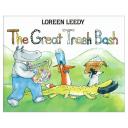
04loreen.jpg bash.jpg  Loreen Leedy’s ‘The Great Trash Bash’ (best title ever!) came out in 1991, but the lessons it teaches kids (and adults) about the different places garbage goes, what a problem too much garbage can be, are just as true today.  I discovered this book while researching potential Literary Trash week authors and thought an author-illustrator of Children’s books would round out our series.  Also, Mayor Hippo is adorable.   

everydaytrash:  How did you come up with the premise of The Great Trash Bash?

Loreen Leedy:  At the time, I was looking for a book project that would showcase the process of characters working together to accomplish a goal. Also, I was interested in working with an environmental theme. Now that it’s been awhile, I can’t recall exactly what inspired the notion of garbage. Perhaps it was/is so ubiquitous it seemed obvious. In general, I try to notice what is all around us yet taken for granted. We become accustomed to “how things are.” It takes insight and leadership to question it, as shown by the mayor of Beaston at the beginning of the story.

everydaytrash:  Even though it’s a book for young people, this story covers the pros and cons of incineration, landfills and recycling. How much research did you have to do to write it?

Leedy:  In those days (15+ years ago) I always went to the local public library to find magazines, encyclopedias, and books for research. Now the Internet is usually my first stop. If the book had required a lot of detail I might have visited an actual landfill and/or incinerator but it wasn’t necessary in this case. 

everydaytrash:  How did you decide to match the different animals to their characters?

Leedy:  Animals are fun to use as characters because they come in such a wide range of sizes, shapes, and colors from mice to alligators to ostriches. For a commanding yet comic presence I made the mayor a relatively large hippo wearing pants and tie (no shirt). Most of the other characters are small to medium-sized, reasonably familiar animals such as raccoons, foxes, and frogs. The diversity of critters reflects the variety of characters found in every town.    

everydaytrash:  What are some of the solutions that the citizens of Beaston come up with to solve their trash problems? Are they easy to follow in real life? 

Leedy:  Create less trash; fix old things instead of buying new things; stop littering; recycle; make a compost bin for food scraps; start a recycling center. Some are easier to follow than others– it’s hard to find anyone to repair electronic devices, for example. Perhaps the best idea is to adopt one new habit at a time until it becomes second nature. An easy one is recycling, though I do run across adults that can’t be bothered to recycle, which is frustrating. Hopefully children will be willing to adopt many of these practices for life. 

everdaytrash:  Do you have any sense of the impact of your book in the classroom? Do you get fan mail from kids and teachers?

Leedy:  I was surprised to learn that so far, The Great Trash Bash is my most translated book and has had many subsidiary rights licensed, such as being reprinted in textbook anthologies. This seems to indicate that garbage is a big issue all over the world and parents and teachers need a way to introduce it to children. Schools do a lot of trash-related projects such as:   

1.  Clean an area of the playground; tally the types of trash (metal/paper/plastic/wood); make a bar graph to show the most common litter found.  

2.  Each class collects the trash from one snack time; paste it onto poster board; display all the class trash posters together to raise awareness. 

3.  Kids bring in clean trash such as cereal boxes/egg cartons/cans; they combine their trash to make “trash monsters.” [editor’s note:  Contact Leila if you want to get together to make trash monsters.  Or make your own and send your photos to everday trash!]  

4.  Make useful items such as bird feeders out of trash.   

These are just some of the activities I’ve heard about, usually via email. It is fun to hear how the book is used in the classroom… you never know what they’ll come up with next!

### 

The Great Trash Bash is available through Leedy’s books. 

Check back tomorrow for more Literary Trash!

Update: Next up on the Literary Trash lineup is David Naguib Pellow, a professor of ethnic studies and author of Garbage Wars: The Struggle for Environmental Justice in Chicago
.
In which we continue Literary Trash, for a third day, with Rats author Robert Sullivan

Wednesday, February 7, 2007

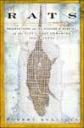
bobsullivan.jpg rats.jpg The first time I bought the book Rats: Observations on the History and Habitat of the City’s Most Unwanted Inhabitants, it was as a birthday gift for my oldest friend, Oro. Oro and I have known each other since infancy. More recently, we have been organizing walking tours for our friends about three or four times a year (nothing too formal, just an excuse to take long walks through new neighborhoods and perhaps eat better and more cheaply than usual). Given our mutual lifetime obsession with New York, Rats seemed like the perfect present. Our local bookstore wrapped the volume in map-of-Manhattan paper, which Oro later hung on the kitchen wall of the apartment he and his mother share. For several years, every time I went over to their apartment (which was about once a month because Oro and his mother are the two other members of my three-person book group), I thought of Rats and how none of us had ever read it and how none of us had ever suggested it for book group. The wrapping paper map on the wall began to represent every book I had ever wanted to read but somehow failed to get to; I wondered whether it would be tacky to ask for the book back.
When I finally did read rats (to prepare for the interview below), it took me all of one sitting. The thing I find so compelling about the topic here is that, like trash, rats are one of those things you only really think about if you can’t afford not to, or if you’re uncontrollably fascinated by details. Robert Sullivan, infectiously, is the latter.

everydaytrash: In writing a book about rats in New York City, how much of your research focused on garbage in New York City?

Robert Sullivan: The food of rats is trash, so I spent a lot of time in, or very near, a lot of trash. I looked at what trash or kinds of trash they (rats) prefer, which turns out to be a lot like the food people tend to prefer. Trash bags in an alley are to rats what fields of delicious grasses are to a wild horse out in an Oregon wilderness. Rats love to wrestle around in individual garbage bags. One of the innovations that has improved rat watching since the time I first went rat watching is the see-through trash bag. Before see-through bags, rats were like kids wrestling in a pup tent; now, they are like the boy in the bubble only they are a rats in trash.

everydaytrash: How much of reducing the rat population in the city do you think relies on reducing the amount of trash we produce?

Sullivan: It’s partly how much trash we produce–and that includes trash we bag and put out on the street and all the trash we just throw down on the ground whenever we feel like it or even accidentally–and partly how we contain our trash. In Chicago, people use metal containers, dumpsters in the alleys. Here we use plastic bags. By using plastic bags, it is as if we are raising rats. A plastic bag to a rat is almost like puff pastry, at least in terms of it toughness as a protective shell.

everydaytrash: In Rats, you cover the housing rights movement and labor organizing among sanitation workers. Do you see rats as a catalyst for social chance?

Sullivan: Rats have been used as a catalyst. People pay attention when you talk about rats. The rent strike I refer to in the book, in which organizers brought rats to city hall and rats even to Congress, is said to be the largest rent strike in the history of the United States, not that you read about it in text books very often. I also think rats are a good indicator species. The presence of rats in neighborhoods, for instance, indicates a place where we, as a city or town, could stand to pay more attention, whether that means spending more money or just caring more somehow.

everydaytrash: Since writing the book, do your friends now give you rat-themed gifts? Are you now called upon to review or endorse strange rat-themed products?

Sullivan: I am sometimes called in by friends who have rodent problems. But
that’s not a problem for me: after having written a rat book I am happy to have any friends at all.

everydaytrash: Are there any new statistics on how many rats live in the city?

Sullivan: There are always new statistics–like the famous one rat per person statistic that never dies, even though it should. But the new statistics are almost inevitably wrong. We might better spend any money we might spend counting rats on helping people not have them.

everydaytrash: If a blogger writing about trash were interested in adding a rat category to her site, what online resources would you recommend she check out?

I can’t help you there. I don’t know any rat blogs. I did once meet a member of the Chicago Rat Patrol, when I was in Chicago looking at rats. He seemed like a nice guy.

###

If your local bookstore doesn’t have Rats in stock, ask them to order it.

Check back tomorrow for more Literary Trash!

Update: Next up on the Literary Trash lineup is Loreen Leedy, author of the children’s book The Great Trash Bash.

Literary Trash day two, a chat with photographer Andrew Hughes

Tuesday, February 6, 2007

I found out about surfer, artist, blogger and author Andrew Hughes and his book of photographs depicting beach debris from Monday’s featured author, Elizabeth Royte. While we haven’t met in person, I know Andy to be a generous and forgiving guy. He responded to my pesky inquiries about his work right away, supplied beautiful photographs to go along with his answers, and even forgave me for accidentally calling him Australian (he’s ENGLISH).


everydaytrash: I read that you’re a surfer. Is that how you discovered this unconventional subject?

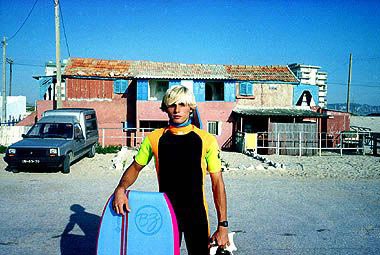
Andrew Hughes: I started learning to surf whilst at art college in Cardiff (Wales) 1989 – ish. One particular beach in Wales (Sker Bay) is just few miles from a very large industrialized zone, huge chemical works…it was on this beach that after coming out of the sea I noticed a sharp/metallic object in the palm of my hand, under the skin. It hurt and when I returned home I pulled it out with tweezers. At this point I thought about all the pollution we were actually immersing our bodies into. The sea water washes in your ears, your mouth etc.


It concerned me, my work (i.e. art) began to consider this as subject matter. At this time I became involved with a group call surfers against sewage almost 16 years ago. My work up until this point was based upon photographs of friends who were surfers.


andysker1.jpg


blueboy1.jpg


everydaytrah: What was the first thing washed up on the beach that you photographed?


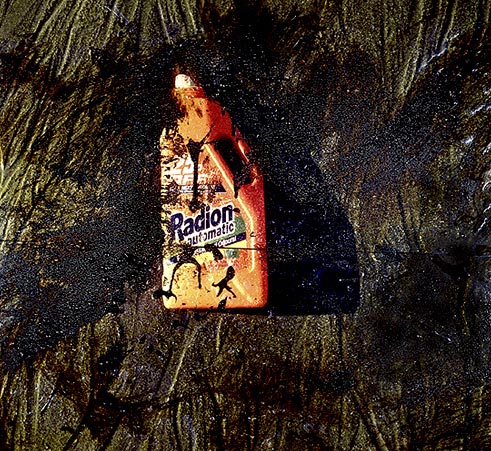
Hughes: This pic was one of the first I did, 1990 – The image was blown up to 4 foot and then covered in oil and Tar I found on the beach. Then re-photographed.


radion.jpg


everydaytrash: Does your work deal with the metaphors of things thrown away and forgotten, or are you purely interested in aesthetics?


Hughes: I think there is a duality, a conflict…in one sense they are all powerful metaphors, in a way I hope that they refer to our own mortality.


They feel somehow lost, often the object has been in close human contact. They had relationships with humans and other objects.


The objects once had a function – then discarded at will with no sense of purpose, to wash back and forth on the coastal fringe.


I think the book gently introduces the viewer to an insight or idea, I hope that they’ll consider and ponder the consequences of our mass consumerism, perhaps some may take some future action, its like “planting a seed.”


The purpose of these images is to enhance and explore how ‘i’ ‘we’ feel when presented with stuff,waste etc. I hope that the experience of art/photography in this manner may encourage individuals to reflect and make links with their own life experiences.


everdaytrash: And similarly, do you consider your work political?


Hughes: In the obvious sense no, but as a subject very much yes, I have been involved with various pressure groups etc. and whilst they are absolutely vital, I have steered away from my images being used in a direct didactic manner.


Picasso’s Geurnica as an example is much more potent and powerful as a work of art than as political statement (even if it is inherent in the work itself). And of course one of the writers/contributors is very much a political activist, have you read Josh Karliners ‘Coporate Planet’ ? Very good.


everydaytrash: How consciously are you drawing attention to consumerism and environmental issues?


Hughes: I hope that by giving presence to the stuff in the images, by almost investing a life in the object people can make the intellectual jump and consider this in the objects they live with, the stuff they use and consume and in turn the object discarded and its effect of other forms of life, on land, in the seas etc.


###


Dominant Wave Theory is available to visit and/or purchase at MoMA and, for those who don’t live in New York City, online.


Next up on the Literary Trash lineup is an interview with Robert Sullivan, the alacrious and tersely cogent author of Rats: Observations on the History and Habitat of the City’s Most Unwanted Inhabitants.


green jams

Tuesday, February 6, 2007

jams.jpg Just as I hit save to the formatting for tomorrow’s interview with a surf/trash photographer, my “daily” email from Cool Hunting arrived, alerting me to their recent posting on Planet Earth Green Label

waste-to-wealth

Monday, February 5, 2007

9dragons.jpg  This article in the Asia Times  and subsequent Internet research led me to several fascinating discoveries today.

1.  The world’s wealthiest garbage tycoon is a woman.  Her company is called Nine Dragon’s Paper and she made her fortune shipping used paper from India to China.

2. Google Finance is a nifty feature for researching big business holdings.

3. The Institute for Local Self-Reliance has a great page on waste-to-wealth initiatives.

Literary Trash, a week of trash authors beginning with Elizabeth Royte

Monday, February 5, 2007

erauthor.jpg A friend in public radio tipped me off to Elizabeth Royte and her fantastic chronicle of trash, Garbage Land: On the Secret Trail of Trash, this past summer after talking to Royte for a show about trash and the law. I bought the book the next day and later met Royte at the Brooklyn Book Fest, where she was reading from her newly released paperback edition. I introduced myself and asked if she’d be willing to be interviewed for everyday trash. “Sure,” she said, adding [something along the lines of], “but I read on your blog that you’re still reading my book, so wait to see if you like it.”

Outed as not yet having finished Garbage Land, but thrilled that a genuine trash reporter had not only heard of but read everyday trash, I filed away the idea of an interview until…author’s week! What better way to kick of a week of interviews than with the Garbage Lady herself?

everydaytrash: Now that you’ve finished your book, do you still research the subject of garbage? Any recent excursions/adventures?

Elizabeth Royte: I try to keep up with garbage news through various media (including yours) [editor’s note: Royte is an occasional and much appreciated tipster to everyday trash], and I go around talking on college campuses about consumption and waste. I was recently invited by a friendly engineer to tour his landfill in Anchorage, but my plane left too early for a visit. Since Garbage Land came out, I’ve written magazine stories about the Katrina cleanup, about corn-based plastics, and waste from pharmaceuticals and personal-care products in our waterways. Oh, and I recently stayed at a zero-waste hotel in Boulder – that was kind of neat. I can’t seem to get away from the topic!

everydaytrash: Your book focuses on the way New York deals with trash. What are some other cities whose creative waste solutions you admire?

Royte: I admire what San Francisco is doing with their zero waste initiative, particularly their composting program. Boulder signed a zero waste resolution last year and is investigating composting options, and now Seattle, which has an excellent curbside program, has started fining residents for putting anything recyclable into the regular trash. It shows they take this seriously. (New York City fines residents for recycling improperly, but it doesn’t seem to be that hard-nosed about it – perhaps recognizing that the public is still pretty confused about our recycling rules.)

everydaytrash: In your book, you use your own household waste as an example of the amount we throw away and what a struggle it can be to reduce that waste. Are you still hyper-sconscious of your own trash?

Royte: I’m still hyperconscious, but I’m not nearly as conscientious as I was when I was sorting and weighing my trash. I’m lazier about getting small pieces of paper – shopping lists, receipts, blow-in cards from magazines–into my paper recycling pile (which is ten steps away and outside my apartment door). But I’m still composting.

everydaytrash: From a bigger picture perspective, are there lobbying or legislative initiatives out there that people should look out for? Is garbage a voting issue or should it be?

Royte: Yes! Mayoral elections in New York have swung on garbage issues. People _should_ be aware of where their garbage is going and have some say in how it’s handled, how their tax dollars are spent. New York City spends over a billion dollars a year collecting and disposing of waste. And yes, all Americans should be pushing for legislation that requires manufacturers of electronic waste to take responsibility for their products’ end-of-life, to recycle this stuff responsibly. Computers are hazardous waste in a landfill. We should be pushing for bottle bills, for composting programs, and for bans that keep yard waste (leaves and grass clippings) out of landfills, where it generates leachate and methane. I could go on, but I’ll spare you.

everydaytrash: Has writing a book about trash earned you any strange nicknames?

Royte: The garbage girl. Or lady.

###

Next up on the Literary Trash lineup is Dominant Wave Theory, a series of photos depicting beach debris by British artist and surfer Andrew Hughes.

Weekly Compactor: Blogroll Edition

Sunday, February 4, 2007

book.jpg This week in garblogging:

The Bellville News Democrat wants YOU!

Saturday, February 3, 2007

sam.png  Calling all amateur trash reporters!  The Bellville News Democrat wants to hear your stories.  “Maybe you turned a worn-out car tire into a colorful swing. Or an old chair into a work of art.” 

Send in your Trash to Treasure stories and be famous in Illinois.

green bowl

Thursday, February 1, 2007

bob_sanders_013107_400×210.jpg  The Super Bowl will apparently be using renewable energy this year.  Only took them XLI tries to get that one right.

sea glass for sale

Wednesday, January 31, 2007

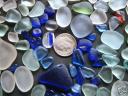
seaglass.jpg I discovered the lovely North American Sea Glass Association in this article today. It’s a collective of beachcombers selling sea glass jewelry and bulk sea glass all over the world. In fact, the West Coast Sea Glass Association even buys sea glass. Check out all the pretty colors on their handy rarity chart.

passive debris collector

Wednesday, January 31, 2007

Earlier this month, Treehugger posted on a floating, trash-collecting dock on the river Thames that “eats trash”.  The simple fix to floating nasties in the water (floating around and collecting them on barge-thingies) is the brainchild of Thames21, a clean water project which, with the help of Riverkeeper volunteers, has made London’s one of the cleanest rivers around. 

cause on a string

Tuesday, January 30, 2007

plastic.jpg Check out these bracelets featured on Great Green Goods, made in Ghana from recycled plastic. They’re right up there with the Ugandan paper beads made from old magazines on my list of favorite gifts-that-double-as-political-talking-pieces.

Which reminds me:

Last week I received another political bracelet, a string of Kenyan grass beads, as a party favor at a fancy gala. To make up for missing my birthday party, a friend rigged an invite for me as a “young leader” to this evening honoring dogooder causes. As a New Yorker and nonprofiteer, it’s not in me to turn down a free drink, let alone an open bar, so after work I threw on a party dress and caught a cab uptown to [an event venue I will not mention here for fear that my labor organizing friends might disown me].

The highlight, for me, was when someone announced that Russell Simmons was in attendance and the eighty-something woman to my right leaned over and asked her son if he was the one who got people moving. “No, that’s Richard,” replied the son.

I’ll spare you details on the speeches, except to share the bizarre and, I found, disturbing fact that the whole event was underwritten by a very large diamond company. Did I miss something, or now that Hollywood has condemned blood diamonds is it ok to fund nonprofit work via their sales?

pipelines to pipe dreams

Tuesday, January 30, 2007

trash.jpg  Japan has to scrap its futuristic system of underground garbage tunnels.  The subterrainian passageways aren’t bringing in the private revenues they once did and thus have become waste themselves (Look out Minneapolis, the Skyway’s days are numbered). 

The tunnels made news earlier this year when some kids from Osaka got stuck inside one.  Of course cash, not safety, is what finally shut them down.

No word yet on whether this will simplify Japan’s complex garbage collection and categorization methods.

Perhaps they’ll just go back to burning it all.

literary trash

Tuesday, January 30, 2007

antiques.jpg  Mark your calendars, next week is book week here at everyday trash.  Starting Monday, I’ll be posting interviews with authors exploring the world through the lens of garbage.

Weekly Compactor

Saturday, January 27, 2007

bushenvironment.jpg  This week in trash news: