Archive for the ‘Intellectual Trash’ Category

Guest post from Fernanda Siles

Saturday, May 9, 2009

While the crew behind everydaytrash.com spend the day editing and recoding our lovely blog, we have the honour of presenting a report of recent trash activities in Nicaragua! Many thanks to Fernanda Siles for sending us this!

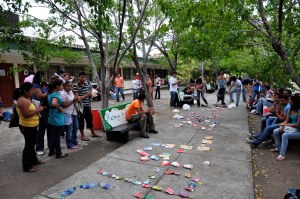
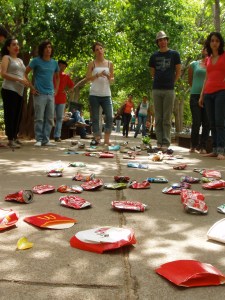
We are a group of Sociology and Social communication students, amateur performers and friends. We picked up trash from the dumpsters of our university and decided to put it back together writing the word globalization with it.

Nicaraguan university trash

Nicaraguan university trash

Twice, first on Saturday April 25 and afterwards on Monday april 27, without any previous notice, we took over one of the halls of our university (Universidad Centroamericana) and performed the next scene:

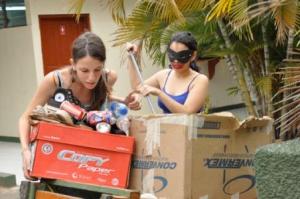
Two people with masks and Ronald McDonald smiles on their faces directed the movements of four others that carried the trash and picked up some more from the areas near the improvised stage. These four started forming the word globalization with the garbage. Meanwhile, the two dominant figures impeded the students watching the act to walk through the area, trying to establish some interaction with the public without speaking (we try not to speak so that the message is not only taken as we had thought it); they also invited some of them to participate in the writing.

Masked trash people with famous smiles

Masked trash people with famous smiles

Two of the initial four ended up lying on the ground, representing the I’s. Once the word was entirely written down, one of the masked characters started a fight with one of the I’s who opposed resistance not only physically, but also by removing labels of transnational chains from his clothes; he got to free himself from the pressure of the dominants and walked freely around the word starting a conversation with the people around. The ending on Saturday was different because the I instead of immediately starting the dialogue, put a plant in the end of the word.

The reactions were quite different both days. On Saturday, the audience was mainly constituted by people who study Social Sciences, and the dialogue was fluent and extremely refreshing!  The plant also represented an important difference. We tried not to make our message so explicit because what we want is for people to reflect on their own about the issues we are dealing with in our performances; this time, people gave very deep meanings to many our symbols – some of which were not even intentional.

Trash globalization dialouge

Trash globalization dialouge

The discussion revolved around the presence of transnational products in the word, the role our country and other “developing” nations play in the globalization process; our individual roles as consumer and active forces in the building and maintenance of neoliberal globalization; the immense production of trash in a global consumer society; the impact of the production of goods and their later dumping in our environment; human capacity to give another form and meaning to globalization.

On Monday, the discussion was harder to establish; the audience was diverse regarding the area of study, but it was mainly young people watching. The most remarkable response we got was the look on people’s faces when they found out the garbage was found in our university.

Requiem for a Paper Bag

Tuesday, April 28, 2009

If you haven’t heard of FOUND Magazine, check out the publication’s charming origin myth. Incidentally, FOUND founder Davy Rothbart has a book coming out called Requiem for a Paper Bag. Like all books about trash, I want to read it. Stay tuned.

But is it doing any good?

Tuesday, April 21, 2009

Elizabeth Royte covers the “Zero-Waste Zealots” in the trashy new issue of MoJo.

The International Scientific Congress on Climate Change

Thursday, March 12, 2009

Today is the last of three days of scientific discussions on climate change, held between some 2 000 experts in Copenhagen. Obviously, with so much brains in the room(s), summarizing outcomes is quite the challange, but the intrigued should check out the conference website for online abstracts. Later, a book will be published to be handed over to our mighty policy makers at the United Nations Climate Change Conference (COP-15), also to be held in Copenhagen, in November-December 2009. As we know, the COP-15 iwill be the site for negotiating the post-kyoto protocol, so this book should be valuable input.

Interview with Mattias Hagberg

Tuesday, February 3, 2009

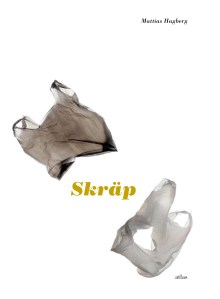
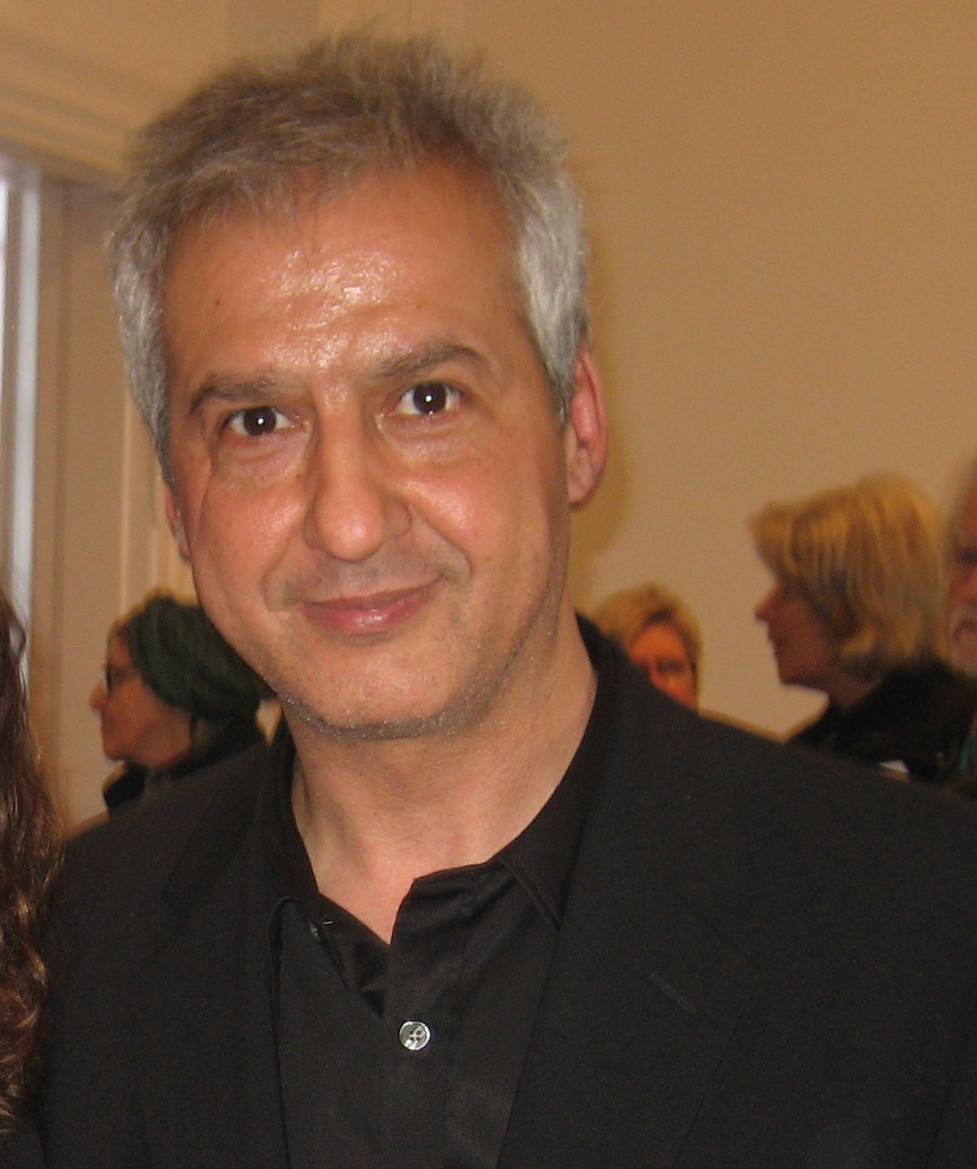
Followers of this blog perhaps recall this post about the book Skräp (“skräp” being Swedish for “garbage”) from November. Today we are proud to present an interview with the author, Mattias Hagberg.

Mattias Hagberg, journalist resident in Sweden's second city Gothenburg, author of Skräp

Mattias Hagberg, journalist resident in Sweden's second city Gothenburg, author of Skräp

Before we start, a little recap: Skräp is a book about garbage, in which Mattias Hagberg starts off with discontinuing the routine of taking out his family’s trash. Instead, he hides their fully loaded plastic garbage bags under the sink. This soon becomes a ridiculous exercise, and Mattias proceeds his experiment in a secret room in the cellar of the house, keeping neighbours using the cellar unaware. However, Mattias quickly understands the practical limitations of this project, and gasping for breath moves his horribly stinking trash collection (only a few days old) to the garbage container room.

Back in his apartment, Mattias Hagberg ponders over where his trash actually will be going, now that it’s out of his experiment and back into the system. Since the early 90’s, Sweden’s had an idea of system called “The Nature’s Cycle”, an idea based on the notion that our garbage can and should be recycled, i.e. return to the Nature’s Cycle. Much like Mufasa teaches his son Simba about how lions die and turn to grass, eaten by anthelopes, in the Disney blockbuster The Lion King.

Skräp, the book

Skräp, the book

Mattias Hagberg soon discovers that trash isn’t much of a happy circle-of-life story. Instead, he gives a thrilling tale about the cash in trash, how “recycling” still produces tonnes and tonnes of toxic waste and how our electronic waste ends up in slum quarters in Ghana and China, in a chain starting at your local recycling depot, going through multi-national corporations, to the mafia.

Hello Mattias Hagberg, how are you, what’s up?

– Doing alright thanks, slight headcold, other than that fine. Working on what feels like a gazillion of projects. I think most relevant for your readers is an article about the Swedish auto industry, with the angle that the point is not to save this industry, but understand that the whole system of autoism is in crisis. That constructing and buying new cars simply won’t do.

Cewl, looking forward to reading it! So, why did you decide to write a book about garbage?

– The idea was actually my editor’s. At first I was scpetic, it all felt very technical, I didn’t really know anything about garbage, had this vague idea about the recycling system working smoothly. Then I did the experiment, stopped taking out the trash, an experiment you know proved do be quite stupid. But it inspired me to take things to the next level. I realised that while we have a functioning recycling system, that system doesn’t recycle everything, far from it. And the system is suffering from the fact that we keep producing increasingly more waste. As everyday citizens however, we have a veil above our eyes for this fact, we are never confronted with the real problem: That we buy a flat screen TV when our old TV works quite well.

Which  part of the work surprised you the most?

– The insane amount of garbage each of us produce in one year. Several hundrered pounds! In the average family, about 20-25% of this garbage is food, that is most often perfectly edible! I was also intrigued by how fooled we are that there is a connection between “recycle” and “close”, how we pervive recycling to be this story about a process in harmony with nature. It’s a global industry, run by multinational enterprise. To me, it resembles the middle-age trade in letters of indulgence. For example, when garbage is burned, energy is produced that heats houses, and filters keeps the smoke clean, but the toxic remains after burning, and the poisons caught in the filter, still remains, and needs to be kept somewhere.

How has this changed your relationship to garbage?

– I think that deep down, we are all aware of that more consumption is just foolish, but we ignore this and continues to buy. For myself, of course the work with the book has effected what I buy and what I do with it, but at the same time I’m a bit fed up with the individualist perspective. We must focus more on the systemic errors of our culture, bring the debate from the behaviour of people to the behaviour of enterprise. Right now we have no debate, and we know that the resources of this earth will end. The garbage system of today is something we really need to adress, together.

Trashtastic Thursday with Samir M’kadmi

Thursday, April 17, 2008

Samir M'kadmi

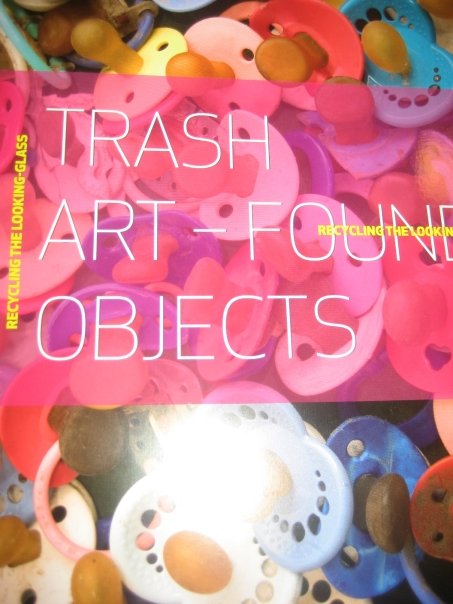
Norway-based, French-raised, Tunisian-born artist Samir M’kadmi is perhaps the only man international and open-minded enough to have curated the trash art show, seminar and catalog “Recycling the Looking Glass“. As you are well aware by now, due to my constant raving since returning, the show opening was a huge success. Despite the demands of a crazy schedule putting on international exhibitions and keeping up with work of his own, Samir kindly agreed to provide everydaytrash readers with a bit more depth on the making of the Oslo show and where trash art falls in the art historical cannon.

everydaytrash: How did the concept for “Recycling the Looking Glass” come about?

M’kadmi : “Recycling the looking-glass” is a result of research and interrogations on topics related to contemporary art, our environment, and global society. Through “Recycling the looking-glass” I tried to re-conceptualise crucial interrogations of globalisation, environmental and cultural issues by resituating these topics not only at an aesthetic level, but also by interrogating and exposing their ethical dimension. These interrogations also occupy a major place in our Norwegian media debates. Of course, these kinds of topics are not specific to Norway. They are global. But, the way these issues are addressed, in Europe, Scandinavia and specifically here in Norway, through our major media, is quite disturbing.

In fact, we can summarise the debate in a few terms: Islamophobia, racism, poverty, immigration, war and terrorism, climate and environmental changes. The first six topics relate to globalisation, cultural and geopolitical domination matters, where concepts such as cleanliness and purity are very often used as metaphors for “our” Western culture and values, and uncleanliness and impurity as metaphors for the “other’s” culture and values. Although this point of view does not reflect the opinion of the majority of Norwegians, it does reflects the opinion of about 17.5 percent of Norwegian voters, which approximately corresponds with the number of voters for the Progress Party (the extreme right).

This point of view, the “other” perceived as a threat, as impurity, as trash, seems also to be the only means of access into the media debate. This is a debate initiated and defined by the editors of the major national newspapers, such as the conservative Aftenposten.

Climate and the environment are tightly linked to the first topics. Here again, the interrogation seems to be blocked between two points of views, one that supports the UN Climate Report and another that opposes it. Here again we find the same political constellation. On the one hand, we have the extreme right, (the Progress Party), which tends to reduce the climate report to a big hoax, on the other hand we find the other political parties who swear by the report and propose some cosmetic environmental solutions. The aim of this debate is how to reduce the discharge of toxic emissions. In short, waste, as toxic emissions, as household or industrial trash, seems to be a common denominator for globalisation, climate change, environmental, and cultural issues. How do contemporary artists deal with these questions? Do they deal with these questions at all? What can artists tell us about trash, recycling, reducing and reusing? Does trash or decay have any aesthetic value? What is the relationship between archiving and trashing? These are just a few of the questions that contributed to the elaboration of the concept behind “Recycling the looking-glass”.
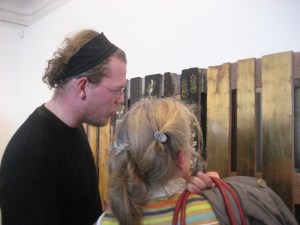
Artist Jan Franciscus de Gier discusses the Euro pallets he and partner Vigdis Haugtrø contributed to the show with a Nowegian artist attending the opening


everydaytrash:
How did you select the participating artists?

M’kadmi :
Selecting the artists for “Recycling the looking-glass” was tightly bound to the development of the exhibition concept itself. It is a work in progress, and a complicated process because it demands a lot of research, especially if you want to articulate simultaneously different approaches and practices in the same context. Every artist represents a unique and at the same time complex position. When you present artworks made by different artists, side by side, you create not only an opportunity to investigate the artworks, and question the artists behind them, you also provide an occasion to confront your own presuppositions and ideas on art, trash and society.

everydaytrash: One question raised at the seminar was what is the line between art and politics and is there a definable border. What do you think?

M’kadmi : I consider the artist to be an intellectual and a political subject. There is no line between art and life. Art is life, art is science, art is philosophy, art is poetry, and art is politics… The French philosopher Jacques Ranciere describes the political subject, among other things, as a non-static entity and a vector of change. He or she only exists through their actions, through their capacity to change the given landscape, to make visible, to show what was hidden or not perceivable. The political subject opens up the political field through his/her activities, beyond the parameters of all known and accepted political institutions.

We are, everywhere, confronted by interests and ideologies that tend to reduce the artist only to a producer of commodities, rejecting any thoughts and ideas that are not compatible with the idea of the artwork as an open creation, and the idea of the work of art as an object. Utility value is, and has always been, a key theme in an art context, in particular if one eradicates the distinction between the ethical and the aesthetic, as did e.g. Marcel Duchamp with his Fountain in 1917. I situate art’s utility value in its freedom and independence, in its autonomy. In short, the political subject exists as the effective manifestation of the capacity of anyone to personally engage in common affairs.
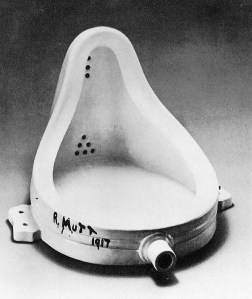
Duchamp's "Fountain"

everydaytrash: What is the connection between found object and trash art?

M’kadmi : Trash art is an art form that insists on a status as waste. Found objects on the other hand, cling tightly to the identity of the object. Found objects are, as the name indicates, a found object, “un objet trouvé”. It is an object that has retained its integrity but has been removed from its original context.

Schwitters' "Cherry Picture"

Dadaism and the Surrealists attacked High Art by introducing elements from reality in their works. Kurt Schwitters created art from “ détritus”, “l’art du détritus”. Marcel Duchamp’s readymade gave another dimension to “L’object trouvé”: appropriation, ‘détournement’, subversion, etc.
From Dadaism to Surrealism, to Pop Art, and Situationism to Fluxus and Nouveau Realism and today’s post-modern Trash art and Found objects, we find here many enthralling issues and discourses, both aesthetic as well as socio-political. Trash art questions received aesthetic conventions.

Junk is a powerful medium that must be given an artistic design: Robert Rauschenberg, César, Ben, J.Beuys, David Hammons, Jimmie Durham…The boundary between trash art and found objects is not watertight.

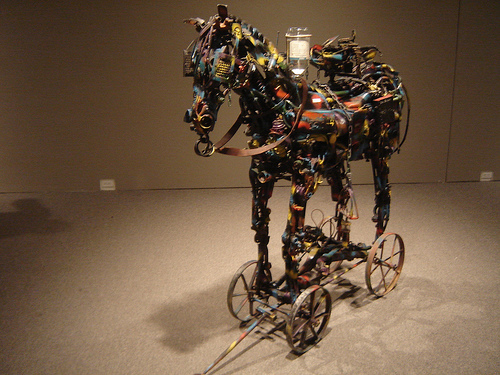
Kjartan Slettemark’s Cocaflower is trash, because an empty Coca Cola can is by definition empty packaging, in other words, trash, recyclable material. South African Willie Bester’s horrifying sculptures of recycled metals that depict cold uniformed giants riding ridiculous war machines are trash, because the objects used in the construction appear as junk. Benin artist Romuald Hazoumé’s African masks made of plastic containers and other garbage strike similar chords. Roddy Bell’s fans and frames are found objects because they are perceived as fans and frames. Safaa Erruas’ pillowcases and shoes are representations of found objects; Jon Gundersen’s briefcase with a pacifier is both a found object and trash, because it combines both. Vigdis Haugtrø and Jan Franciscus de Gier’s Europallets painted with rosemaling are modified found objects; Bill Morrison’s film clip compositions are found footage …

Work by Bester

Work by Hazoumé

“Recycling the looking-glass” publication

(Recycling the Looking Glass-Trash Art-Found Object)

everydaytrash: How does trash art fit into the canon of accepted and appreciated media? What is the future of trash art?

M’kadmi :
In our global art history, a history that is not yet written, Trash art is already an integrated genre. Trash, both as raw material and sign, has a major place in our global contemporary art. Many artworks made of trash are already canonised.

But, in spite of this canonisation Trash remains a “hot” matter because it often entails an implicit, if not explicit, critique of society. For the artist, trash is not solely signs, symptoms, markers, evidence and indicators of interpersonal experience and the various different existential foundations of all humans, but a signifying material for communication and expression.

Asking about the future of Trash art is like asking about our future relation to waste and all that is refused, denied, is in a way asking about our future relation to death.

Samir and Nasra at the opening
Literary Trash, an encore for ‘Waste and Want’

Tuesday, February 27, 2007

waste_strasser.jpgwaste.gif Susan Strasser’s bio describes her as “a historian of American consumer culture.” Her book, ‘Waste and Want: A Social History of Trash’ covers America’s tranisiton from a thrifty,resourceful culture to one whose definition of “trash” has vastly expanded.

everydaytrash: In your book, you say that trash is defined by our sorting processes. How have those processes/our definition of what is trash/disposable evolved in the developed world?

Susan Straser: The sorting process that creates trash varies from person to person, and it differs from place to place. Some people are more frugal or sentimental than others; some cultures value saving things – the Scots have this reputation – while nomadic people, who must travel light, save less. Above all, sorting is an issue of class: wealthy people can afford to be wasteful, while the poor scavenge for materials to use and to sell.

But the sorting differs also according to skill. Repair ideas come more easily to people who make things. If you know how to knit or do carpentry, you also understand how to mend a torn sweater or repair a broken chair. Even at the end of the nineteenth century, when factory production was well established, many Americans possessed the skills and consciousness required for repairing. Now making and repairing things have become hobbies, no longer typical and on their way to being exceptional.

Most Americans produced little trash before the 20th century. Goods were sold in bulk; even in cities, people practiced habits of reuse that had prevailed in agricultural communities; durable items were passed on or stored in attics or basements; broken things could be brought back to their makers, fixed by somebody handy, or taken to people who specialized in repairs. In cities, ragmen worked the streets, usually buying bones, paper, old iron, and bottles as well, and selling the junk to dealers who marketed it in turn to manufacturers. This trade in used goods amounted to a recycling system that provided raw materials for industrial production. It faded with the institution of municipal trash collection, new papermaking technologies that substituted wood pulp for rags, the mechanization of bottle-making, and the rise of giant modern meatpackers who marketed massive amounts of byproducts to fertilizer companies.

everydaytrash: Is it possible to curb or reverse that trend?

Strasser: I do not think we will revive the stewardship of objects and materials that was formed in a bygone culture of handwork. I do like to think that new ideas of morality, utility, common sense, and the value of labor have begun to emerge, based on the stewardship of the planet and of its natural resources. Recycling and composting programs are now recognized as viable options; activists have pressured both government agencies and corporations to create such programs and to reduce waste at the source. Some businesses and agencies have responded only under pressure; others have cooperated, usually persuaded by environmentally concerned managers in their own ranks. After decades of assuming that public policy and corporate profit-making would send us always in the direction of saving time and trouble, some people and enterprises have begun to promote practices that require more of both. Recycling has been successful, and not because of market incentives.

evreydaytrash: How do different cultural beliefs about charity affect the amount of waste we produce?

Strasser: Giving old things to the poor has long been a common act of charity, practiced by individuals and by organized groups. During the decades around the turn of the 20th century – the same period when municipal trash collection was being established, encouraging middle-class people to throw things out – new kinds of charities began to accept donated materials. The personal relationships fostered by dealing directly with beggars yielded to a new sort of benevolence: giving things to organizations like Goodwill and the Salvation Army. These organizations offered impoverished people jobs, spiritual salvation, and a chance to be consumers, and they provided the better-off a virtuous outlet for unwanted things, free from social discomforts. The organizations also fostered new ways of thinking about the sorting process: people could now avoid the trouble of repair, getting rid of unwanted things without having to define them as worthless.

everydaytrash: In researching your book, what were some of the most interesting stories of reusing and repurposing that you came across?

Strasser: The stories and ideas were endless, and endlessly amazing to me. People used broken crockery and glued shattered glass back together. Leftover food was regarded as a resource, often even leftovers on people’s plates. Some practices – such as “turning” thinning sheets by tearing them down the middle and sewing the outer edges – are mentioned so often in so many advice books that we may regard them as commonplace. Butterick and other pattern manufacturers sold patterns for pieces of dresses – collars, cuffs, skirts, and sleeves – so that women could renovate dresses that they deemed old-fashioned. New buttons or trimmings were an even easier fix. The wealthiest women sent their old clothes back to Paris couturiers to be remade and brought back into style.

everydaytrash
: Is there a modern-day equivalent of the rag picker?

Strasser: There are literally modern rag pickers in third-world countries. In the developed world, contemporary recycling systems offer some analog to the post-consumer recycling of the ragpicker, the rag-and-bone man, and the paper mill.

###

Waste and Want is available from the publisher, ask your local independent bookstore to order you a copy.

Literary Trash, take five, David Naguib Pellow discusses Garbage Wars

Friday, February 9, 2007

garbage-wars.jpgethnicstudies_david_pellow.jpg We end a fantastic week of trash author interviews with David Naguib Pellow, sociologist and author of Garbage Wars: The Struggle for Environmental Justice in Chicago. In ‘Garbage Wars,’ Pellow provides a 20-year lit review and evidence-based analysis of Chicago’s waste management. This is a book about the politics of garbage (which are, as we all know, the very same politics that apply to race and class). It’s about the simple, universal fact that we all make waste–most of it smelly, some of it hazerdous–but only some people have to live with it. This book is the perfect finale to our exploration of trash lit because it brings us back to the very core of the everyday trash message: there is no such thing as “away”.

everydaytrash: Could this book have been written about another city?

David Naguib Pellow: Yes, absolutely. Chicago is really almost a metaphor or a window for what’s going on not only in other cities in the U.S. (Detroit, New York, New Orleans, etc.) but it reflects a global reality as well, since greater volumes of garbage and waste are being generated as societies become more ‘advanced’ and industrialized. Chicago is a particularly excellent site for this kind of study, however, because it has historically been much more racially segregated than most places in the U.S. This means that the garbage wars occurring in Chicago produce and reflect a much deeper sensitivity to racial inequality. In other places, garbage wars may fall more clearly along social class divides.

everydaytrash: Garbage Wars seems to be more about class and race than anything else. Why focus on trash and the solid waste industry?

Pellow: The way we treat our trash tells us a lot about the way we think about our relationship to nature. But it also tells us a lot about our relationship to other people, particularly populations that are marginalized politically, economically, and culturally. I have traveled to many cities and countries in the time since Garbage Wars was published and almost without fail, those groups at the bottom of the social pecking order tend to live and work in places where they are exposed to the rest of society’s trash and pollution. In other words, as much as we’d like to think of garbage and waste only as environmental problems, they’re actually social and political issues more than anything else.

everydaytrash: Is the environmental justice movement alive and well? Has it evolved in response to newer threats of high tech waste?

Pellow: Yes, the environmental justice movement is thriving in the U.S. and globally. In fact, some of the most exciting work going on in this movement is occurring outside the U.S. Electronic waste (e-waste) is a good case in point. As rich industrialized nations consume and dispose of hundreds of millions of computers each year, the waste from these products often ends up in global south nations, where workers attempt to refurbish them for reuse and remanufacturing. Unfortunately, since the average computer contains many pounds of toxic materials, this is an inherently dangerous process that threatens workers and ecosystems. In response, activists in West Africa, Latin America, and Asia have teamed up with advocates in the U.S. and Europe (where most e-waste originates) to push electronics producers (most notably computer firms) and governments to enact policies that would prevent the export of hazardous electronic waste to global south nations and to reduce the use of toxic chemicals in the production of electronics in the first place.

everydaytrash: What are some examples of current struggles between vulnerable populations and the garbage imposed on them? Where are today’s garbage wars being waged?

Pellow: Today Roma communities throughout Europe are threatened with environmental racism, as many of these populations are forced to live on or near garbage dumps. Some Roma activists are reframing and turning upside down the traditionally racist view that Roma prefer living near garbage dumps. In Sofia, Bulgaria, they are documenting the fact that Roma are often forced by cities and by threat of public violence to live in close proximity to garbage dumps (a classic example of environmental racism); they are also documenting the fact that Roma who are taking objects out of the dumps for reuse or resale, are what, in any other context, we might call recyclers or waste recovery workers, because they are contributing to Bulgaria’s national recycling efforts. So they are flipping the script on the work Roma are doing in garbage dumps and on why they are living there in the first place.

Similar struggles are going on in places like Egypt and the Philippines where people seek to turn environmental injustice into an opportunity to recover waste for reuse and economic development. So many of today’s garbage wars are being waged over the right to use garbage as a resource for our future rather than as a means for corporate profit.

###

This marks the end of authors’ week, but look out for future interviews with trash authors and personalities from around the world. And check back for daily posts on the art and politics of garbage.

blog in a book

Thursday, February 8, 2007

trashbook.jpg  The latest issue of the hard-cover Canadian art magazine, Alphabet City, covers our very favorite topic.  I came accross it at the Whitney last weekend and have been peering at the chapters one Subway ride at a time every since.  What I like best about this book is how diverse it is, covering everything from really wonky articles to a woman’s poems about her sanitation worker uncle.  It starts off with beautiful close-up photos of dust bunnies and covers everything from a collection of found paper airplanes to photos of industrial spaces to forgotten people in Mexico.  I’ll try to hook up an interview with the editor.     

intellectual trash

Monday, November 13, 2006

Salut, trashies, I’m back from West Africa and everyday trash is back to everyday living. That’s right, no more exotic trips planned for now and back to our regularly scheduled programming. Thanks for your patience. It appears the world spun a bit more quickly than usual while I was gone: the US government more or less changed hands and violence in Africa and the Middle East bubbled. To lower our blood pressure in the face of chaos, here’s a link to a New Yorker trash piece pointed out to me by my friend salmon.

This is a blog about trash.

Sunday, August 27, 2006

This is a blog about Oscar the Grouch. It’s about the smoke of burning trash piles wafting through every developing country in the world. It’s about the billions of dollars a year spent exporting garbage from one state to another. It’s about diving into a dumpster and coming up with a still-warm burger and three packets of mustard. It’s about detonating landmines with old truck tires and building bookshelves out of milk crates. It’s about barges. It’s about battery acid. It’s about paying sixty bucks for a change purse made of soda can tabs because the label says a women’s group in Latin America glued them together. It’s about sorting plastics. It’s about beaches built on landfills and landfills built on beaches. It’s about the “away” in throw away and the “out” in toss out and the “rid” in get rid of it. This is a blog about the art, money, power, politics, people and literature of garbage. It’s a subject that shocks and amuses me nearly every day, which is about how often I imagine I’ll be posting. I hope you’ll share in the fascination.