One thing I’ve been meaning to post more about here is the ecochic backlash, or the mass marketing of “green” goods that encourage us to buy more instead of create less. I for one am always tempted to buy trash-themed items, even ones I don’t need because I’m enticed by the idea of repurposed and recycled goods. It’s hard to tame my inner consumer! I’d love to hear your thoughts.
Archive for April, 2008
Eco-chic backlash
Saturday, April 12, 2008Weekly Compactor
Saturday, April 12, 2008
This week in trash news:
- People in Ohio bag butts;
- Trash has become a voting issue in Italy;
- Spring brings extra trash to Toronto;
- Students in Tennessee stage a trashion show; and
- CNN highlights a little boy living in a Thai dump.
(Photo credit: Dan Rivers for CNN)
2nd best
Friday, April 11, 2008Someone out there is ranking garbloggers. Update: the author assures me the blogs aren’t listed in any ranking order. My bruised ego may now begin the process of healing. Note that everydaytrash is now listed first (feeling a little childish now).
Blue Music and Garbage Sound
Friday, April 11, 2008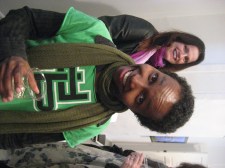 I met a lot of amazing people last weekend in Oslo. One of the most inspiring was Nasra Ali Omar, a Somali-Norwegian who grew up in Somalia, then Kenya then Northern Norway. Nasra was helping out with the trash art/found object show, but her real passion is music. And environmentally friendly music at that. She and her collaborators are committed to releasing their music in electronic files only, never burned onto CDs that end up in the trash.
Still more amazing is the technology she’s developing to debut in Norway later this year. Using motion sensors designed for medical examinations and blue tooth technology, Nasra manipulates a series of electric pads stuck to her fingers and arms that allow her to affect the intensity of her sound while playing the drums, play back pre-recorded beats and lay a track while performing , adding layer upon layer to her sound. She performs with a dancer, also fitted with the sensors so that the dancer and her movements can control the music as well. Others have tried similar programming in the past, but always with lots of wires or having to wear an entire electric jacket. With the small sensors and wireless blue tooth, Nasra and co. are breaking new ground. A bit off the subject of garbage, but trashtastic nonetheless!
In other music news, and to reroot ourselves in the subject of trash, Neopolitan musicians have made lemonade out of the recent trash crisis in Naples. “Garbage Sound” is music made using instruments crafted from things found in the trash.
(That’s Nasra above, striking a silly pose during the opening of Recycling the Looking Glass)
Latex Sandwich
Thursday, April 10, 2008TORCH, a peer education program run by Naral-Prochoice New York, has been working on a trash art project getting high school students to reuse expired condoms in creative ways. The goal is to raise awareness about condoms and the results are being exhibited in a show called “This is My Everyday.” The idea is to make everyday items out of condoms to emphasize that condoms are part of everyday life (I dig the repetition of everyday and the trash theme, it’s like we’re collaborating)! Here are some shots of a lovely sandwich made by one of the students. Yum!
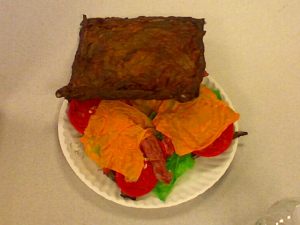
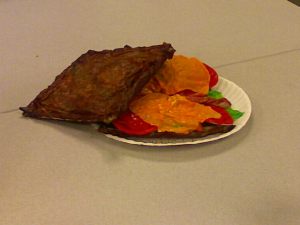
Update: This sandwich was created by Aschly Valladares and Anastasia Georgoulis was the project supervisor.
Cutest Street Art Ever
Wednesday, April 9, 2008I first heard about Joshua Allan Harris’ inflating plastic bear and other sculptures via a link to this Wooster Collective post on the Visible Trash Society garblog. Then I found his air zoo on The Fader.
And then today, my public radio friend Julie sent me an NPR story pulling all of this wonderful street art into our favorite context: TRASH! Who knew the fight against plastic bags could be so endearing?
Event Composting
Wednesday, April 9, 2008 Tipster Julie S turned me on to Earthgirl Composting, a struggling doorstep composting service in Vermont (if you live there, take note!). The waste picked up from households is delivered to a local company that makes compost and sells it to organic farmers. In addition, they do “event composting.” I’ve never heard of event composting before, but I bet a lot of green brides out there would be interested in offsetting the environmental impact of their weddings by composting the leftover cake and other waste!
Photo ripped from Earthgirl Composting Web site.
Coke bottles recycled into school uniforms
Monday, April 7, 2008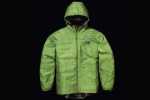 I read this in The Guardian on the plane back from Oslo, seems pretty cool. Apparently some English schools are buying fabric from the Chinese made from recycled coke bottles and having that fabric made into school uniforms. Though a bit more expensive than the old materials, the recycled material helps any school who uses it meet carbon footprint quotas set by the state. I guess the bigger question is, what do we think of these quotas?
Photo from Keetsa.com of plastic bottle hoodie.
Everydaytrash on the Road
Saturday, April 5, 2008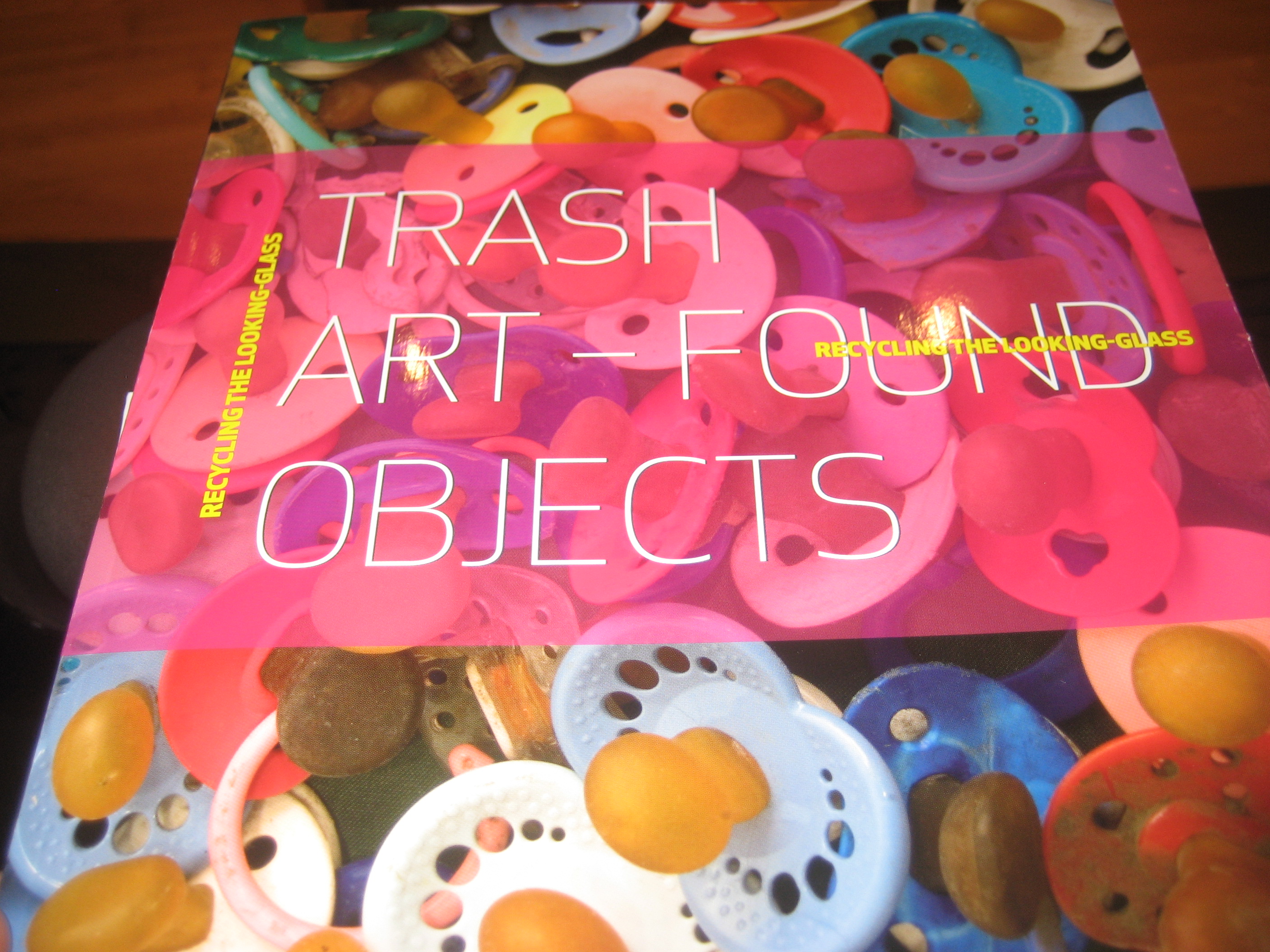
Recycling the Looking Glass catalog
“Hi hi” from Oslo. I’m here attending the opening of “Recycling the Looking Glass, Trash Art-Found Objects” a wonderful group show curated by the incomparable Samir M’kadmi. Much, much more will be posted here about the show, the contributors and organizers. At the moment, I’ll throw up a couple photos from the opening seminar and the piece I submitted to the catalog (my talk was basically a longer version of what’s below). Other panalists included a feminist art critic, an economist and an ecologist who uses trash art projects to teach kids about the environment. Two artists also gave talks. Stay tuned for less Leila-centric posts very soon, I have met amazing artists and art world peeps from all over the World this weekend and can’t wait to share the virtual booty with all of you!
—
A Short History of Garblogging
My obsession with trash began when, as a journalism student in New York City, I started researching the unimaginable number of tax dollars spent each year transferring garbage from my hometown to places as far away as the middle of the country.
New York closed it’s only landfill in 2001 with no immediate plans for what to do with all the trash created by the millions of local residents and businesses. The immediate solution was to export the waste to other states, an expensive venture involving enormous contracts with private waste haulers. Previously, the city had evacuated the majority of its trash on barges pulled by tugboats. This new plan created a billion-dollar-a-year industry and added significantly to the number of trucks circling the already congested city streets.
Not surprisingly, the poorest neighborhoods bore the brunt of these changes. In order for the garbage to be moved long distances, it had to be emptied from local dump trucks and packed up again into larger vehicles. This transfer of trash—a smelly process that attracts rats—continues to take place in several of the city’s poorest neighborhoods.
While the story I was writing focused on local politics, my fascination with garbage extended far beyond the United States. I started to see trash as everything from an indicator of poverty to a medium for art. Before long, everyone I knew associated me with trash and when they came across related factoids, I would receive an email. So I started a blog. The Internet seemed to be the perfect outlet for these tidbits and the perfect venue to start a larger conversation.
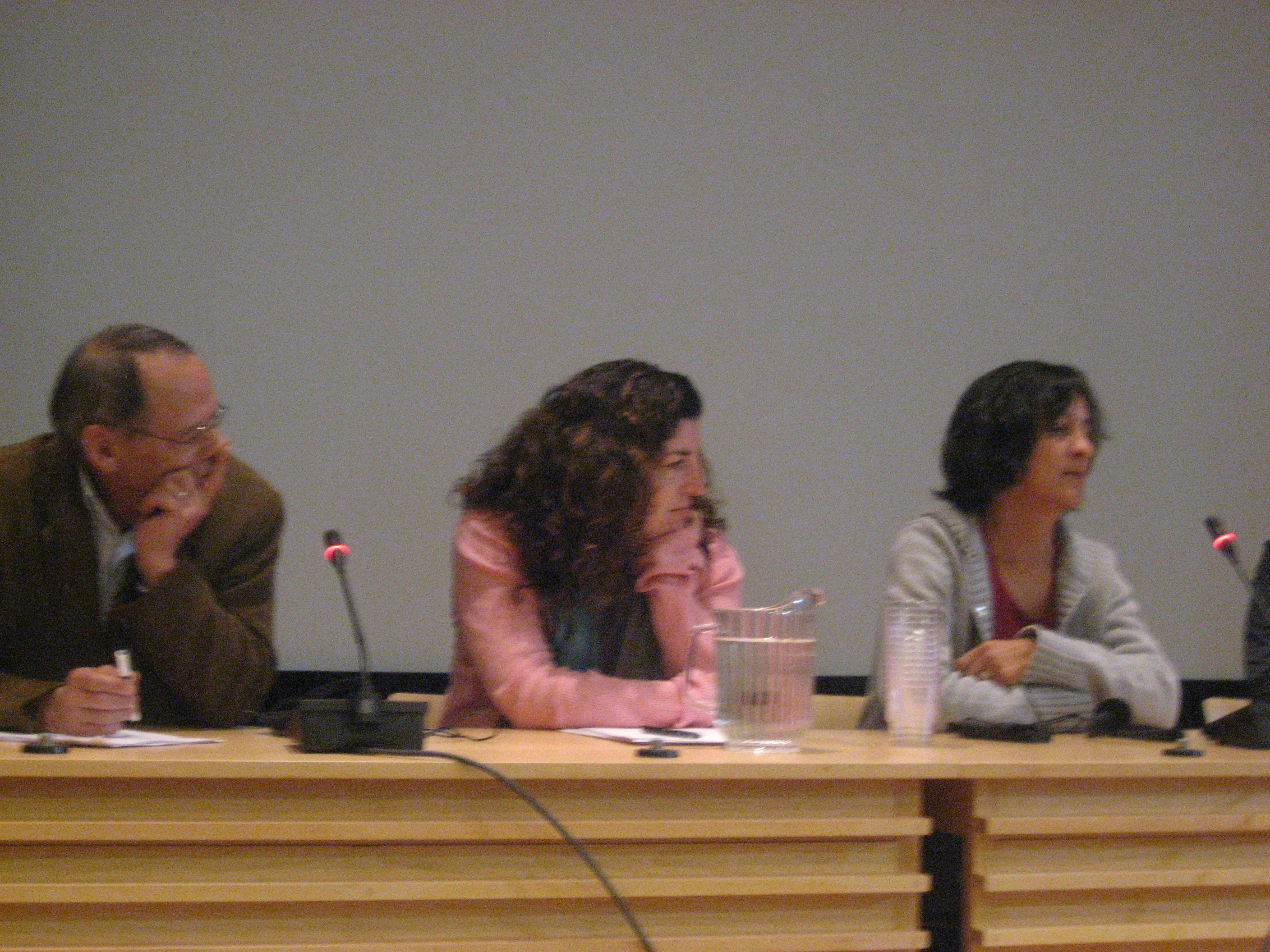
Through the Looking Glass panel
(French economist Gérard Bertolini, me, Panama-based American artist Donna Conlon)
The wonderful thing about the World Wide Web is that if you have a pet interest, it is easy to locate whole communities of people who share that interest. And so it was for me with trash. Soon after launching everydaytrash.com, over two years ago now, I discovered a universe of other sites dealing with interrelated themes. Because my interest in the subject had grown from local politics, it took me some time to think of everytrash.com as an environmental or “green” blog.
My audience had no such doubts. I quickly realized that the majority of people interested in trash are interested in reducing waste and approach the issue in terms of saving the planet. I came across people keeping track of their own waste online, weighing their garbage each day and trying hard to make less the next. And there were sales sites, marketing niche environmentally-friendly products to those willing to pay a bit more for a clear conscience. There appears to be a huge market out there for reusable tote bags, organic baby clothes and business card holders made from recycled gasoline.
It doesn’t take much exploration into the world of trash to see that, fundamentally, trash is an economic and class issue. Only those less fortunate ever have to worry about what happens to what society discards. The rest of society, on the other hand, sleepwalks through life believing that trash disappears the moment it hits the bottom of a trash can.
Early on in the life of the blog, I became interested in trash pickers, communities of people who go through the trash and find new uses for what others have chucked. In Argentina, China and Egypt and probably many other places, there are words for these people and the practice is associated with very particular ethnic groups. In many other places, people supplement their income by collecting and redeeming cans or hunting for and selling scrap metal. Sifting through the smattering of articles that pop up each year on trash pickers, I am constantly reminded of the wastefulness of the era I live in.
"Garblogging" translated in the English/Norweigan catalog--love it!
Once you notice trash, it’s hard to ignore. Around the time I was pouring through New York’s solid waste management plans, my job at a public health nonprofit began taking me to Africa. There, I encountered a relationship with material goods entirely foreign to me. Terms like recycling and zero waste have no place in these societies where value and lifespan of any given product are given their full respect. In places where people have very little, these concepts are organic.
I met a roadside tailor in Malawi who spent his days mending the worn clothing of local villagers, squeezing extra days, weeks and months out of the worn fabric. In Uganda, women from the North, an area burdened by enduring violence and high rates of HIV/AIDS, form beads out of old magazine pages that they then shellac to create brightly colored bracelets and necklaces. Women in Kenya collect floating flip flops from the ocean to refashion into crafts to sell; one project has even created a giant whale out of the discarded plastic shoes to raise awareness about the dangers of plastic waste to marine life. Plastic bags in Burkina Faso are twisted into small dolls and sold to tourists. While the African cultures I visited varied dramatically, the unmistakable smell of burning garbage welcomed me the moment I stepped off the plane and onto the tarmac in a new city.
In fact, many of the news articles I read while traveling focused the depletion of Africa’s resources and the threat of disease. The contrast between the joyful and hopeful efforts of the beaders and doll makers and the overall pessimism of news coverage on Africa fed my enthusiasm for blogging. I was glad to have a forum to highlight positive, homegrown responses to seemingly overwhelming problems.
Of course many positive approaches to the subject of trash come from the artistic community. Through everydaytrash.com, I have discovered “trashion” designers who create fantastical outfits from discarded items as well as countless artists who use trash as a dynamic medium with which to create provocative pieces. What I love most about these works is their effortless incorporation of an often dense political topic. Trashtastic!
The Gleaners
Wednesday, April 2, 2008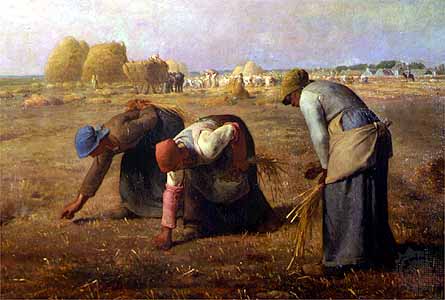 At dinner the other night, someone suggested I look up a film called “The Gleaners and I” about some crazy French law that says after harvest farmers must let peasants onto their land to pick through leftover produce. There are some famous French paintings of the activity and the film evidently delves deeper into the issue and carries us all the way up to present day society. It’s at the top of my Netflix queue, but I couldn’t wait to post this here and to share this informative link on the topic. I’m kind of shocked I’d never heard of gleaning or the film before. They sound kind of like early freegans.
Pictured here, François Millet‘s “The Gleaners”
Update: A friend just emailed the following: “The concept of gleaning is actually much older than an obscure French law – according to Jewish biblical teachings, farmers were required to not reap all the way to the edges of their fields and not to pick up anything they dropped along the way so as to leave some for the poor and for strangers.” Thanks, friend!
Amersterdam
Wednesday, April 2, 2008
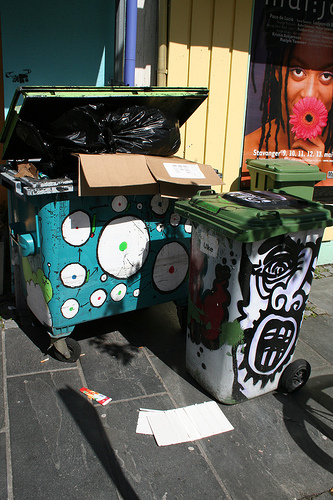
That last post reminded me of a layover I had once in Amsterdam and these gallery-quality trash cans I saw in a store window. Kind of silly if you ask me.
 everydaytrash