 Even though it didn’t win an Oscar, I think you’ll appreciate the short documentary Recycled Life about a toxic dump in Central America and the people who fight for survival nearby.
Archive for the ‘Trash Politics’ Category
Recycled Life
Monday, February 26, 2007Sofia saga wages on
Monday, February 26, 2007 The conflict between the people and the local government of Sofia, Bulgaria over where a neighborhood slotted for a dump is blocking all incoming trash until they get something in exchange (namely improvements to their ‘hood and the promise of a recycling facility to reduce the burden of all that trash).
The Cradle of Civilization
Friday, February 23, 2007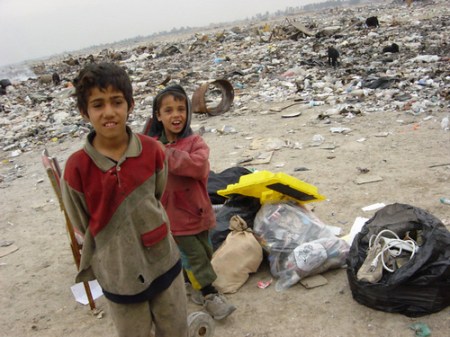 Displaced people in Iraq are reduced to sifting through the trash to find food and “eke out a living,” Reuters reports this morning. IRIN had the above photo on file, so clearly this is nothing new.
Yesterday, while getting dressed to hit the gym before work, I grabbed a black t-shirt with the neck cut out from my drawer. It wasn’t the top I was looking for, but as I put it back, I noticed the design on the front. “Stop the War Against Iraq,” it read, next to the doe-eyed and somber face of a little girl in pig tails. I bought the shirt in 2000—long before the current invasion—to protest military sanctions, a.k.a. the “silent war,” on Iraq. A few months later, I got on a plane with a bunch of other Americans and headed off to Baghdad to commemorate the tenth anniversary of what we call the first Gulf War and what the people I met in Iraq referred to as “the American Aggression”.
It was an informative trip. A radical and perhaps misguided form of protest—defying the sanctions by traveling to Iraq with medical supplies, conducting what we called an objective fact-finding mission in a country whose government handlers don’t allow for such unobstructed investigations—but an informative trip nonetheless. In the end, a large part of why I went to journalism school was to learn a less subjective methodology for my fact finding than traveling on international delegations with clear political slants.
What I think about most often, though, were the college students I met while visiting a university. I look back at the photos we took together and marvel at the fact that, aside from my dorky name-tag, you’d be hard pressed to say which one was the visiting American and which were the Baghdad students.
That was six years ago. I wonder where they are now.
And Nepal takes one step closer to becoming a developed nation..
Thursday, February 22, 2007 Looks like the people living near that landfill outside of Kathmandu finally reached an agreement with the government—trash collection resumes today and the city will investigate alternative dumping sites and, gasp, an actual waste management plan.
Celebutrash
Wednesday, February 21, 2007 Every once in a while it pays to include other blogs in Internet trash searches. Evidently Paris Hilton was pelted by trash at a recent press event in Austria. There’s even a video of the event unfolding.
zero waste groovin’
Tuesday, February 20, 2007 Tipster-in-chief Kimberly sent me this article today on a dance floor in the Netherlands that harnesses the power of those who grove upon it.
Dirty business, parts one and two
Monday, February 19, 2007
The grey nomad’s trail
Saturday, February 17, 2007
humbug
Wednesday, February 14, 2007 I would include a special valentine’s round-up, but I’m burnt out on green love this week.
taking less out
Wednesday, February 14, 2007 I found this admirable GreenBiz link on take-out containers while contemplating/googling over-packaging. Consider this a call for entries. What’s the most ridiculously over-packaged food item you purchased in the past year?
Thermal Depolymerization
Monday, February 12, 2007 Loreen Leedy went from subject to tipster in one fell swoop when she sent me this link on turning trash into energy along with the answers to her interview questions last week. It’s a round up on blog, magazine, newspaper and academic sources on making oil out of just about anything.
Its a nice day for a green wedding…
Sunday, February 11, 2007 The Times has a lovely piece in today’s Sunday Styles section about the growing trend of environmentally friendly weddings. It’s a topic I know my side bar buddies Ethical Weddings and Great Green Wedding keep in mind when posting. Of course the number one way I can think of the reduce your ceremony’s footprint (not to mention your and your parents’ energy output) is to not throw such elaborate parties. That said, I’ve been to one of those farm to table places upstate, where the article mentions the couple held their rehersal dinner–crisp weather, more kinds of carrots than you knew existed, pigs wandering about, compostable cutlery, picturesque carriage trails perfect for hikes and runs…I could imagine a fantastic feast served there.
Update: For even MORE on green weddings, check out this post of the same name over at hippy shopper.
Literary Trash, take five, David Naguib Pellow discusses Garbage Wars
Friday, February 9, 2007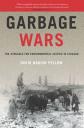
 We end a fantastic week of trash author interviews with David Naguib Pellow, sociologist and author of Garbage Wars: The Struggle for Environmental Justice in Chicago. In ‘Garbage Wars,’ Pellow provides a 20-year lit review and evidence-based analysis of Chicago’s waste management. This is a book about the politics of garbage (which are, as we all know, the very same politics that apply to race and class). It’s about the simple, universal fact that we all make waste–most of it smelly, some of it hazerdous–but only some people have to live with it. This book is the perfect finale to our exploration of trash lit because it brings us back to the very core of the everyday trash message: there is no such thing as “away”.
everydaytrash: Could this book have been written about another city?
David Naguib Pellow: Yes, absolutely. Chicago is really almost a metaphor or a window for what’s going on not only in other cities in the U.S. (Detroit, New York, New Orleans, etc.) but it reflects a global reality as well, since greater volumes of garbage and waste are being generated as societies become more ‘advanced’ and industrialized. Chicago is a particularly excellent site for this kind of study, however, because it has historically been much more racially segregated than most places in the U.S. This means that the garbage wars occurring in Chicago produce and reflect a much deeper sensitivity to racial inequality. In other places, garbage wars may fall more clearly along social class divides.
everydaytrash: Garbage Wars seems to be more about class and race than anything else. Why focus on trash and the solid waste industry?
Pellow: The way we treat our trash tells us a lot about the way we think about our relationship to nature. But it also tells us a lot about our relationship to other people, particularly populations that are marginalized politically, economically, and culturally. I have traveled to many cities and countries in the time since Garbage Wars was published and almost without fail, those groups at the bottom of the social pecking order tend to live and work in places where they are exposed to the rest of society’s trash and pollution. In other words, as much as we’d like to think of garbage and waste only as environmental problems, they’re actually social and political issues more than anything else.
everydaytrash: Is the environmental justice movement alive and well? Has it evolved in response to newer threats of high tech waste?
Pellow: Yes, the environmental justice movement is thriving in the U.S. and globally. In fact, some of the most exciting work going on in this movement is occurring outside the U.S. Electronic waste (e-waste) is a good case in point. As rich industrialized nations consume and dispose of hundreds of millions of computers each year, the waste from these products often ends up in global south nations, where workers attempt to refurbish them for reuse and remanufacturing. Unfortunately, since the average computer contains many pounds of toxic materials, this is an inherently dangerous process that threatens workers and ecosystems. In response, activists in West Africa, Latin America, and Asia have teamed up with advocates in the U.S. and Europe (where most e-waste originates) to push electronics producers (most notably computer firms) and governments to enact policies that would prevent the export of hazardous electronic waste to global south nations and to reduce the use of toxic chemicals in the production of electronics in the first place.
everydaytrash: What are some examples of current struggles between vulnerable populations and the garbage imposed on them? Where are today’s garbage wars being waged?
Pellow: Today Roma communities throughout Europe are threatened with environmental racism, as many of these populations are forced to live on or near garbage dumps. Some Roma activists are reframing and turning upside down the traditionally racist view that Roma prefer living near garbage dumps. In Sofia, Bulgaria, they are documenting the fact that Roma are often forced by cities and by threat of public violence to live in close proximity to garbage dumps (a classic example of environmental racism); they are also documenting the fact that Roma who are taking objects out of the dumps for reuse or resale, are what, in any other context, we might call recyclers or waste recovery workers, because they are contributing to Bulgaria’s national recycling efforts. So they are flipping the script on the work Roma are doing in garbage dumps and on why they are living there in the first place.
Similar struggles are going on in places like Egypt and the Philippines where people seek to turn environmental injustice into an opportunity to recover waste for reuse and economic development. So many of today’s garbage wars are being waged over the right to use garbage as a resource for our future rather than as a means for corporate profit.
###
This marks the end of authors’ week, but look out for future interviews with trash authors and personalities from around the world. And check back for daily posts on the art and politics of garbage.
Going Through Gramacho
Thursday, February 8, 2007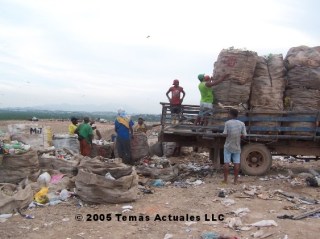 Over at The Temas Blog, fellow garblogger Keith resurrects his Trash Photos series with a powerful and in-depth look at Gramacho, a landfill outside of Rio regularly picked over by catadores, Brazilian rag pickers. As usual, Keith reports on the issue in exhaustive detail, exploiting statistics, photographs and even video to show the effects of the landfill on the surrounding environment, culture and economy.
Day four of Literary Trash features children’s book author and illustrator Loreen Leedy
Thursday, February 8, 2007
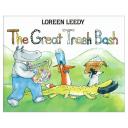 Loreen Leedy’s ‘The Great Trash Bash’ (best title ever!) came out in 1991, but the lessons it teaches kids (and adults) about the different places garbage goes, what a problem too much garbage can be, are just as true today. I discovered this book while researching potential Literary Trash week authors and thought an author-illustrator of Children’s books would round out our series. Also, Mayor Hippo is adorable.
everydaytrash: How did you come up with the premise of The Great Trash Bash?
Loreen Leedy: At the time, I was looking for a book project that would showcase the process of characters working together to accomplish a goal. Also, I was interested in working with an environmental theme. Now that it’s been awhile, I can’t recall exactly what inspired the notion of garbage. Perhaps it was/is so ubiquitous it seemed obvious. In general, I try to notice what is all around us yet taken for granted. We become accustomed to “how things are.” It takes insight and leadership to question it, as shown by the mayor of Beaston at the beginning of the story.
everydaytrash: Even though it’s a book for young people, this story covers the pros and cons of incineration, landfills and recycling. How much research did you have to do to write it?
Leedy: In those days (15+ years ago) I always went to the local public library to find magazines, encyclopedias, and books for research. Now the Internet is usually my first stop. If the book had required a lot of detail I might have visited an actual landfill and/or incinerator but it wasn’t necessary in this case.
everydaytrash: How did you decide to match the different animals to their characters?
Leedy: Animals are fun to use as characters because they come in such a wide range of sizes, shapes, and colors from mice to alligators to ostriches. For a commanding yet comic presence I made the mayor a relatively large hippo wearing pants and tie (no shirt). Most of the other characters are small to medium-sized, reasonably familiar animals such as raccoons, foxes, and frogs. The diversity of critters reflects the variety of characters found in every town.
everydaytrash: What are some of the solutions that the citizens of Beaston come up with to solve their trash problems? Are they easy to follow in real life?
Leedy: Create less trash; fix old things instead of buying new things; stop littering; recycle; make a compost bin for food scraps; start a recycling center. Some are easier to follow than others– it’s hard to find anyone to repair electronic devices, for example. Perhaps the best idea is to adopt one new habit at a time until it becomes second nature. An easy one is recycling, though I do run across adults that can’t be bothered to recycle, which is frustrating. Hopefully children will be willing to adopt many of these practices for life.
everdaytrash: Do you have any sense of the impact of your book in the classroom? Do you get fan mail from kids and teachers?
Leedy: I was surprised to learn that so far, The Great Trash Bash is my most translated book and has had many subsidiary rights licensed, such as being reprinted in textbook anthologies. This seems to indicate that garbage is a big issue all over the world and parents and teachers need a way to introduce it to children. Schools do a lot of trash-related projects such as:
1. Clean an area of the playground; tally the types of trash (metal/paper/plastic/wood); make a bar graph to show the most common litter found.
2. Each class collects the trash from one snack time; paste it onto poster board; display all the class trash posters together to raise awareness.
3. Kids bring in clean trash such as cereal boxes/egg cartons/cans; they combine their trash to make “trash monsters.” [editor’s note: Contact Leila if you want to get together to make trash monsters. Or make your own and send your photos to everday trash!]
4. Make useful items such as bird feeders out of trash.
These are just some of the activities I’ve heard about, usually via email. It is fun to hear how the book is used in the classroom… you never know what they’ll come up with next!
###
The Great Trash Bash is available through Leedy’s books.
Check back tomorrow for more Literary Trash!
Update: Next up on the Literary Trash lineup is David Naguib Pellow, a professor of ethnic studies and author of Garbage Wars: The Struggle for Environmental Justice in Chicago
.
 everydaytrash