Archive for November, 2009

Got rubber?

Friday, November 6, 2009

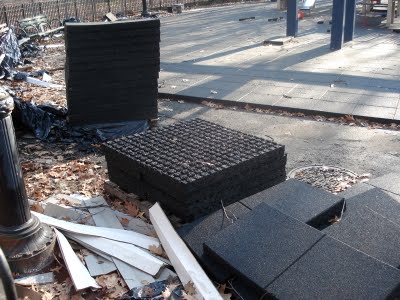
Ahoy trashies, upcyclers, dumpster divers and what have you. A friend is collecting discarded playground rubber—you know, the kind of stuff under jungle gyms—for use lining the floors of his music studio. I am particularly invested in this project because a) it deals with trash and b) this friend is also my bandmate and this studio is also our rehearsal space. A noisy bakery recently opened up next door and sounds are leaking into our once sacred space. This unwanted sound must be absorbed! Diffused! Redirected! Eliminated! Got rubber? Know someone throwing it away? Is your local park redoing the kiddie area? Does your friendly neighborhood junk man have a stack of this stuff in the corner of his workspace? Let us know!
rubber

Park rubber

He’s also looking for celotex, homesote, old blankets or any other material that insulates and blocks sound.

PLEASE REPOST WIDELY. THIS IS A TRUE TEST OF THE TRASHIE NETWORK.

Oh, and in case you were wondering, the band is called Battle of the Camel. I play drums and we’re amazing.

Vespa chairs

Friday, November 6, 2009

One day, I will own my own brownstone. Or at least half of one. My sister can have the other half. And inside this brownstone will be enough room for a dining room table to cook for my friends and a desk by a window so I can work from home. I will sit in this:

vespachair6

Upcycled Vespa chair by bel & bel via Inhabitat

Counterbalance

Friday, November 6, 2009

New Yorkers, save the date for November 14th. Quad Cinema will screen Counterbalance, a new film about waste pickers in Dehli as part of the 8th Annual Mahindra Indo-American Arts Council (MIAAC) Film Festival. Event starts at noon. $15 general admission, $12 students and IAAC members. Purchase tickets here. Check out the Facebook invite for details here.

wastepickers

Wastepickers, photo via Chintan

Here’s a description:

Every day, tens of thousands of waste pickers and waste recyclers in Delhi earn their income from collecting, selling and recycling trash. Their work, measured to be highly efficient, has not only been undervalued but even marginalized with the introduction of large private companies. This is the story of two municipalities in Delhi: one that has incorporated the work of the waste recyclers as part of the formal waste system, while the other has taken another direction.

Counterbalance is the product of a partnership between the video advocacy group WITNESS and the Indian environmental group Chintan. You can watch an interview with Bharati Chaturvedi, the film’s director and the founder and director of Chintan, here and here.

And for more about WITNESS, click here. For more about Chintan Environmental Research and Action Group, click here.

Thanks for the tip, Elizabeth!

12 ways…

Friday, November 6, 2009

Check out this Treehugger compilation (via unconsumption):

12 Ways to Use Shipping Containers as Offices, Housing and Art.

shipping-container-google

via Treehugger

I think everydaytrash.com should have a little office made of shipping containers. I wonder who might fund that project.

Now there’s a trashy news show

Thursday, November 5, 2009

Sesame Street Mocks “Pox News” via HuffPo

Happy Birthday, Sesame Street. Thank you for Oscar. I remember when Big Bird was the only person who could see Snuffy. And when Mr. Cooper died. He was the first person I knew who died. Everyone on Sesame Street drank hot chocolate that day and so did I.

Trash Trip

Thursday, November 5, 2009

Another trashy woman rec from the wonderful Beth Terry of Fake Plastic Fish: Trash Trip. It’s the website of engineer and artist Karen Hawes who will trek from Alaska to Argentina reporting on trash along the way. We look forward to updates and interviews from the road.


Million dollar trashies

Thursday, November 5, 2009

Everydaytrash.com sends a warm congratulations to The Spirit of Youth Association—an association of Zaballeen from the Caireen shantytown of Manchiet Nasser—who recently received a $1 million grant from the Bill & Melinda Gates Foundation.

The grant was announced following a screening of the documentary Garbage Dreams (which we’ve touted here on more than one occasion) at the International Sustainability Conference in Cairo. The Spirit of Youth Association is the nonprofit that runs the recycling school featured in Garbage Dreams.

Iskander, Nabil, Osama & Adham

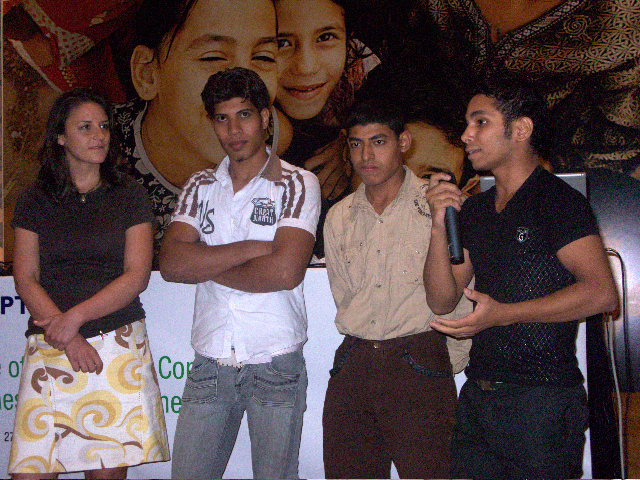
Mai Iskander, Nabil, Osama & Adham of "Garbage Dreams"

Special Kudos to filmmaker Mai Iskander for harnessing the power of journalism to raise awareness around the Zaballeen and informal trash picking communities in general and to Adham, Nabil, Osama and their teacher, Laila, for lending their life stories to the cause. More to come on this evolving story.

Martin Waters and Spurn Point

Thursday, November 5, 2009

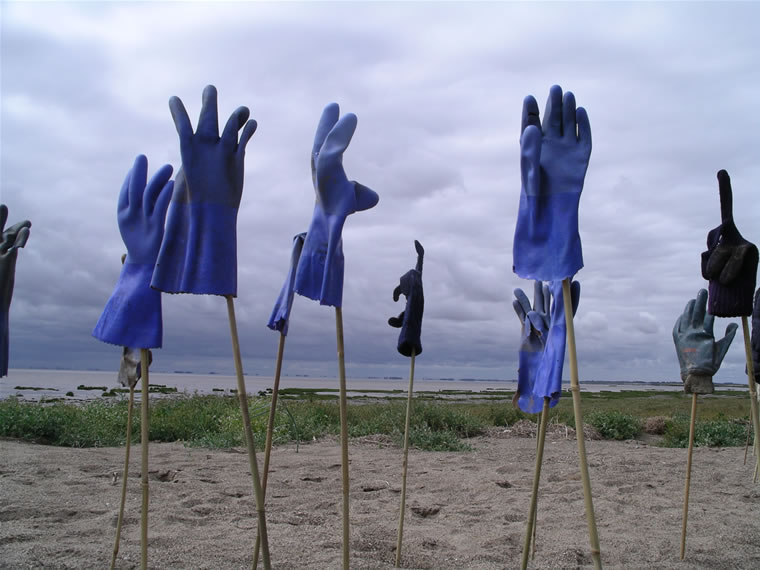
Trash artist Martin Waters recently sent us a link to his website, a resource chock-full of compelling sculpture, photography and images of past installations. He uses a lot of beach debris in his work, collected from Spurn Point, where he was artist in residence in 2007.

spurn_glove_jpg

Spurn glove installation, image via http://martin-waters.co.uk/

In Waters’ own words:

Spurn Point is a fast disappearing stretch of the East Yorkshire coastline.

It has been the greatest influence on my artistic endeavours for the last twenty years and my life since I was seven years old, living at Paull on the Humber bank.

A fascination with painting and drawing naturally led me to this raw spit of land where I started to record my impressions. A love of collecting and beachcombing conspired to bring me to the artworks I create now. Through my art therapy work I am interested in the process of creating art and I have let that process take me where it will.

Roots of Health

Thursday, November 5, 2009

A few months ago, my friend Ami Evangelista Swanepoel and her husband Marcus packed up their New York City life and set off for her native Philippines to start a nonprofit organization called Roots of Health (Ugat ng Kalusugan). Roots of Health’s mission is to improve the health and lives of women and girls and their communities in Puerto Princesa, Palawan.

landfillplayground

Boy playing on collected recylclables, photo via Roots of Health

In order to best direct their efforts in this monumental task, Ami and her team have been conducting surveys in rural areas not served by health centers to assess the areas of greatest need and determine those best matched to what Roots of Health can do to help.  I and others have been following their progress via the Roots of Health blog where this week Ami describes the issues facing a community living beside a landfill.

Earlier this week we returned to an area in Santa Lourdes called Purok Matahimik which means “quiet place”, also known as “Pulang Lupa” or red earth because of the color of the soil, and is also simply known as “Dumpsite” because of the community’s proximity to the Puerto Princesa landfill. This community is a top runner for where we might begin our services as it is quite isolated and very poor and has high numbers of malnourished children.

Photos from our visit are here.

It appears the links between my lives as a garblogger and reproductive health nonprofiteer grow stronger every day. I guess it’s not surprising, health and trash are universal connectors. Click here for Ami’s full post and survey results. And click here to visit (and fan) the Roots of Health Facebook page.

Cool or creepy?

Thursday, November 5, 2009

My friend Oriana posted this Curbed blurb on Facebook under the above heading. These people are leaving free chairs for the taking out with the trash. The catch, the chairs contain sensors to track where they end up. Check out their Flikr for images. I’m not sure a designer chair is worth the invasion of privacy. What do you think?

International electronic tra$h crimes 101

Wednesday, November 4, 2009

We probably missed it (released in June 2009) due to not being on the send list, but now we’ve read it and it is high time we introduced to you the INTERPOL report Electronic Waste and Organized Crime – Assessing the Links.

The report goes in to some depth analysis of electronic & electric tra$h, highlighting facts such as the annual turnover of the UK market; UK£2 million (US$ 3,3 million), using the example to paint an overview. Most intriguing conclusion is that actors in the legal market claim that contractors offering free recycling of toxic electronic products probably also operate illegally, as profiting otherwise wouldn’t be possible.

Further, the report gives an image of the incentives of entering the illegal market: Tra$h fat cats buy (for example) an old TV, with the promise that their company will recycle it and sell the parts for profit, but instead sells it in a developing country. Buying the unit will cost US$4 or so, and sell for US$8.

Last but not least, the people behind the report call for more research in order to cast light over these shadowed activities. We most certainly agree to that. Increased efforts of recycling must not be the source of growing international crime (and with that, increased numbers of non-recycled electronics and electrics spewing out toxins once their capacity to entertain finally stops).