Author Archive

Zen Trash Squad

Monday, November 5, 2007

Check out this post on “Zen and the Art of Dumpster Diving” from the nytimes.com blog, Dot Earth. Apparently dumpster diving is an honored tradition among monks in Michigan. Not surprising when one considers the age-old world of trash pickers and Buddhist disdain for waste.

zen.jpg

Unflattering photo caught by Geoff Kroepel for the Environment Report, reposted here via Dot Earth.  (Why that guy needs a back brace to scoop a parka from the trash is anyone’s guess.  Perhaps it’s all part of the meditation and center-searching.  I was kind of hoping for trash slings fashioned from saffron-colored robes.) 

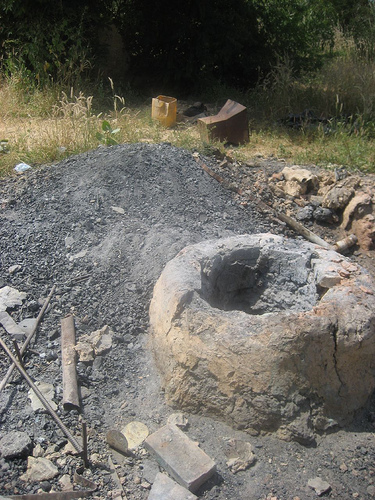
Laongo, Burkina Faso

Sunday, November 4, 2007

burkinaburntrash.jpg

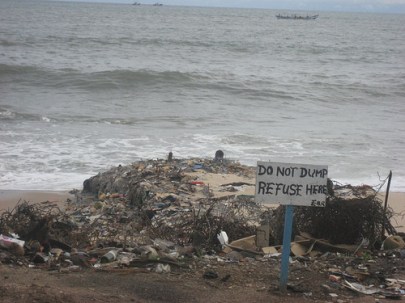
Elmina, Ghana

Sunday, November 4, 2007

capecoastdump.jpg

Paris, France

Sunday, November 4, 2007

paristrash.jpg

Swipe Your Heals Three Times…

Friday, November 2, 2007

metrocard.jpg

Check out these inspired, trashy costumes from the NYC Halloween Parade. Here’s a note on the artist from Dorothy:

The artist, Andy Padre, creates Metrocard art for a variety of events each year. Last year’s Halloween parade was a Metrocard wedding party (search flickr for those tags and pictures come up), we were sea creatures in the Mermaid Parade, and he also creates Metrocard Easter bonnets for the Easter Parade. Andy’s work has been featured in Metro newspaper and yesterday on Good Day NY. This year he used over 5000 Metrocards and over 20,000 staples!

Dump to theme park

Wednesday, October 31, 2007

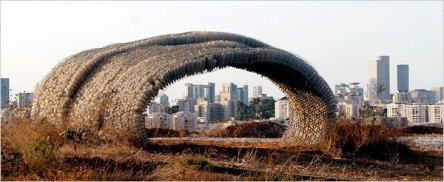
israeli-dump.jpg In what is becoming a more and more common urban planning move, Tel Aviv is turning a former dump into a park. Interestingly, they aren’t hiding the trashy past of the space, but rather celebrating it in recycling-themed sculptures. Interesting stuff. Thanks for the link, Alina! And thanks to everyone out there for bearing with me through this most recent and most lengthy trash hiatus. I took a couple trashy photos in West Africa, which I hope to share soon but was otherwise preoccupied by the demands of the day job, absorbing the wonders of new cultures and fighting off various parasites. It’s good to be home!

Photo by Isabel Kershner via nytimes.com

Hometown Trash

Wednesday, October 17, 2007

Oh my trashies, if only Internet access in Ouagadougou weren’t so precarious this week I would take my time to delve into wonky depths of NYC trash wars.  Alas, I must use this precious online access to send reports back to the day job.  Lucky for you, Gotham Gazette knows their trash!

Garbage Warrior

Wednesday, October 17, 2007

Check out this movie trailer.

Trash Hiatus

Tuesday, October 2, 2007

Dear Trashies,

It’s that time of year again when, due to the demands of the day job, I pack up and head to lands of less reliable Internet connections.  I’ve made empty promises before about keeping up with the posts while away, but this time I’m taking the approach explained to me by a former entry-level investment banker: under promise, over produce.  Since he’s no longer so entry-level, I have respect for the mantra.  So, here it is, I will try to incorporate trash research into my travels and will make an effort to post while away.  In particular, I’ll be looking for these crafty ladies and may also look into buying some of these goodies.  If I succeed, you will, of course, be the first to know. 

As usual, my tapering off is a great time to catch up on news from the stellar side bar (I don’t compile these links for my health, friends, please click through to the many trash resourses).  And, new this week, take part in everydaytrash discussions over at facebook.  I’ve started a few trash talking topics, but please don’t feel restrained by those.  Start your own conversation or debate!

Yours,

Leila

Onesies

Monday, October 1, 2007

organiconesieorchidzora.jpg  This weekend was the Atlantic Antic, a large annual street fair in Brooklyn.  I’ve missed the past two, so I was psyched to get out there today.  One dominating theme: babies.  Granted, I live in the second-most-posh-baby-populated hood in the borough, if not the state (spotted Michelle Williams this afternoon pushing a stroller in the seasonal uniform of skinny jeans tucked into ankle boots), but come on.  When did onesies become the new Starbucks?  Every other booth, it seemed, boasted designer baby suits with various embellishments: Indian wood printed giraffes and lions, the local area code, a Coney Island mermaid…

I have to admit, I purchased an ity-bity tee for a Parisian baby I’ll be meeting for the first time next week.  Presented with the choice, I shelled out an extra three bucks for the “organic” version.  To be good to the environment and all.  But now that I’m examining my pre-Paris bank balance, I’m weighing the environmental good of an organic shirt for the little one, versus the excess energy I’ll have to exert when I return to off-set the extra spending.  I can never decide: do I buy more because it’s “green”?

Care to share your thoughts on the subject?

Photo via Tiny Birds Organics

Baah!

Saturday, September 29, 2007

logo_facebook-rgb-7inch.jpg  I finally caved to the pressure and joined facebook.  So did everydaytrash (I’ve taken to discussing the blog as a ventriloquist might her marionette, as though the thing has a life of its own uncontrolled by me).  So, trashies, if you’re into social networking, show some love for us both and join the everydaytrash facebook group.  All the cool kids are doing it.  What’s more, so are the outcasts.  

Gomi round-up

Thursday, September 27, 2007

gomi.gif

Fellow trashie, DumpsterTaoist recently turned me on to the subject of gomi, or japanese trash.  Trash, like most aspects of japanese culture, comes with its own set of intricate protocols.  Here are some interesting links on the subject detailing:

Trashtastic Tuesday with Raz Godelnik

Tuesday, September 25, 2007

This week on Trashtastic Tuesday, we check in with Raz Godelnik of Eco-Libris, a green business encouraging readers to off-set the paper consumed by their book-buying by donating money to plant trees in developing countries.

______________

everydaytrash: How did you come up with the idea of Eco-Libris?

Godelnik: It all started when I was thinking about paper and the environmental impacts of its production. I realized it might take a while to get to the point where eco-friendly alternatives (from the use of recycled paper to e-books) will replace virgin paper. Then, I talked with some friends about the idea of giving people the opportunity to balance out their paper consumption by planting trees and received good feedback about it.

The decision to focus on books was made after learning that only about 5% of the paper used for printing books is made of recycled paper and because most books don’t have yet any online eco-friendly alternative (e-book) like magazines and newspapers have. So if you want a book, you usually can’t avoid purchasing the paper-made version, unless you go to the library or get it from places like bookcrossing.com, which are both excellent choices. You also can’t tell people to stop reading books, so it seems only natural to give book lovers a new alternative to make their reading habits greener – planting trees for the books they read.

everydaytrash: How did you find and select planting partners?

Godelnik: We are very picky about our planting partners as we want to make sure the right species of trees are planted in the right places in collaboration with local communities. We conducted an extensive and in-depth selection process to find the right partners that included review of many criteria to ensure the quality of the plantings, such as the specific species that are planted, locations of planting, mixed forest, usage of native species, monitoring and management plans of the plantings, etc.

Eventually we chose 3 non-profit organizations – Sustainable Harvest International (SHI), RIPPLE Africa and The Alliance for International Reforestation (AIR). These are highly respected organizations, registered in the US and the UK, which plant trees in the highest ecological and sustainability standards in Latin America and Africa. In these areas, deforestation is a crucial problem, and planting trees not only helps conserve soil and water, but also raises the ecological awareness of the local communities for whom these trees offer many benefits and an opportunity for a better future. All the planting operations are being conducted in full collaboration with the local communities.

everydaytrash: How many books have you off-set/trees have you planted since starting up your operation?

Godelnik: We have balanced out so far more than 3,500 books. Each book is balanced out by planting one tree (actually we plant via our planting partners 1.3 trees for every book to maximize the chances that 1 tree will reach maturity). Our goal is to balance out half a million books by the end of 2008

everydaytrash: What about other forms of paper waste? Do you have plans to expand this concept into the corporate world to encourage companies to off-set office paper waste?

Godelnik: At the moment we’re focused only on books because of the reasons I talked about earlier and also because we feel that being focused on one major issue helps us to make our message and call for action more powerful. We also want to inspire people and organizations to balance out books as their first stop on the road to sustainability. On the personal level, it means to continue from balancing out books to starting to reduce the whole household’s paper consumption. The same goes with organizations in the book publishing industry, from publishers to bookstores. In any case, in the future, we will definitely consider to expand our call for action into other areas that use paper unsustainably.

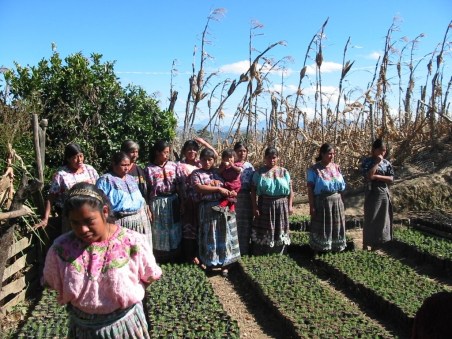
Photos courtesy of RIPPLE Africa, Sustainable Harvest International (SHI) and The Alliance for International Reforestation (AIR).

Weekly Compactor

Friday, September 21, 2007

This week in trash news:

Stealing a carrot from a pig (or raising awareness about our wasteful society)

Wednesday, September 19, 2007

Tonight I finally took a freegan trash tour, something I’ve been meaning to do for months. I’m glad I waited for two reasons. One, it’s Ramadan, a time of year when I’m especially conscious of food, its overabundance in my daily life and temporary absence during fasting. Two, tonight’s trash tour took place in Morningside Heights, which afforded me a fresh view of my childhood neighborhood.
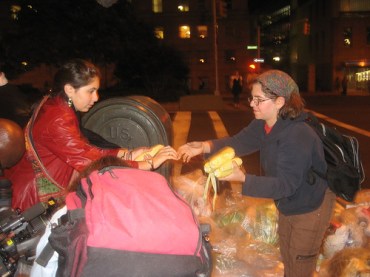
corn.jpg

Freegans

From what I understand, the “freegans” of freegan.info see themselves as a sort of public relations arm of a larger movement aimed at reducing society’s waste and making use of discarded food. The group takes advantage of the relative freedom of New York City to dumpster dive and forage openly and with little interruption from store managers or the police. Members of the media and those new to freeganism are invited to rummage through garbage bags on street corners during trash tours (held several times a month) and to dine communally on the booty at occasional “freegan feasts.” In addition, their Web site deals with a variety of issues ranging from what we eat to a concept called “voluntary joblessness.”

What interested me was the chance to spend an evening more or less practicing what I preach here about ways to combat the overwhelming swell of city garbage. While it’s too late in the evening to process what I learned, I can share with you a little of what I experienced.

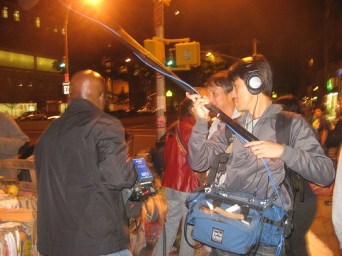
Meeting up with this evening’s tour proved easy enough. I showed up at the designated street corner where a Japanese cable access film crew, a student camera crew and a still photographer from Newsweek had already begun to document events. Right away I recognized at least three faces in the crowd from past media stories on freeganism. One of the organizers, a young woman in rubber-like protective bike gear and a bandanna, kicked off the tour with a short speech about privacy (for the benefit of the media present) and the importance of leaving places as clean as we found them. And we were off.
media.jpg

Obligatory Japanese film crew

I accompanied the tour to three nearby sites: two grocery stores and one bagel joint. The first stop yielded less than expected (many present were collecting goods for a freegan potluck feast later in the week)—some bruised fruits and vegetables, mostly onions, made their way into tote bags and backpacks. As one freegan put it “it looks like pretty trashy trash this evening”.

The second stop, a high-end grocery known for poor labor practices and beautifully arranged if unaffordable produce, provided more in terms of both food and spectacle. Large plastic trash bins brimmed with overripe avocados, broken carrots and a hodgepodge of fancy greens. As the freegans went to work sorting and the accompanying media fell over themselves recording, a number of passersby stopped to stare, question and even join in the foraging. The event organizers quickly passed out calendar flyers, recited talking points and collected email addresses (I relay this not so much sarcastically as in awe of such tightly organized media strategy).
fruit.jpg

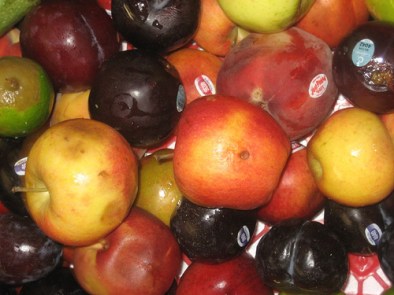
Rescued fruit

As one young man tipped a bin of wet produce into another empty container to sort through the carrots and berries at the bottom, a thickly accented voice piped up from across the sidewalk: “animals eat.” I turned around. Apparently an employee of the store, the man with the accent—Turkish it turns out—had stood watching the sorting and documenting from the doorway to the grocery for quite some time before offering this key intelligence. In broken English, the informant explained to me that the trash had been sorted into real trash (collected nightly by a waste hauler), cardboard (collected every other night by a separate recycling hauler) and slops, collected nightly by a private company that drove it to an animal farm in New Jersey. One organizer muttered to another that perhaps this store should be dropped from the tour, seeing as the organic waste they were picking through might not truly be “trash”.
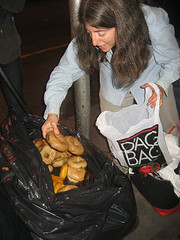
freegan.jpg

Bagels!

After about an hour of rummaging and a brief display of yam juggling, the woman pictured above stood before an impressive array of produce, bread and half a salami and spoke on a melange of topics including excess waste, fossil fuels, war, labor abuses and rain forest cutting in Central America.

Next, it was on to bagels. I accepted a nearly-whole, perfectly good looking carrot from one of the bins (that by now may be on its way to feed Jersey pigs), peeked into a bag full of bagels from the shop next door and, plucking a pumpernickel for the road, thanked the organizers and headed on my way.

As I walked past the Turkish grocery man again, he asked “going home?”

“Yes,” I said, “thanks again for the information.” He had given me the name of the food waste collection company used by the store. “Wait, I get you sample,” he said. In chatting about garbage collection, we had established the Middle Eastern connection. When I said my family was from Iran, his eyes lit up. He had seemed grateful for a familiar term of reference after watching middle class whites root through would-be-pig-slops for so long. Now, he slipped into the store and returned with a lush container of fresh fruit cup (complete with papaya!), a plastic fork and a plastic bag to carry it in.

“For my neighbor,” he said. I thanked him profusely, considered refusing the bag, but in the end tucked the whole collection into my tote along with my partial carrot and stale black bagel, all to be sampled pre-dawn before another long day of fasting and meditating on food and waste.