 Every once in a while it pays to include other blogs in Internet trash searches. Evidently Paris Hilton was pelted by trash at a recent press event in Austria. There’s even a video of the event unfolding.
Author Archive
Celebutrash
Wednesday, February 21, 2007zero waste groovin’
Tuesday, February 20, 2007 Tipster-in-chief Kimberly sent me this article today on a dance floor in the Netherlands that harnesses the power of those who grove upon it.
Dirty business, parts one and two
Monday, February 19, 2007
The grey nomad’s trail
Saturday, February 17, 2007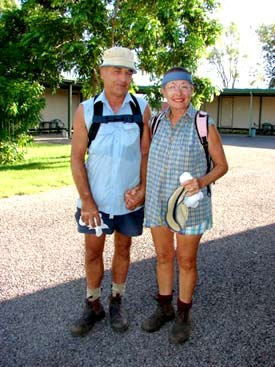
Weekly Compactor
Friday, February 16, 2007 This week in trash news:
- If passed, a new energy bill would offer Americans tax incentives for using solar power;
- Toronto gussies up recycle bins for a public art project;
- North Reading, Mass., comtemplates an unforseen jump in trash created by residents;
- The Asian Development Bank predicts that, if current rates hold, the continent will create 1.8 million tons of trash per day by 2025; and
- Locals in Nepal continue to block dumping in a landfill outside of Kathmandu.
Mierle Laderman Ukeles
Thursday, February 15, 2007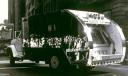 A friendly tipster alerted me to the fact that NYC’s trash artist in residence, Mierle Laderman Ukeles, has an upcoming show. She has at least one piece, an installation created from a garbage truck, on display February 23-26 at the 2007 Armory Show.
According to Amy Zimmer’s article in yesterday’s Metro:
The booth will feature elements of her past works, such as “Touch Sanitation,” where from 1977 to 1980 she followed routes in all five boroughs to shake the hand of each sanitation worker and say, “Thank you for keeping New York alive.” At P.S.1 in 1987, she created “Re-entry,” a 90-foot sculpture made from 11 tons of recyclables. “I wanted to make it like building blocks so you could imagine [these objects] really could have another use,” she said. Her “Ceremonial Arch Honoring Service Workers in the New Economy,” which was made with 12,000 dirty gloves from sanitation and other workers, graced the World Financial Center in 1988.
Ukeles past work includes pieces highlighted here on the Avant-Guardian’s online ‘textlet’ on “Cycle-Logical Art” and these photos of Fresh Kills, the massive land fill that will one day form the base of a massive park.
humbug
Wednesday, February 14, 2007 I would include a special valentine’s round-up, but I’m burnt out on green love this week.
taking less out
Wednesday, February 14, 2007 I found this admirable GreenBiz link on take-out containers while contemplating/googling over-packaging. Consider this a call for entries. What’s the most ridiculously over-packaged food item you purchased in the past year?
Thermal Depolymerization
Monday, February 12, 2007 Loreen Leedy went from subject to tipster in one fell swoop when she sent me this link on turning trash into energy along with the answers to her interview questions last week. It’s a round up on blog, magazine, newspaper and academic sources on making oil out of just about anything.
Carnival of the Green
Monday, February 12, 2007 Every Monday one member of the green blogosphere rounds up great posts from fellow envirobloggers in a rotating tradition called Carnival of the Green. Check out the sampling posted today over at the Savvy Vegetarian and note the shout out to my everydaytrash interview with photographer Andy Hughes.
Its a nice day for a green wedding…
Sunday, February 11, 2007 The Times has a lovely piece in today’s Sunday Styles section about the growing trend of environmentally friendly weddings. It’s a topic I know my side bar buddies Ethical Weddings and Great Green Wedding keep in mind when posting. Of course the number one way I can think of the reduce your ceremony’s footprint (not to mention your and your parents’ energy output) is to not throw such elaborate parties. That said, I’ve been to one of those farm to table places upstate, where the article mentions the couple held their rehersal dinner–crisp weather, more kinds of carrots than you knew existed, pigs wandering about, compostable cutlery, picturesque carriage trails perfect for hikes and runs…I could imagine a fantastic feast served there.
Update: For even MORE on green weddings, check out this post of the same name over at hippy shopper.
Weekly Compactor: Literary Trash Edition
Saturday, February 10, 2007



 Thanks to all the authors who participated in Literary Trash, a week of garbage lit Q & A’s. I’m pleased as punch that five bonafide trash writers agreed to take part and especially proud that I was able to find such a varied crowd. What started as an idea to 1)beef up the original content on my blog and 2) expand the everyday trash network, turned into a fun and educational week dedicated to testing the bounds of the great trash debate.
Check back soon for more interviews with trash personalities–and by all means, please suggest interview subjects for future posts!
Literary Trash, take five, David Naguib Pellow discusses Garbage Wars
Friday, February 9, 2007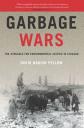
 We end a fantastic week of trash author interviews with David Naguib Pellow, sociologist and author of Garbage Wars: The Struggle for Environmental Justice in Chicago. In ‘Garbage Wars,’ Pellow provides a 20-year lit review and evidence-based analysis of Chicago’s waste management. This is a book about the politics of garbage (which are, as we all know, the very same politics that apply to race and class). It’s about the simple, universal fact that we all make waste–most of it smelly, some of it hazerdous–but only some people have to live with it. This book is the perfect finale to our exploration of trash lit because it brings us back to the very core of the everyday trash message: there is no such thing as “away”.
everydaytrash: Could this book have been written about another city?
David Naguib Pellow: Yes, absolutely. Chicago is really almost a metaphor or a window for what’s going on not only in other cities in the U.S. (Detroit, New York, New Orleans, etc.) but it reflects a global reality as well, since greater volumes of garbage and waste are being generated as societies become more ‘advanced’ and industrialized. Chicago is a particularly excellent site for this kind of study, however, because it has historically been much more racially segregated than most places in the U.S. This means that the garbage wars occurring in Chicago produce and reflect a much deeper sensitivity to racial inequality. In other places, garbage wars may fall more clearly along social class divides.
everydaytrash: Garbage Wars seems to be more about class and race than anything else. Why focus on trash and the solid waste industry?
Pellow: The way we treat our trash tells us a lot about the way we think about our relationship to nature. But it also tells us a lot about our relationship to other people, particularly populations that are marginalized politically, economically, and culturally. I have traveled to many cities and countries in the time since Garbage Wars was published and almost without fail, those groups at the bottom of the social pecking order tend to live and work in places where they are exposed to the rest of society’s trash and pollution. In other words, as much as we’d like to think of garbage and waste only as environmental problems, they’re actually social and political issues more than anything else.
everydaytrash: Is the environmental justice movement alive and well? Has it evolved in response to newer threats of high tech waste?
Pellow: Yes, the environmental justice movement is thriving in the U.S. and globally. In fact, some of the most exciting work going on in this movement is occurring outside the U.S. Electronic waste (e-waste) is a good case in point. As rich industrialized nations consume and dispose of hundreds of millions of computers each year, the waste from these products often ends up in global south nations, where workers attempt to refurbish them for reuse and remanufacturing. Unfortunately, since the average computer contains many pounds of toxic materials, this is an inherently dangerous process that threatens workers and ecosystems. In response, activists in West Africa, Latin America, and Asia have teamed up with advocates in the U.S. and Europe (where most e-waste originates) to push electronics producers (most notably computer firms) and governments to enact policies that would prevent the export of hazardous electronic waste to global south nations and to reduce the use of toxic chemicals in the production of electronics in the first place.
everydaytrash: What are some examples of current struggles between vulnerable populations and the garbage imposed on them? Where are today’s garbage wars being waged?
Pellow: Today Roma communities throughout Europe are threatened with environmental racism, as many of these populations are forced to live on or near garbage dumps. Some Roma activists are reframing and turning upside down the traditionally racist view that Roma prefer living near garbage dumps. In Sofia, Bulgaria, they are documenting the fact that Roma are often forced by cities and by threat of public violence to live in close proximity to garbage dumps (a classic example of environmental racism); they are also documenting the fact that Roma who are taking objects out of the dumps for reuse or resale, are what, in any other context, we might call recyclers or waste recovery workers, because they are contributing to Bulgaria’s national recycling efforts. So they are flipping the script on the work Roma are doing in garbage dumps and on why they are living there in the first place.
Similar struggles are going on in places like Egypt and the Philippines where people seek to turn environmental injustice into an opportunity to recover waste for reuse and economic development. So many of today’s garbage wars are being waged over the right to use garbage as a resource for our future rather than as a means for corporate profit.
###
This marks the end of authors’ week, but look out for future interviews with trash authors and personalities from around the world. And check back for daily posts on the art and politics of garbage.
Going Through Gramacho
Thursday, February 8, 2007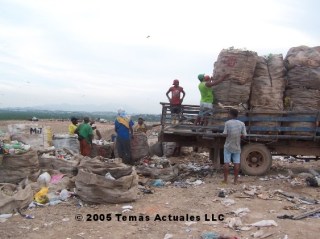 Over at The Temas Blog, fellow garblogger Keith resurrects his Trash Photos series with a powerful and in-depth look at Gramacho, a landfill outside of Rio regularly picked over by catadores, Brazilian rag pickers. As usual, Keith reports on the issue in exhaustive detail, exploiting statistics, photographs and even video to show the effects of the landfill on the surrounding environment, culture and economy.
blog in a book
Thursday, February 8, 2007 The latest issue of the hard-cover Canadian art magazine, Alphabet City, covers our very favorite topic. I came accross it at the Whitney last weekend and have been peering at the chapters one Subway ride at a time every since. What I like best about this book is how diverse it is, covering everything from really wonky articles to a woman’s poems about her sanitation worker uncle. It starts off with beautiful close-up photos of dust bunnies and covers everything from a collection of found paper airplanes to photos of industrial spaces to forgotten people in Mexico. I’ll try to hook up an interview with the editor.
 everydaytrash
