The Swedish Public Radio reports that Sweden, after two years, has yet to stipulate punishment levels for breaking the European Union imposed legislation that prohobits tra$h smuggling to developing countries. Hence, there’s no knowing what to do with a container of illegal refrigerators that was confiscated this Friday by border authorities, and no way of knowing what to do with the persons trying to send it off to Uganda. Well done, parliament.
Author Archive
No punishment for breaking tra$h laws
Sunday, May 17, 2009Fishing trash bad for fish
Friday, May 15, 2009While fishing as such is an agricultural practice with the ultimate goal of catching and killing fish, i.e. not fantastic for fish to begin with, fishing gear dumped at the bottom of lakes and oceans are killing fish even after the actual fishing stops, says a UN report.
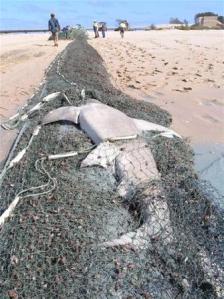
Photographer: Jane Dermer, Carpentaria Ghost Nets, ghostnets.com
Apparently, discarded fishing gear compromises about 10%, or 640 000 tonnes, of all sea trash, creating a situation of so-called “ghost fishing”, when innocent maritime denizens happily enjoying off-season swim into discarded nets and related rubble, ending their lives in highest indignity. In the report, several pressures on fishers are named as contributing to this terrible situation, namely
Enforcement pressure causing those operating illegally to abandon gear; operational
pressure and weather making it more likely that gear will be left or discarded; economic pressure leading to dumping of unwanted fishing gear at sea rather than disposal onshore; and spatial pressures resulting in the loss or damage of gear through gear conflicts. Indirect causes include the unavailability of onshore waste disposal facilities, as well as their accessibility and cost of use.
As seen, fishing trash management isn’t working out that well. The report suggests preventive efforts and says that mitigation is crucial, etc. We could also just stop fishing, but while poverty exists, one might need to recognize that’s not a very realistic scenario.
Lastly, extracurricular nerd info: The report teaches us a new acronym; ALDFG (Abandoned, lost or otherwise discarded fishing gear)!
Dumpster cooking
Wednesday, May 13, 2009If you happen to pass through Litz, Austria, May 14-15th, you should head out to the Subversive Fair (somewhere in the docks, check website for directions), and check out Interacting Arts’ performance Dumpster Cooking.
The performance, according to Interacting Arts,
Consists of two parts. The first part includes dumpster diving and collecting food for the performance. These excursions will be documented through video. The second part takes place at the fair where cooking of the retrieved goods will be carried out in public.
When the food is done everyone present is welcome to join in the meal. The cooking is done against a projected background of the earlier documented food retrieval.
As cream on top, Interacting Arts says the following about trash:
The middle class standpoint: Only trash consumes trash. It’s from this point of view that dumpster diving can be seen as not only an anti-capitalist way of survival but also a true rebellion against society as whole.
In other words, head for Litz, discover what those Austrians really eat! It can’t be all schnitzel, ya?
Guest post from Fernanda Siles
Saturday, May 9, 2009While the crew behind everydaytrash.com spend the day editing and recoding our lovely blog, we have the honour of presenting a report of recent trash activities in Nicaragua! Many thanks to Fernanda Siles for sending us this!
—
We are a group of Sociology and Social communication students, amateur performers and friends. We picked up trash from the dumpsters of our university and decided to put it back together writing the word globalization with it.
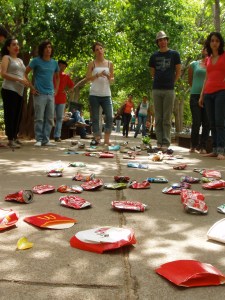
Nicaraguan university trash
Twice, first on Saturday April 25 and afterwards on Monday april 27, without any previous notice, we took over one of the halls of our university (Universidad Centroamericana) and performed the next scene:
Two people with masks and Ronald McDonald smiles on their faces directed the movements of four others that carried the trash and picked up some more from the areas near the improvised stage. These four started forming the word globalization with the garbage. Meanwhile, the two dominant figures impeded the students watching the act to walk through the area, trying to establish some interaction with the public without speaking (we try not to speak so that the message is not only taken as we had thought it); they also invited some of them to participate in the writing.
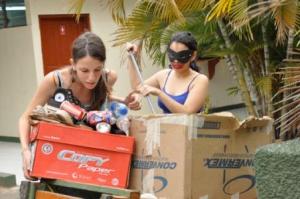
Masked trash people with famous smiles
Two of the initial four ended up lying on the ground, representing the I’s. Once the word was entirely written down, one of the masked characters started a fight with one of the I’s who opposed resistance not only physically, but also by removing labels of transnational chains from his clothes; he got to free himself from the pressure of the dominants and walked freely around the word starting a conversation with the people around. The ending on Saturday was different because the I instead of immediately starting the dialogue, put a plant in the end of the word.
The reactions were quite different both days. On Saturday, the audience was mainly constituted by people who study Social Sciences, and the dialogue was fluent and extremely refreshing! The plant also represented an important difference. We tried not to make our message so explicit because what we want is for people to reflect on their own about the issues we are dealing with in our performances; this time, people gave very deep meanings to many our symbols – some of which were not even intentional.
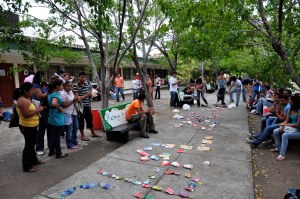
Trash globalization dialouge
The discussion revolved around the presence of transnational products in the word, the role our country and other “developing” nations play in the globalization process; our individual roles as consumer and active forces in the building and maintenance of neoliberal globalization; the immense production of trash in a global consumer society; the impact of the production of goods and their later dumping in our environment; human capacity to give another form and meaning to globalization.
On Monday, the discussion was harder to establish; the audience was diverse regarding the area of study, but it was mainly young people watching. The most remarkable response we got was the look on people’s faces when they found out the garbage was found in our university.
Smithsonian goes trashy
Tuesday, May 5, 2009For those lucky cheeses who happen to pass through Washington D.C. (Leila, road trip!), the Smithsonian American Art Museum now shows the piece Common Threads by Jean Shin. It’s all true trash art, with high ambitions! How about modified old sports trophies, celebrating carpenters and waitresses? Big, fiery-looking light-thingies built from old bottles? Or my favourite, the stacks of $25,000 worth of lottery tickets with loosing numbers.
The exhibition runs until July 26, but the Smithsonian have discovered the Internetz, and on Flickr we can all view what things looked like when Common Threads was put up, hopefully also beyond the end of July. Lastly, I would like to recommend NPR’s coverage of Shin’s exciting work.
Outdoor random decorated dumpsters
Friday, May 1, 2009Maria Ferm was kind to share two more deco dumpster pix she shot last summer. You have to love the gold bus stop dumster (that usually comes in something close to “coniferous forest green”).
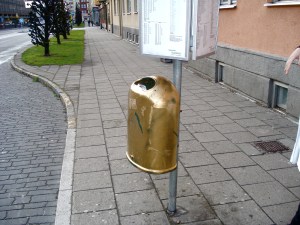
Decorative dumpster at bus stop, Malmö
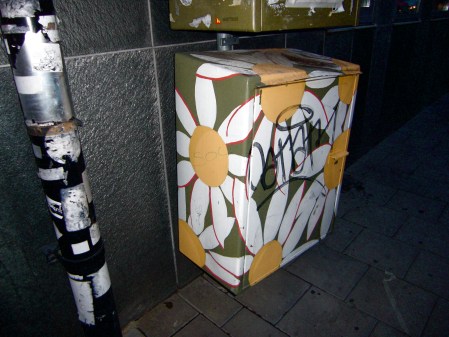
Container used by kiosks to return unsold tabloids, pimped
STHLM Underground Deco Dumpsters
Friday, May 1, 2009At two of my favourite stops on the underground back in Stockholm, Zinkensdamm and Hornstull (pronounce that in English), magnificent work has been done by someone or somebody, seriously competing with the original art that came with the station (to read more about the art, go here).
These pics come courtesy of Hanna Hård, generally excellent word nerd and co-editor of Swedish feminist blog Vi Som Aldrig Sa Sexist, and Maria Ferm, pizza expert and co-spokesperson for Green Youth, the Youth League of Swedish opposition party The Greens (and yes Maria also blogs).
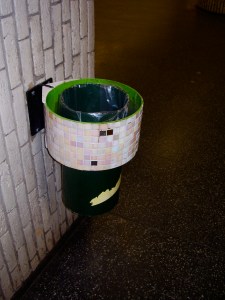
Decorative dumpster Hornstull
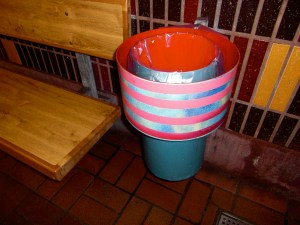
Decorative dumpster Zinkensdamm
Cuff it up!
Wednesday, April 29, 2009The latest in upcycling and trashion seems to be cuff links. Check out these cool samples, first one by Liza Hermeline from old typewriter keys, second one by David Wright from old circuit boards. Follow the links to purchase.

Cufflinks by Liza Hermeline

Cufflinks by David Wright
What’s WEEE and why is it bad?
Tuesday, April 28, 2009makeITfare, SwedWatch, the Church of Sweden and the Fair Trade Centre have produced a fairly substantive report on electronic tra$h flows from the European Union to developing countires. Speaking the language of the European Commission, the report uses the amusing term “Waste from Electrical and Electronic Equipment” (WEEE), but that’s where the fun stuff ends.
Quick facts: About 50 million tonnes of WEEE is produced annualy, and in the EU as a whole, only about a third is collected for recycling. Much of this is toxic and hazardous to handle, and even though some of the worst chemicals are no longer used in the EU, we can expect that most of the EU-WEEE predates July 2006, which is when regulations where tightened. As an example, an avarege cellphone contains about 200 chemical compounds.
According to the report, the flow of elctric trash from the EU to countries such as Pakistan, Ghana, China and the Philippines comes in many shapes. Three main routes can however be identified. First, there the tra$h that we are used to, garbage as an international commodity, on a market where the price of a laptop can be about US$ 10. Secondly, there’s the black market tra$h, which essentially is the same thing, only more illegal. Thirdly, there’s the export of used but fully functional computer, fridges, cell phones etc. from the global North to the global South.
When it comes to legal and illegal tra$h, the report points at the problem not really being whether what’s sold generates proper VAT, the problem is that regardless of who sells and buys, there are not adequate systems available when the tra$h reaches its final destination – it is taken care of by children and people living in poverty. The result is spelled in raised levels of led in their blood, and a long list of other things. For some tra$h tycoons, the ends justify the means. “Recycling” a computer costs about 15% in India, compared to West Europe.
For the donated computers and white goods, the problem will in the end be the same: Nowhere to recycle once the family fridge goes WEEE. I.e., it might feel all great giving your used laptop to an orphanage in Sub-Saharan Africa instead of sending it back to recycling, but trashly speaking, you might actually make things worse. Also worth to mention is that much of the used things that are supposed to be donated, actually end up as tra$h (and in some circumstances, its the other way round).
One of the more interesting, and at the same time deeply disturbing phenomena brought forward by the report are the so-called “trash tourists” that roam scrap yards and shady business offices in the EU. Trash tourists are essentially people who migrate in search of tra$h, more or less voluntarily. Makes me think of a Swedish investigative journalist TV-programme, exposing a businessman who in effect employed men from West Africa, without paying them, to sort out recycled car tires. He claimed they were guests, visiting to scout the market. They lived in barracks on the (incidentally toxic) grounds.
To conclude, the report notes with sadness that the Basel Convention, in place to prevent all this since 1989, is still terribly dysfunctional.
Big ship tra$h
Wednesday, April 22, 2009Yesterday we reported on rad trash activist Yuyun Ismawati being awarded one of this years Goldman Environmental Prizes. One of Ismawati’s fellow recipients, Syeda Rizwana Hasan, is also truly worthy of praise.
Hasan, a lawyer, works on behalf of the 20,000+ ship breaking workers dismantling ships in yards on the shores of Bangladesh, work that is being carried out under enormous hazards. Think lead paint counted by the tonnes, and any other toxic you might find on a ship, you see, they arrive as is. According to Hasan’s bio on the Goldman Prize web, one worker dies each week. As with electronic tra$h, which we’ve talked about in several posts, ship tra$h is a very lucrative business. Somewhere out there sits a gang of ship dismantling fat cats, with blood on their diamond credit cards.
Hasan’s work has led to, among other things, increased government legislation and increased public awareness. Last month, 36 ship yards were closed following tightened regulations instituted by the Bangladesh Supreme Court. For these achievements, we lift our hats off for Hasan, and hope that increased publicity might make ship owners think twice, before sending their used-up naval transportation units to the coast of Bangladesh, where incidentally the rare Irawaddy dolphin seems to be making a comeback.
Garbloggers on Twitter, unite and take over!
Wednesday, April 22, 2009Late yesterday we discovered that on Twitter (another Internet sensation), the hashtag #trash is not really used by anyone for anything in particular. These days are gone, fellow garbloggers. Please join us in filling #trash with the meaning it deserves (and remember to follow @hashtags to make it work)!
To learn more about Twitter and hashtags, check out the Twitter Fan Wiki.
Goldman Prize awarded to trash activist
Tuesday, April 21, 2009One of this years seven recipients of the Goldman Environmental Prize is Yuyun Ismawati, 44, from Indonesia. Ismawati has been awarded for her work related to the growing challenges of trash on small islands, where trash storage space is scarce and poses an obvious threat to the land and community.
Ismawati has a long history in activism, advocacy and NGO work related to recycling and tra$h. For a full description check out her bio at the Goldman Environmental Prize web. One thing too cool not to mention though, is that Ismawati last year contributed strongly in developing Indonesia’s first-ever bill on waste management and waste management strategy! Hurrah!
Smelly trash and resistent bacterial floras
Monday, April 20, 2009The smelly trash (also known as poo) we all produce is normally taken care of (where there’s enough water) in sewage treatment works, to be cleaned. A study from Linköping Univeristy (in Sweden) has now concluded that resistent bacterial flora, such as Methicillin-resistant Staphylococcus aureus (or MRSA), has the ability to survive this process. This becomes a problem for example in hospitals, where washing your hands all of a sudden isn’t that patient friendly. Apparently, the problem is worst in the UK, France and Japan.
In the Swedish newspaper Dagens Nyheter, Åke Hjelm, Information Officer at the University, describes the discovery as a “world sensation”, as previous studies have come to the opposite conclusion. Myself, I just long even more for the outhouse at our family’s coniferous forest cottage.
Green Market pic phest
Sunday, April 19, 2009People at the Hopewell Valley Green Market expressed great surprise over everydaytrash.com coming “all the way” from Brooklyn to the market this weekend. All you city kittens, please take a look and see what you missed.
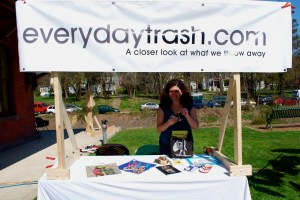
Our space with lovely new banner
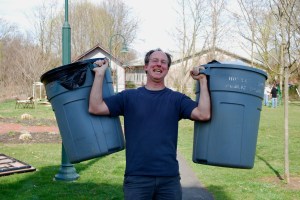
Organizer and trash superhero Tom Adelman
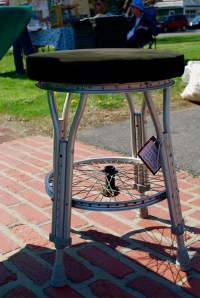
Upcycled medical equipment
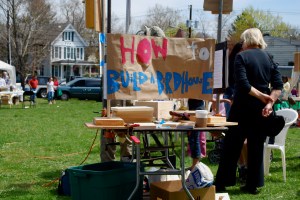
From flooding debris to birhouses
What does this mean?
Sunday, April 19, 2009As regular followers know, everydaytrash.com went to Hopewell Valley Green Market this weekend, to represent and absorb new ideas. At the entrance to the Market, the following public information was posted. Very useful and very cute!
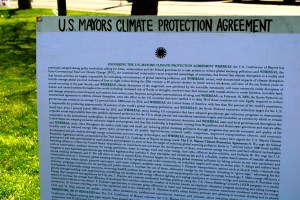
u.s. mayors climate protection agreementWhat does this mean?What does this mean?
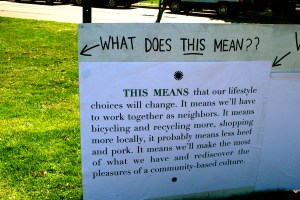
So, what does this mean?
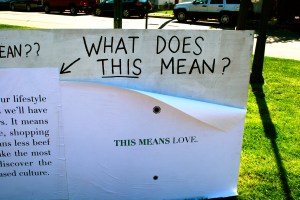
What it really means!
 everydaytrash