 I found this and other cleverly titled and artfully shot photos of trash here. According to the “about” blurb: ” The Art of Talking Trash is dedicated to showcasing the most progressive and inspiring garbage in NYC and beyond.” Welcome to the garblogosphere, comrad. This photo reminds me of Donna Conlon‘s trash trees in Panama.
Archive for the ‘Artistic Trash’ Category
The Art of Talking Trash
Friday, April 18, 2008Detritus
Friday, April 18, 2008 You may remember a request to fill out a survey about the waste you created over the course of one day…the results are in and have been morphed into a play called Detritus running next weekend (April 26 and 27 in NYC) under the tagline “inspired by New York City’s trash.
Here’s the brief and intriguing description from the creators…
Trashtastic Thursday with Samir M’kadmi
Thursday, April 17, 2008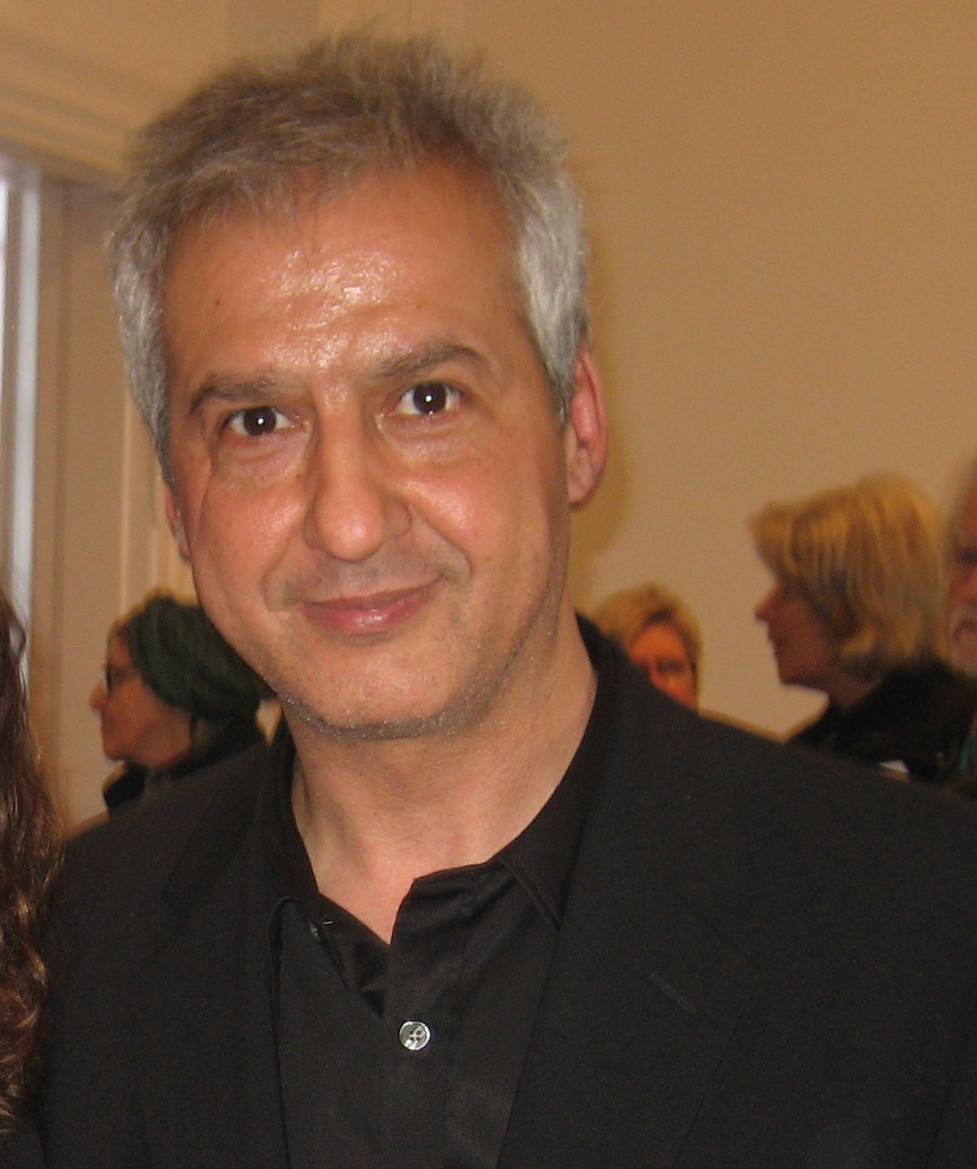
Samir M'kadmi
Norway-based, French-raised, Tunisian-born artist Samir M’kadmi is perhaps the only man international and open-minded enough to have curated the trash art show, seminar and catalog “Recycling the Looking Glass“. As you are well aware by now, due to my constant raving since returning, the show opening was a huge success. Despite the demands of a crazy schedule putting on international exhibitions and keeping up with work of his own, Samir kindly agreed to provide everydaytrash readers with a bit more depth on the making of the Oslo show and where trash art falls in the art historical cannon.
—
everydaytrash: How did the concept for “Recycling the Looking Glass” come about?
M’kadmi : “Recycling the looking-glass” is a result of research and interrogations on topics related to contemporary art, our environment, and global society. Through “Recycling the looking-glass” I tried to re-conceptualise crucial interrogations of globalisation, environmental and cultural issues by resituating these topics not only at an aesthetic level, but also by interrogating and exposing their ethical dimension. These interrogations also occupy a major place in our Norwegian media debates. Of course, these kinds of topics are not specific to Norway. They are global. But, the way these issues are addressed, in Europe, Scandinavia and specifically here in Norway, through our major media, is quite disturbing.
In fact, we can summarise the debate in a few terms: Islamophobia, racism, poverty, immigration, war and terrorism, climate and environmental changes. The first six topics relate to globalisation, cultural and geopolitical domination matters, where concepts such as cleanliness and purity are very often used as metaphors for “our” Western culture and values, and uncleanliness and impurity as metaphors for the “other’s” culture and values. Although this point of view does not reflect the opinion of the majority of Norwegians, it does reflects the opinion of about 17.5 percent of Norwegian voters, which approximately corresponds with the number of voters for the Progress Party (the extreme right).
This point of view, the “other” perceived as a threat, as impurity, as trash, seems also to be the only means of access into the media debate. This is a debate initiated and defined by the editors of the major national newspapers, such as the conservative Aftenposten.
Climate and the environment are tightly linked to the first topics. Here again, the interrogation seems to be blocked between two points of views, one that supports the UN Climate Report and another that opposes it. Here again we find the same political constellation. On the one hand, we have the extreme right, (the Progress Party), which tends to reduce the climate report to a big hoax, on the other hand we find the other political parties who swear by the report and propose some cosmetic environmental solutions. The aim of this debate is how to reduce the discharge of toxic emissions. In short, waste, as toxic emissions, as household or industrial trash, seems to be a common denominator for globalisation, climate change, environmental, and cultural issues. How do contemporary artists deal with these questions? Do they deal with these questions at all? What can artists tell us about trash, recycling, reducing and reusing? Does trash or decay have any aesthetic value? What is the relationship between archiving and trashing? These are just a few of the questions that contributed to the elaboration of the concept behind “Recycling the looking-glass”.

Artist Jan Franciscus de Gier discusses the Euro pallets he and partner Vigdis Haugtrø contributed to the show with a Nowegian artist attending the opening
everydaytrash: How did you select the participating artists?
M’kadmi : Selecting the artists for “Recycling the looking-glass” was tightly bound to the development of the exhibition concept itself. It is a work in progress, and a complicated process because it demands a lot of research, especially if you want to articulate simultaneously different approaches and practices in the same context. Every artist represents a unique and at the same time complex position. When you present artworks made by different artists, side by side, you create not only an opportunity to investigate the artworks, and question the artists behind them, you also provide an occasion to confront your own presuppositions and ideas on art, trash and society.
everydaytrash: One question raised at the seminar was what is the line between art and politics and is there a definable border. What do you think?
M’kadmi : I consider the artist to be an intellectual and a political subject. There is no line between art and life. Art is life, art is science, art is philosophy, art is poetry, and art is politics… The French philosopher Jacques Ranciere describes the political subject, among other things, as a non-static entity and a vector of change. He or she only exists through their actions, through their capacity to change the given landscape, to make visible, to show what was hidden or not perceivable. The political subject opens up the political field through his/her activities, beyond the parameters of all known and accepted political institutions.
We are, everywhere, confronted by interests and ideologies that tend to reduce the artist only to a producer of commodities, rejecting any thoughts and ideas that are not compatible with the idea of the artwork as an open creation, and the idea of the work of art as an object. Utility value is, and has always been, a key theme in an art context, in particular if one eradicates the distinction between the ethical and the aesthetic, as did e.g. Marcel Duchamp with his Fountain in 1917. I situate art’s utility value in its freedom and independence, in its autonomy. In short, the political subject exists as the effective manifestation of the capacity of anyone to personally engage in common affairs.
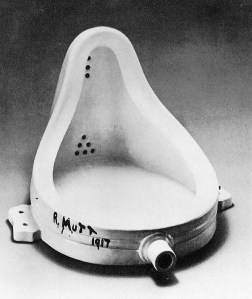
Duchamp's "Fountain"
everydaytrash: What is the connection between found object and trash art?
M’kadmi : Trash art is an art form that insists on a status as waste. Found objects on the other hand, cling tightly to the identity of the object. Found objects are, as the name indicates, a found object, “un objet trouvé”. It is an object that has retained its integrity but has been removed from its original context.

Schwitters' "Cherry Picture"
Dadaism and the Surrealists attacked High Art by introducing elements from reality in their works. Kurt Schwitters created art from “ détritus”, “l’art du détritus”. Marcel Duchamp’s readymade gave another dimension to “L’object trouvé”: appropriation, ‘détournement’, subversion, etc.
From Dadaism to Surrealism, to Pop Art, and Situationism to Fluxus and Nouveau Realism and today’s post-modern Trash art and Found objects, we find here many enthralling issues and discourses, both aesthetic as well as socio-political. Trash art questions received aesthetic conventions.
Junk is a powerful medium that must be given an artistic design: Robert Rauschenberg, César, Ben, J.Beuys, David Hammons, Jimmie Durham…The boundary between trash art and found objects is not watertight.
Kjartan Slettemark’s Cocaflower is trash, because an empty Coca Cola can is by definition empty packaging, in other words, trash, recyclable material. South African Willie Bester’s horrifying sculptures of recycled metals that depict cold uniformed giants riding ridiculous war machines are trash, because the objects used in the construction appear as junk. Benin artist Romuald Hazoumé’s African masks made of plastic containers and other garbage strike similar chords. Roddy Bell’s fans and frames are found objects because they are perceived as fans and frames. Safaa Erruas’ pillowcases and shoes are representations of found objects; Jon Gundersen’s briefcase with a pacifier is both a found object and trash, because it combines both. Vigdis Haugtrø and Jan Franciscus de Gier’s Europallets painted with rosemaling are modified found objects; Bill Morrison’s film clip compositions are found footage …
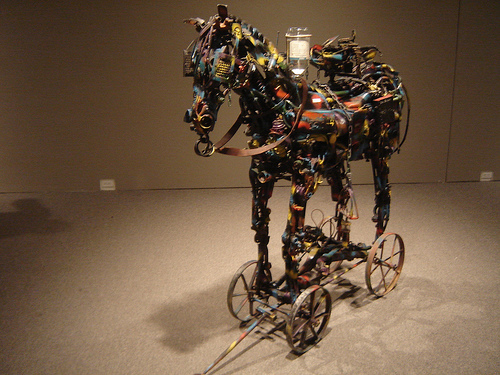
Work by Bester

Work by Hazoumé
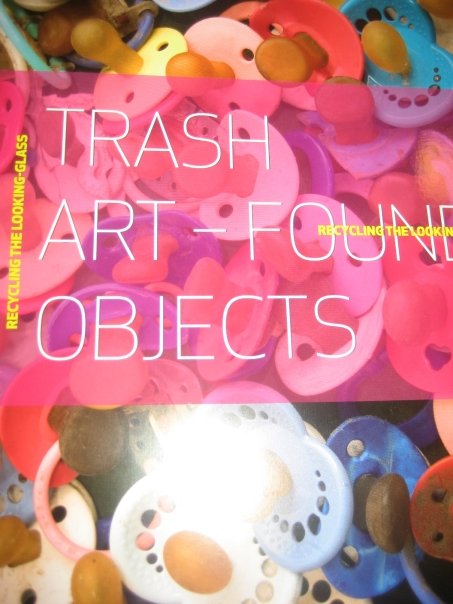
“Recycling the looking-glass” publication
(Recycling the Looking Glass-Trash Art-Found Object)
everydaytrash: How does trash art fit into the canon of accepted and appreciated media? What is the future of trash art?
M’kadmi : In our global art history, a history that is not yet written, Trash art is already an integrated genre. Trash, both as raw material and sign, has a major place in our global contemporary art. Many artworks made of trash are already canonised.
But, in spite of this canonisation Trash remains a “hot” matter because it often entails an implicit, if not explicit, critique of society. For the artist, trash is not solely signs, symptoms, markers, evidence and indicators of interpersonal experience and the various different existential foundations of all humans, but a signifying material for communication and expression.
Asking about the future of Trash art is like asking about our future relation to waste and all that is refused, denied, is in a way asking about our future relation to death.

Samir and Nasra at the opening
Trashtastic Tuesday with Donna Conlon
Tuesday, April 15, 2008As promised, here’s a bit more detail on the wonderful trash art I encountered in Norway a week and a half ago. Donna Conlon, an American artist living in Panama, has been a trash artist for years. I saw her videos for the first time at the Recycling the Looking Glass-Trash Art-Found Object seminar before the show opened. Conlon gave an artist’s talk and showed some of her amazing video projects. She was also kind enough to answer some questions for Trashtastic Tuesday. Check out her answers and Web site, where much of her work with trash can be perused.
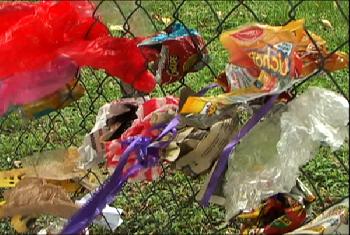
Summer Breeze
(Video still of Summer Breeze, one of Donna Conlon’s pieces shown in Oslo)
—
everydaytrash: What are trash trees?
Conlon: they are urban trees which have become “useful” as places to dispose of waste. i discovered them walking around in my neighborhood in Panama City then spent some months photographing them to document the phenomenon. i was just totally intrigued with the fastidiousness they represent – the impulse to put trash SOMEWHERE, and this becomes a very creative solution as the trash is usually placed very deliberately and often with a keen eye for form. i also think they speak to the conflicted nature of our relationship with other living things – we appreciate them with respect to their usefulness to us (more so than for their absolute value).
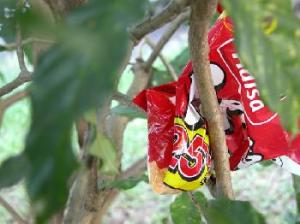
Papitas
(“Papitas” photo by Donna Conlon)
everydaytrash: At the seminar, you were asked about the link between politics and activism. Do you see your work as political? Did it become more political over time?
Conlon: political, yes. overtly activist, no. there are much more effective venues for activism. but like i said, if someone’s perspective or actions change as a result of my work, that represents an activist element that i have played, even though it is not my primary intention (and i am happy about it because it indicates successful communication which i am very interested in). my primary intention is to make good art and to stay engaged in the world around me by exploring it, observing and critiquing it. i make work
about things/situations in the world i find intriquing or puzzling – the political content reflects my personal preocupations.

Plastic river installation
(Photo of “100% Pure,” an installation of a waterfall Conlon constructed from plastic water bottles)
everydaytrash: What drew you to video?
Conlon: the realization that it was more interesting (to me) to not “transform” found objects into something else, but rather to analyze their inherent properties and let them tell us something about ourselves. then video became a way to stay in the discovery moment, to show the actual habitat of the found object (trash being the ultimate found object).

Panama City skyline
everydaytrash: Who are your trash art inspirations?
Conlon: i came to using trash in art via the trash, not other artists. i’m an opportunist who uses things that are available in my everyday life, and there just happens to be a lot of trash out there available. that said, if i think about other people who have one way or another used trash in their work, i hold Merle Ukeles in utmost esteem.
Latex Sandwich
Thursday, April 10, 2008TORCH, a peer education program run by Naral-Prochoice New York, has been working on a trash art project getting high school students to reuse expired condoms in creative ways. The goal is to raise awareness about condoms and the results are being exhibited in a show called “This is My Everyday.” The idea is to make everyday items out of condoms to emphasize that condoms are part of everyday life (I dig the repetition of everyday and the trash theme, it’s like we’re collaborating)! Here are some shots of a lovely sandwich made by one of the students. Yum!
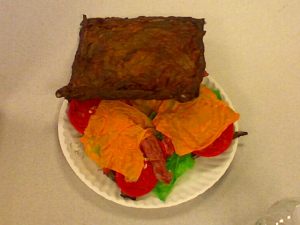
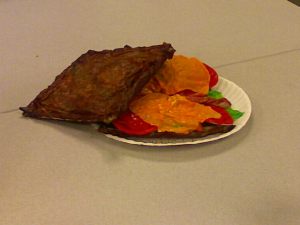
Update: This sandwich was created by Aschly Valladares and Anastasia Georgoulis was the project supervisor.
Cutest Street Art Ever
Wednesday, April 9, 2008I first heard about Joshua Allan Harris’ inflating plastic bear and other sculptures via a link to this Wooster Collective post on the Visible Trash Society garblog. Then I found his air zoo on The Fader.
And then today, my public radio friend Julie sent me an NPR story pulling all of this wonderful street art into our favorite context: TRASH! Who knew the fight against plastic bags could be so endearing?
Everydaytrash on the Road
Saturday, April 5, 2008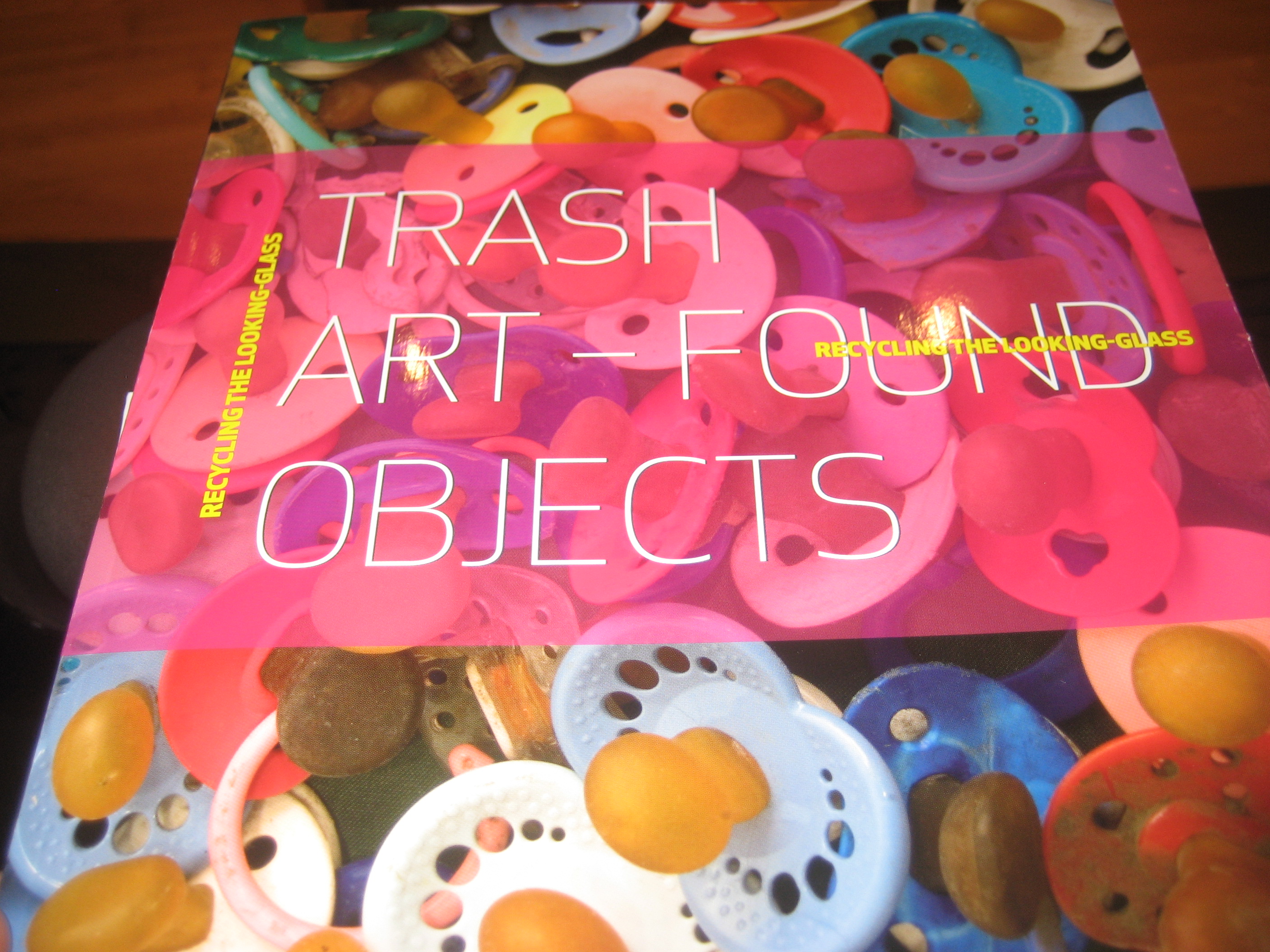
Recycling the Looking Glass catalog
“Hi hi” from Oslo. I’m here attending the opening of “Recycling the Looking Glass, Trash Art-Found Objects” a wonderful group show curated by the incomparable Samir M’kadmi. Much, much more will be posted here about the show, the contributors and organizers. At the moment, I’ll throw up a couple photos from the opening seminar and the piece I submitted to the catalog (my talk was basically a longer version of what’s below). Other panalists included a feminist art critic, an economist and an ecologist who uses trash art projects to teach kids about the environment. Two artists also gave talks. Stay tuned for less Leila-centric posts very soon, I have met amazing artists and art world peeps from all over the World this weekend and can’t wait to share the virtual booty with all of you!
—
A Short History of Garblogging
My obsession with trash began when, as a journalism student in New York City, I started researching the unimaginable number of tax dollars spent each year transferring garbage from my hometown to places as far away as the middle of the country.
New York closed it’s only landfill in 2001 with no immediate plans for what to do with all the trash created by the millions of local residents and businesses. The immediate solution was to export the waste to other states, an expensive venture involving enormous contracts with private waste haulers. Previously, the city had evacuated the majority of its trash on barges pulled by tugboats. This new plan created a billion-dollar-a-year industry and added significantly to the number of trucks circling the already congested city streets.
Not surprisingly, the poorest neighborhoods bore the brunt of these changes. In order for the garbage to be moved long distances, it had to be emptied from local dump trucks and packed up again into larger vehicles. This transfer of trash—a smelly process that attracts rats—continues to take place in several of the city’s poorest neighborhoods.
While the story I was writing focused on local politics, my fascination with garbage extended far beyond the United States. I started to see trash as everything from an indicator of poverty to a medium for art. Before long, everyone I knew associated me with trash and when they came across related factoids, I would receive an email. So I started a blog. The Internet seemed to be the perfect outlet for these tidbits and the perfect venue to start a larger conversation.
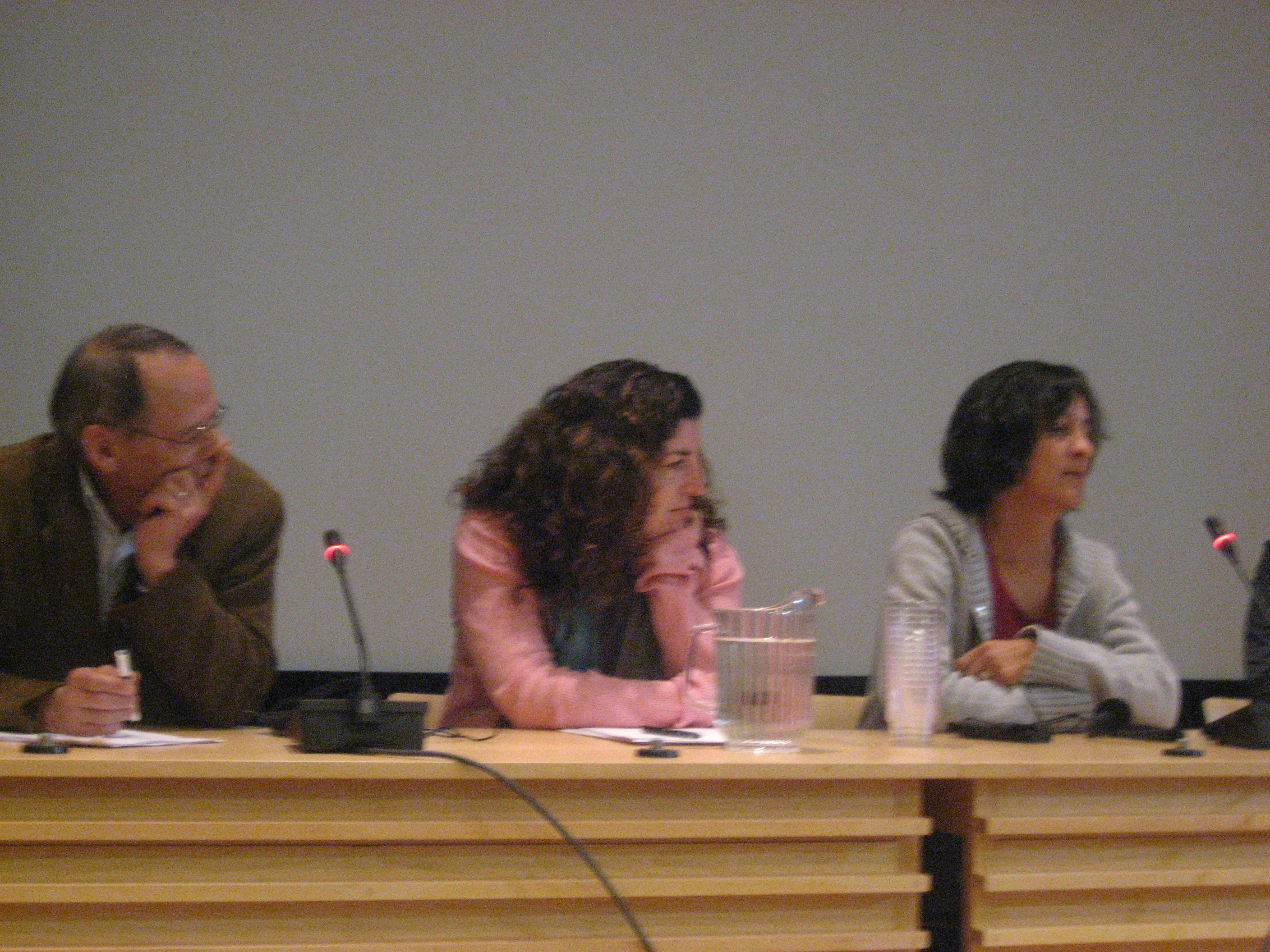
Through the Looking Glass panel
(French economist Gérard Bertolini, me, Panama-based American artist Donna Conlon)
The wonderful thing about the World Wide Web is that if you have a pet interest, it is easy to locate whole communities of people who share that interest. And so it was for me with trash. Soon after launching everydaytrash.com, over two years ago now, I discovered a universe of other sites dealing with interrelated themes. Because my interest in the subject had grown from local politics, it took me some time to think of everytrash.com as an environmental or “green” blog.
My audience had no such doubts. I quickly realized that the majority of people interested in trash are interested in reducing waste and approach the issue in terms of saving the planet. I came across people keeping track of their own waste online, weighing their garbage each day and trying hard to make less the next. And there were sales sites, marketing niche environmentally-friendly products to those willing to pay a bit more for a clear conscience. There appears to be a huge market out there for reusable tote bags, organic baby clothes and business card holders made from recycled gasoline.
It doesn’t take much exploration into the world of trash to see that, fundamentally, trash is an economic and class issue. Only those less fortunate ever have to worry about what happens to what society discards. The rest of society, on the other hand, sleepwalks through life believing that trash disappears the moment it hits the bottom of a trash can.
Early on in the life of the blog, I became interested in trash pickers, communities of people who go through the trash and find new uses for what others have chucked. In Argentina, China and Egypt and probably many other places, there are words for these people and the practice is associated with very particular ethnic groups. In many other places, people supplement their income by collecting and redeeming cans or hunting for and selling scrap metal. Sifting through the smattering of articles that pop up each year on trash pickers, I am constantly reminded of the wastefulness of the era I live in.
"Garblogging" translated in the English/Norweigan catalog--love it!
Once you notice trash, it’s hard to ignore. Around the time I was pouring through New York’s solid waste management plans, my job at a public health nonprofit began taking me to Africa. There, I encountered a relationship with material goods entirely foreign to me. Terms like recycling and zero waste have no place in these societies where value and lifespan of any given product are given their full respect. In places where people have very little, these concepts are organic.
I met a roadside tailor in Malawi who spent his days mending the worn clothing of local villagers, squeezing extra days, weeks and months out of the worn fabric. In Uganda, women from the North, an area burdened by enduring violence and high rates of HIV/AIDS, form beads out of old magazine pages that they then shellac to create brightly colored bracelets and necklaces. Women in Kenya collect floating flip flops from the ocean to refashion into crafts to sell; one project has even created a giant whale out of the discarded plastic shoes to raise awareness about the dangers of plastic waste to marine life. Plastic bags in Burkina Faso are twisted into small dolls and sold to tourists. While the African cultures I visited varied dramatically, the unmistakable smell of burning garbage welcomed me the moment I stepped off the plane and onto the tarmac in a new city.
In fact, many of the news articles I read while traveling focused the depletion of Africa’s resources and the threat of disease. The contrast between the joyful and hopeful efforts of the beaders and doll makers and the overall pessimism of news coverage on Africa fed my enthusiasm for blogging. I was glad to have a forum to highlight positive, homegrown responses to seemingly overwhelming problems.
Of course many positive approaches to the subject of trash come from the artistic community. Through everydaytrash.com, I have discovered “trashion” designers who create fantastical outfits from discarded items as well as countless artists who use trash as a dynamic medium with which to create provocative pieces. What I love most about these works is their effortless incorporation of an often dense political topic. Trashtastic!
The Gleaners
Wednesday, April 2, 2008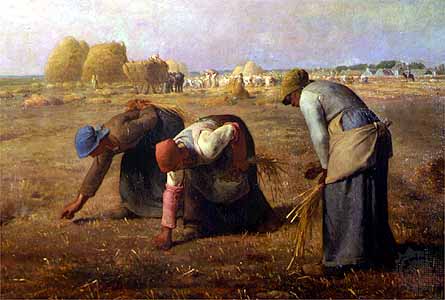 At dinner the other night, someone suggested I look up a film called “The Gleaners and I” about some crazy French law that says after harvest farmers must let peasants onto their land to pick through leftover produce. There are some famous French paintings of the activity and the film evidently delves deeper into the issue and carries us all the way up to present day society. It’s at the top of my Netflix queue, but I couldn’t wait to post this here and to share this informative link on the topic. I’m kind of shocked I’d never heard of gleaning or the film before. They sound kind of like early freegans.
Pictured here, François Millet‘s “The Gleaners”
Update: A friend just emailed the following: “The concept of gleaning is actually much older than an obscure French law – according to Jewish biblical teachings, farmers were required to not reap all the way to the edges of their fields and not to pick up anything they dropped along the way so as to leave some for the poor and for strangers.” Thanks, friend!
Amersterdam
Wednesday, April 2, 2008
That last post reminded me of a layover I had once in Amsterdam and these gallery-quality trash cans I saw in a store window. Kind of silly if you ask me.
Found on Flikr
Tuesday, April 1, 2008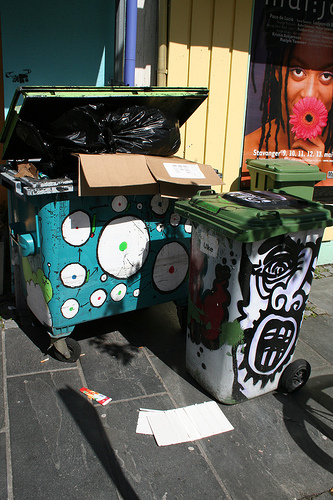
Les Petits Hommes Verts de Douglas Brodoff
Monday, March 31, 2008One of my favorite things about keeping a trash blog, as I like to mention here, is that it not only allows me to find and report on things that interest me, but for people to find me themselves and pass on interesting tidbits. This morning was one of those days. I woke up, checked my email and found a nice note from Douglas Brodoff, an American artist living in France whose ongoing series “Petits Hommes Verts” or “Little Green Men” honors the sanitation workers of Paris on canvas and in photographs.
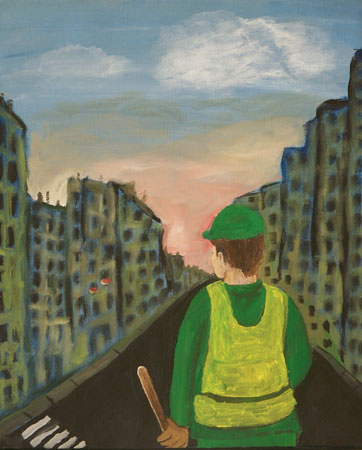
- Douglas Brodoff
Take a click through, I think you’ll enjoy what you see. Pictured here is Brodoff’s “Les ordures dorment jamais” or “Refuse Never Sleeps”. I love the pink light of Paris used in such a trashy context.
For more on Parisian trash, revisit old posts on the poubelle and its namesake.
Trash Survey to Help Theatre Group
Friday, March 7, 2008The Internet connections in Kampala have been terrible this week. Please excuse the infrequent postings. Below is an invitation to keep track of your trash on the 9th. I’ll be participating from Africa, hope you will too!
—
Leila,
I am artistic director of THE COMBUSTIBLES, a New York based physical theater company making original, ensemble-based work. We conduct explorations into the impulses of movement, the poetry of text, and the mysteries of objects. We strive to create green, less wasteful theatre, while launching thrilling and unexpected new works. The company’s current project is DETRITUS, a dark and comic tale about New York City’s trash.
The company has been reading your blog as a part of our research process of gathering source material and information on trash. I wanted to share with you what we are working on and to extend an invitation. As a part of our research we are conducting a day survey project on Friday March 7th. On this day all participants will join the company in keeping a record of their day, especially with regards to trash. Would you be interested in participating? Also, would you be willing to post something on everydaytrash announcing the project and as an open call for participants? Being able to reach the large and diverse community of readers of everydaytrash would be amazing for this project and for the company.
Please let me know if any of this interests you. I am excited about starting a dialogue with you
and would love to talk more with you about our company and find out more about your work.
Thanks,
Anne Sorce
http://www.thecombustibles.com
More info about DETRITUS:
Remember the 5 pounds of trash you neatly tied up and tossed into the can outside yesterday? What would you do if the contents came back to haunt you? In DETRITUS, five creatures from the underworld bring back to the surface what you thought you’d disposed of forever.
Inspired by New York’s trash, these grotesques and bouffons will keep you laughing, even as the terrifying facts about waste spill into your laps.
More info about the survey:
Responses to the survey will be a vital part of the creation of DETRITUS.
The instructions and form for the survey are included below.
Friday March 7th is the day. Please email surveys to info@thecombustibles.com.
For more information, please explore http://www.thecombustibles.com.
The aim of the day’s survey is to discover what happened to each
Observer on that particular day, especially in regards to waste. ABOVE AND BEYOND, we are interested in what waste you produced today. If you don’t do anything else, pay particular attention to this and report it.
What is required is primarily a factual statement; then an account of any feelings he/she had which seem sufficiently important or noteworthy for record.
1) State your name, address, age, sex, married or single, politics or
religion, if any, very briefly.
2) State your job or occupation during the day. (State whether it was
a normal day for you, or if abnormal, in what way.)
3) State your health on the day in question.
4) Describe briefly and factually the events of your day, giving
times; please make particular note of any material (solid, liquid or gas) that you disposed of, recycled, burned. However ordinary the events and objects may seem to you, they are of interest in this inquiry.
5) Keep your feelings out of 3-6. Then describe your feelings about any of the waste during the day, if possible, in a final selection.
The following suggestions may of assistance:
*Try to write down notes as frequently as possible. Do not interrupt
anything to do so.
*In all cases it should be stated when the observations were written
down, and when finally written up.
Trashtastic Tuesday with Frieso Boning
Saturday, March 1, 2008Tuesday comes early this week as I pack up for a wee hiatus. This week we check in Frieso Boning, the trashy mastermind behind The Winnipeg Trash Museum (first garblogged by Visible Trash).

everydaytrash: The Winnipeg Trash Museum has been described alternately as a grant proposal, art exhibit, dream, myth and reality. How would you describe what it is exactly?
Boning: The Winnipeg Trash museum is all of these things. Let me describe it exactly. It was first an idea. A simple little idea combining a love of the abused and used, the lost, the discarded and the abandoned with a love of THE MUSEUM – ( use any dictionary definition). The Winnipeg Trash Museum then became a grant proposal and failed as such on two different occasions, much to the consternation of many, including a financially strapped artist. With the moral and financial support of ACE ART, Winnipeg’s premiere artist run co-operative the work was finally realized as an art exhibit. The exhibition took about three years to develop and put together. It was exhibited from September 13 to October 13, 2007 at ACE ART in Winnipeg. So the dream of creating an exhibit about creating the Trash Museum Project was realized. But what about the museum? What about the dream? Well if I had a million dollars for every positive comment I had about the show and its content and meaning, we’d be breaking the ground for the museum tomorrow. The reality is that the Winnipeg Trash Museum has become, in many senses, mythical in its proportions. It now exists solely in the minds and hearts of all the people who attended the exhibit and the vision lives on in every bit of debris and piece of garbage that is noticed on a sidewalk, street or field, and then imagined upon.

everydaytrash: How did you first become interested in trash and what got you started on this project?
Boning: I have had a lifelong interest in trash and garbage and this interest has, throughout my career, found its way into my practice. Back in 1983 I constructed a series of sculptures made up entirely of garbage. The works were called “Animals of the City” and the works, when completed, were returned to the streets to be discovered and possibly recovered or simply not noticed. That’s one early example. Fast Forward. The Winnipeg Trash Museum‘s origin was inspired by two things that, when connected, became the project. The first inspirational element was my interest in the architectural competition for the design of our city’s proposed Museum of Human Rights and a strange desire I had to build my own museum. At about the same time, in the early spring of 2005, I began collecting little bits of garbage and debris that emerged from the melting snow. What broke things open was seeing the form a building in a collected pile of junk. I recognized it as a museum. A museum about Trash.

everydaytrash: While many artists who deal with issues of waste and consumption stick to the serious side of the subject matter, your work seems to employ a lot of satire. Is trash inherently funny?
Boning: Some people felt I had my “tongue firmly planted in my cheek”, and that I was primarily interested in sending up, not just environmentalism and serious museological practice, but also the proposed new museum of human rights. Some people thought of the idea as benignly quixotic and that I was just plain crazy. None of this is true. I knew from the start that this project was going to be a hard sell. So I employed an often subversive humorous and satirical stance to make my voice heard, to communicate the more sensitive and meaningful things that underlie the Trash Museum project. Trash is not inherently funny to me. I see it as a subject that can be examined in any number of ways: scientifically, sociologically, psychologically, historically, culturally and even poetically. I am most interested in the bathos and pathos of trash. You have only to take a long look at the “Children of the Landfill” or Ann Lawler’s “If Combs Could Speak” to understand.
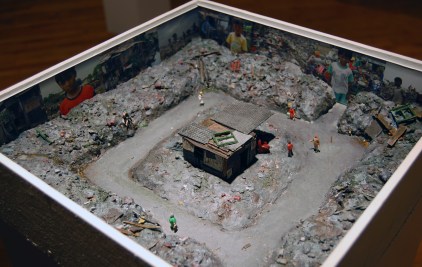
Photos generously provided by Boning
Weekly Compactor
Friday, February 29, 2008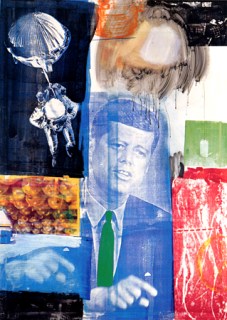
This week in trash news:
- Switzerland will take–and burn–180,000 tons of trash from ailing Naples;
- Catadores contribute to better recycling in Brazil;
- Rauschenberg sues a gallery for selling his trash as art; and
- Reese Witherspoon confesses to garbage neurosis.
Photo of a Rauschenberg via warhol.org
Trash in photos
Saturday, February 23, 2008Kimberly sent me this link yesterday to trash art on the New York Times Web site. Check out artist Chris Jordan’s work. He photographs massive and painstakingly organized quantities of stuff, like plastic cups, cell phones, Barbies or folder prison uniforms. At a glance the pictures look like abstract art, zooming in, they make a painful statement about consumption, like this image of 60,000 plastic bags.

Photo via http://www.chrisjordan.com
 everydaytrash