The fabulous Dr. Robin Nagle, Anthropologist in Residence for the Department of Sanitation of New York, is taking trashy questions over at City Room. I posted one about waste policies. Got burning quesitons of your own? Here’s your chance to ask an expert!
Dr. Robin Nagle
For more on the woman behind such a cool job title, check out the Trashtastic Tuesday Q&A she granted everydaytrash.com back in 2008.
Does your city have a store? Mine does. City Hall augments tax dollars and offsets the cost of renovating and upkeeping by selling New Yorkers city-related stuff. What kind of stuff? Well, for example, if you get married at City Hall, you can pick up flowers, travel tissues, bride and groom rubber duckies, etc. All the essentials, really.
City Hall wedding souvenir
I am deeply conflicted about private/public partnership in this town. On the one hand, we have a beautiful park in the center of Manhattan. You may have heard of it, it’s called Central Park. But the Parks Department can’t afford to keep it fresh-smelling and bum-free on tax dollars alone. That would be a problem if there weren’t so many rich people who love the park and are willing to put their own money into keeping it nice. So they do. And in return, the park has a board of directors called the Central Park Conservancy that oversees official park business. Perfect synergy. Except: the park is also a popular gathering spot. A few years ago, the U.S. wanted to start this never-ending war in Iraq and concerned citizens decided to gather in the park to say NO. Unfortunately, the place they wanted to gather was a grassy lawn recently replanted on the Conservancy’s dime. So the Conservancy said NO, which is kind of scary when you look at it as a private board telling the public they can’t have a public gathering in a public space. Now, this story is not new to most of you and has lots of nuances left out. But it’s an example of the kind of questions this shit raises. Enter Oscar.
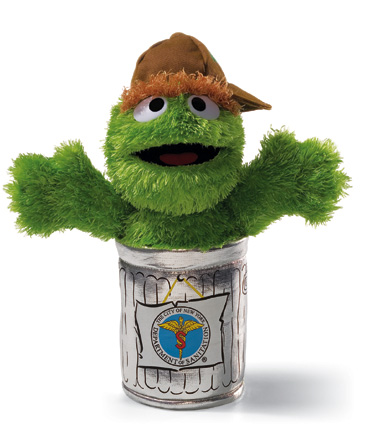
DSNY Oscar
The latest product launch at the City of New York Store is a series of stuffed Sesame Street characters dressed as employees of various city agencies. Oscar is a sanitation worker, of course. And the others seem to have been determined by fur color. Cookie Monster is NYPD blue. Elmo is a red fireman. And Big Bird Drives a yellow cab (which, as the daughter of a retired yellow cab driver I have to say is poor casting. Where the hell is that gritty muppet from the Caper?).
Don’t get me wrong, I know there’s a financial crisis going on and that if this were a Gund campaign to save the pandas, I’d be cooing. There is just something that rubs me the wrong way about all these products going on sale to raise money for city projects. Part of the concern is the commercialization. Sesame Street is one brand, Gund is another that’s two companies mixing with the brand of NYC. This new product line, however, comes at a time when the city is greatly expanding semicorporate ventures in the name of development. Gutting and reconstructing Coney Island, for example. There is something unfair about the sentiment that grit defines this city and removing it is wrong, I know. But there is also something sad about these corporate ventures. They feel to me like giving up, like quick fixes for what local government should be able to do on its own and like poorly thought-through plans that can lead to private interest trumping people’s interests. Like the people who live in Coney Island now.
Anyway, this is a subject I am inarticulate and confused about. What do you think? Is it a good thing that Snapple is the official drink of New York and that somewhere in America, there sits a Taco Bell chair in Women’s Studies? All I know is that I really want an Oscar the Grouch sanitation worker doll and that I really don’t want to want one.
In 2006, 896 million new cell phones were put on the global market. With such an incredibly high input, a good guess is that there is a lot of people using a second-hand cell phone out there, but also that a lot of old cell phones are gathering dust in drawers. What we know is that far too many end up as non recycled trash, or are “recycled” by people working for a tiny income under terrible conditions.
In a new report released today, the United Nations Environment Programme draw attention to electronic and electric waste, pointing out that official data is scarce and that metals in themselves are trashy not only post cell phone life, but that mining is indeed a wasteful business. Electronic and electric waste contains a lot of metal, such as aluminum, copper, palladium and gold.
The report is an intriguing technical guide on how to properly recycle electronic and electric waste, but it also provides estimates on how volumes of electronic and electric waste will increase in so-called developing countries over the coming years. In Uganda, for example, quantities will increase by a factor between 6 and 8 by 2020. Challenges are, as per usual, complex and correspondingly huge. There is need for legislation and policing of such legislation, but legal recycling can’t happen without proper smelting facilities and dismembering factories.
In a comment to the Guardian, Ruediger Kuehr, United Nations University, points out that with increasing demand follows a surge in illegal import of what the global North considers trash.
It’s definitely in the countries which have substantial increase in consumption – countries like China and India, which are still substantial targets for illegal imports of e-waste. The same applies for countries like Nigeria.
With the risk of being repetitive, the background problem is our collective obsession with consuming new products and a world more and more characterized by electronic consumer products, while insufficient attention is given to recycling and upcycling.
[This will be a total rewrite, but as I don’t live in the motherland at the moment, I have to rely on larger news outlets. Apologies.]
According to newspaper Svenska Dagbladet, municipal authorities have been getting 17 times as many complaint calls from citizens regarding uncollected garbage bags, following the decision by Stockholm refuse collectors we reported on earlier this month.
In short, a conflict between contractors and their employees has led to a situation in which the refuse collectors refuse to carry more than what is legal, in manners that are legal, as stipulated in the Occupational Safety and Health Act. Trash bags heavier than 33 pounds remain uncollected, as do any bags positioned in a facility behind piles of snow.
City officials are of course blaming the contractors, who seems to have failed to comment properly so far..
Remember the trash collector wildcat strike that broke out in Stockholm exactly one year ago? Yesterday, the labour court came to a decision on issues in the aftermath. In short, the court ruled in favour of the tra$h company who fired wildcat striking trash collectors who wouldn’t accept a monthly salary, instead of the piece wages traditionally paid in the industry.
The union organizing trash collectors have (in outrage) responded to this by announcing that they henceforth will abide strictly to the Occupational Safety and Health Act, which will be problematic to say the least. Union spokesperson Peder Murellissued the following statement to the Swedish Radio:
We will not haul trash bags heavier than 15 kilograms [33 pounds], we will not handle containers without wheels, we will not collect if snow hasn’t been shoveled away. I expect a lot of stuff will stay where it is.
As context, Stockholm has had its coldest January since 1987 and there is more snow than anyone can remember. To be continued.
Watching Majora Carter‘s TEDTalk on the way to work today reminded me why I’m such a big fan of this local environmental revolutionary. She articulates better than anyone what it’s like to live in the “away” other people never picture when they throw things away, the lasting legacy of Robert Moses and the impact his reign over New York City planning and expansion had on her neighborhood and how she has led a community effort to fight back and “green the ghetto.”
Last month, corporate parent Borders announced they will soon be closing 200 Waldenbooks book stores in communities nationwide. Current Waldenbooks employees have come forward to alert the public that the company plans to dispose of many unsold books in the cheapest, easiest, least responsible way possible – by trashing them.
Read more here. First H&M, now this. Clearly we aren’t doing a good enough job communicating the simple reality that throwing things away is never the cheaper solution. Not in the long run. Ideas on how to better message through the thick skulls of corporate America?
International trash transit seems to have run into some government bureaucracy this week, according to a piece in The Daily News. Apparently, trash shipments from Hawaii to Washington, over the Columbia River, have been suspended due to the need for an environmental assessment plan, including a 30-day public comment. Transports have up until now gone over road and rail, and with the change in transportation mode, regulations kick in. I.e., if you are a reader of everydaytrash.com and live in the area, you should be interested and here’s a golden opportunity.
While the imports of Hawaiian Waste Systems (based in Seattle) are on hold, trash that hoped to float along the North Pacific Ocean are stacking up in Honolulu docks. Several hundreds of tonnes of trash bales are posing a health threat, says Hawaiian officials. On the other hand, if one trusts a news piece from The Seattle Times written in June 2008, explaining the intended process, it seems as if the risk is minimal. In any case, the bales are likely to sit around for another two months or so, while the wheel of bureaucracy keep on turning.
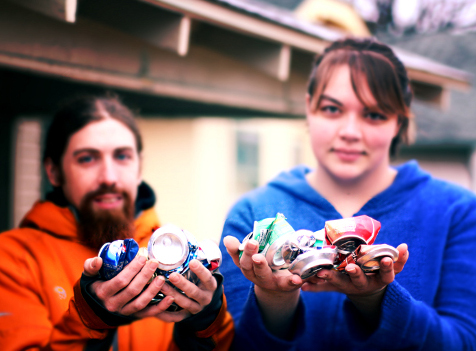
Pete and Andrea want to get married and they want a party. Nothing too fancy, just a potluck among friends, some home brew and a sword fight. They estimate they can pay for it all, and raise environmental awareness around their town, in 400,000 cans. They have named their project Wedding Cans and given it a website (via Chicagonow.com).
Commuters waiting for the bus have been tossing their trash on the sidewalk and lawn in front of Rosanna Gennarelli’s Bronx home — leaving her to face hundreds of dollars of littering summonses…more
In honor of Buy Nothing Day, here’s a little tale from Andy “Cotton” Sarjahani, whom you may remember from his work on food waste. Sarjahani told me recently that he had met an eccentric drifter who saw dumpster diving as an essential part of his life philosophy. I asked if he’d be willing to write up the encounter for everydaytrash.com and he was kind enough to do so. Enjoy.
Bo Knows Dumpster Diving
A few weeks ago, while filling up my ’97 Toyota Corolla (Marilyn – after “Marilyn Whirlwind” on Northern Exposure), I noticed a fellow holding up a sign saying that he was hungry and needed food. I was pretty hungry myself and since I do sustainable food systems/food justice work, I asked him if he wanted to go get some food with me. He said his name was Bo (Beau?) and that he came up to Montana (where I live) from Oklahoma, in search of “true freedom”. The quest for our “true liberty” seems to be a recurring theme here in Big Sky Country and will also be in this piece. Bo was definitely keen on food, but insisted on Burger King. He stated that the food there was the only thing he liked. True freedom. After an 87 second pontification on the numerous things wrong with patronizing the home of the Whopper, we finally ended up at the deli of the local food co-op. We grubbed on beet and kale slaw, maple mustard pastured chicken, and Peruvian purple fingerling ‘taters. Bo had an interesting story to tell indeed. He is 47, but could have passed for 67 (likely due to the multitude of intense experiences that have bombarded his life). He even had a dog named “Freedom” for eleven years that has seen the whole country. Bo spoke of how cruel the world is, his disdain for “the button-pushers” of society, his days train-hopping, and many other random anecdotal pieces of information.
After Bo and I finished our meals, we bought him some groceries (he was confused that the co-op didn’t carry bologna, hot dogs, and Ho-Ho’s) and then drove out to the Gallatin National Forest to drop him off to head out to his camp site. Bo smoked a bit of marijuana then continued to go off on society’s “button-pushers” and how “weak and insufficient” they are, and how they didn’t know what “true freedom” was. I asked Bo if he saw the irony in this critique of society – I asked him if he felt like he was ever at the mercy of society for his survival. He said no. I asked him if he knew how to hunt and fish and clean/process his own animals. He said yes but he did not do so. I asked him what he did to survive. His answer? Dumpster diving. Bo feels at liberty because he dumpster dives. He then explained to me that he feels comfortable taking money given to him during panhandling sessions and taking it to spend on liquor and drugs. He feels that if you give someone money, it’s theirs to do whatever they want with it and the giver should just accept that. He feels that he can survive off of dumpster diving and use the money given him for self-medication. Here’s what’s pertinent to readers of this blog and what would be interesting to hear feedback on – Bo kept coming back to dumpster diving as his rationale for a couple of his unique philosophies – justification in taking money and using it for self-medication and the safety net for “true freedom” is dumpster diving.
Bo decided that he wanted me to drop him off at the liquor store because he didn’t want me to know where he camped (for fear I might steal his things). When I dropped him off at the liquor store, he gave me a couple of hugs and said goodbye. He was on his way back to true freedom…



 everydaytrash