Check out this infographic from GOOD (thanks for the tip, Lauren!).

inforgraphic
The Indian government estimates that 15% of the nation’s food grains are served and “wasted” at lavish wedding ceremonies. In an attempt to regulate that waste and keep up with a growing economy, India is looking to ban or restrict lavish weddings.
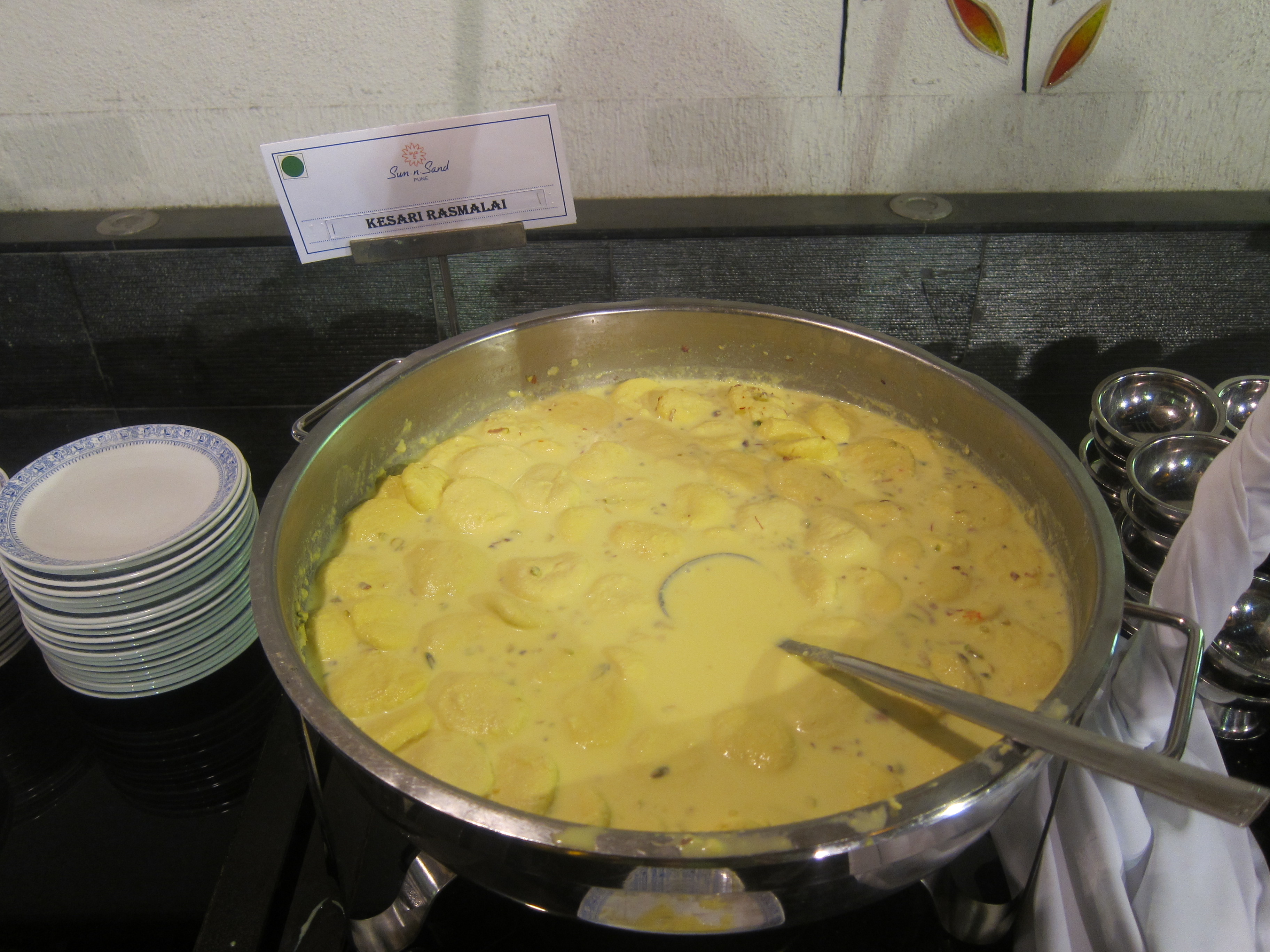
Saffron pudding, the only photo of food I took at the not-so-lavish Indian wedding I attended in December.
As care2 puts it:
But the government shouldn’t just try to control how people organize events, they also need to be responsible for how they distribute food, and it’s entirely possible that those networks are corrupt and inefficient. So perhaps they can do both – encourage people to cut down on lavish spending, but also improve their own internal channels for bringing food to the poor.
via Wasted Food
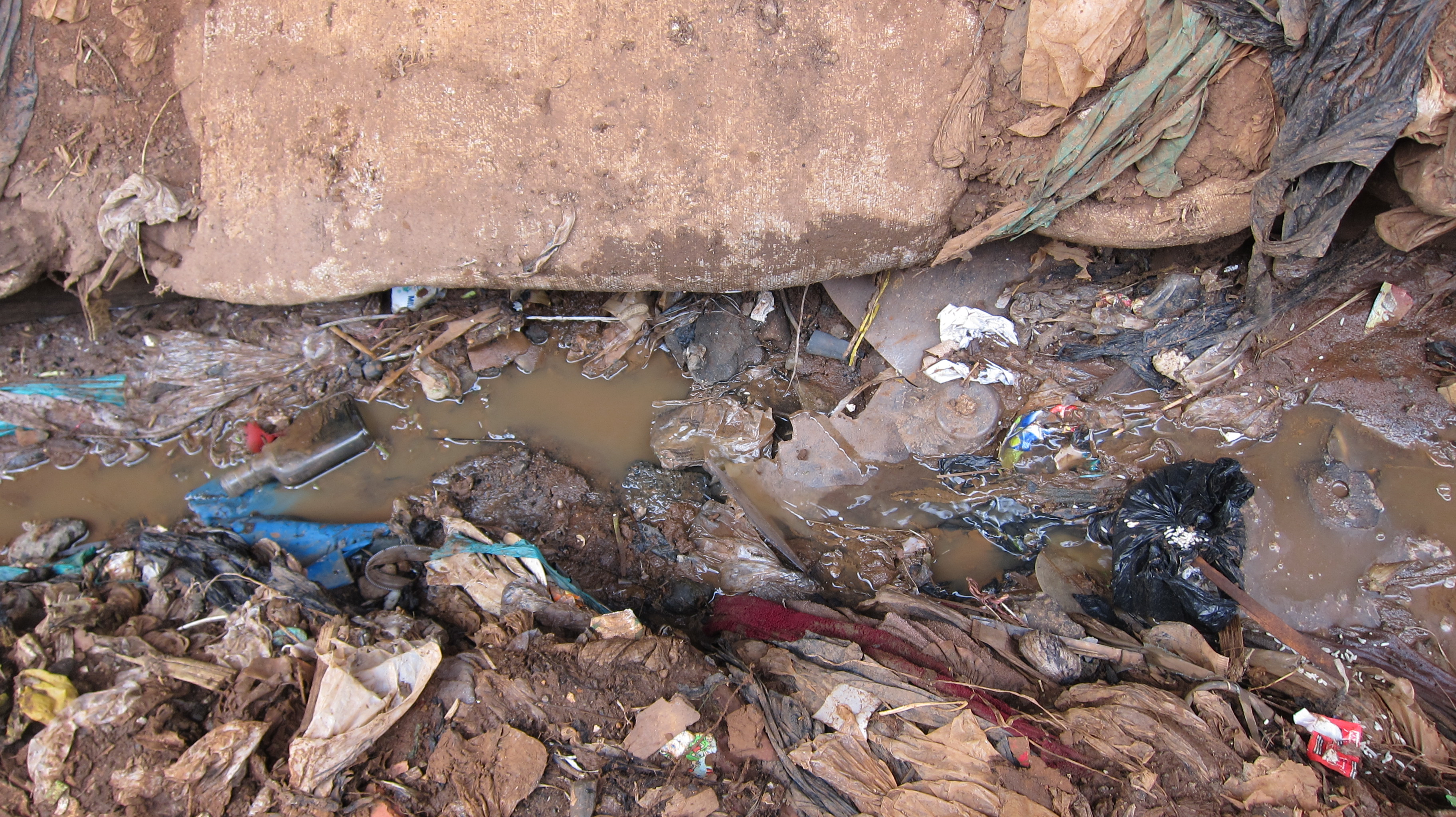
While traveling in Kenya last week for work, I had the rare fortune to visit with Carolina for Kibera, a youth-driven urban poverty nonprofit and home to Taka ni Pato aka the Trash is Cash project (featured in a recent post). Here are some photos from my walk through Kibera, East Africa’s largest slum. The population is a topic of much dispute and debate. To average the estimates, let’s say half a million people crammed into an area the size of Manhattan’s Central Park.

Kids
These kids aren’t part of the Trash is Cash project, they’re just some little ones I passed on the main road cutting through the slum. A colleague who works in Kibera advised against taking photos of people, especially kids because there is some resentment on the part of locals who think too many photographers come in, photograph their children and profit off the images. If I wasn’t careful with my camera, he said, people might hurl stones at us. I don’t know how true this is, but for the most part heeded the warning.
Gutter

Side street

Tracks
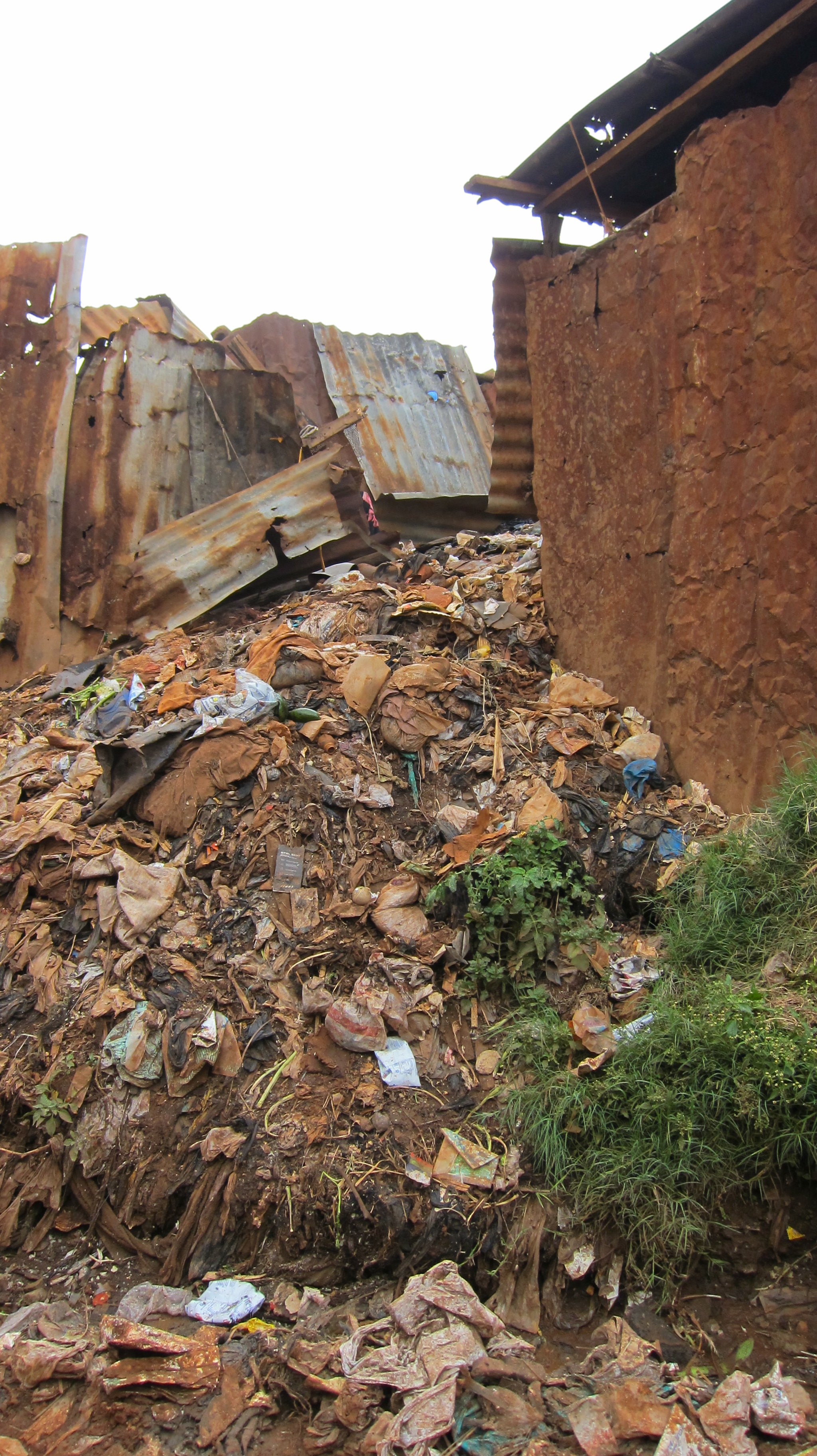
Layers of trash
As you can see, trash is such a part of the landscape it is indistinguishable from the ground. At times it was impossible to tell if we were walking on mud or plastic. Trash is Cash teaches youth from Kibera how to sort reusable material, collect it form their neighbors and wash and shred plastic to sell to Kenyan recycling companies. They started out just collecting plastic but soon discovered they could quadruple profits by cleaning and shredding. I didn’t have a chance to see any of this in action on this trip, but hope to get a trash-specific tour on my next visit to Nairobi. Here’s a blog post with a bit more info on the project.
And for anyone who missed it, here again is the Trash is Cash music video featuring Kenyan artists. I am truly humbled and inspired by these kids.
Apologies for the light posting of late, I’ve been traveling with shitty internet access.
xo
Leila
P.S. This is everydaytrash.com’s 1000th post. Thank you all for sticking with me, especially those of you who send me tips and most especially my partner in trash, Victor. Here’s a link to the very first post published on August 27th, 2006.
Jennifer Beals, star of (Flashdance, The L Word and) a new show called The Chicago Code, wants the real life city of Chicago to start recycling. CLARIFICATION THANKS TO COMMENTER BELOW: CHICAGO RECYCLES, BEALS’ COMMENT IS ABOUT THE ART INSTITUTE IN PARTICULAR, WHICH SHE THINKS SHOULD LET HER BRING HER OWN WATER BOTTLE.
And, for no trash-related reason, the best dance scene from Flashdance (if you think it’s the flying somersault, you are wrong)!
Thanks, Jasmine, for sharing a link to this amazing video made by Zuh-d and Wafalme & Makia, a group of kids from the slums of Nairobi.
Check the remix here. According to the caption on YouTube, they won a Positive Climate award from MTV for this video. Not surprising given the catchy and uplifting chourus: “No more Pollution (trash is cash!)/This my solution (trash is cash!)”
Side note: In two weeks I’ll be touring Kabira slum with another amazing group of slum kids. The trip is day-job focused, but I predict some urban trash stories and photos will be popping up here. Stay tuned.
My friend Oriana, whose name you may recognize as a frequently-thanked tipster, has an amazing new blog project of her own called Brooklyn Spaces documenting creative use of space in our fine borough and interviewing the masterminds behind each project. The latest entry on the community garden and guerrilla gardening group Trees Not Trash will be of particular interest to readers of this blog.

Photo by Maximus Comissar (ripped from Brooklyn Spaces)
Members set up planters made from used tires and other recycled material around the Bushwick neighborhood, built a community garden out of a previously garbage-filled lot and have requested and helped to plant thousands of trees throughout the area. Also, they have a cute tagline: “Putting the bush back in Bushwick.” Check it out Oriana’s interview with co-founder Kate here.

Haitian trash sculpture
Follow this link. Follow this link. Incredible trash art from sculptures in Haiti. Click on each artist’s name to view the work. And/or check out this badass documentary.
Thanks for the tip, Charles!
Hello from Mumbai! Apologies in advance if posts this week and next are a bit stripped down and sans images, I’m traveling over the holiday season with limited internet connection. Vacation from the day job, however, does not mean a slow down in the influx of trash tips. Today’s came from Brooklyn Based, a local email newsletter I subscribe to (and which you should sign up for if you, too, live in Brooklyn). The update for today, entitled Green Vinyl, can be found online and read in full here. It features Brooklyn Phono, a local record making company that has started to offer recycled vinyl as an option for bands and labels interested in pressing a record. Check out a video of the process here.
I’m hoping my band can opt for green vinyl when we make our first 7″ this Spring. Our studio, Clean and Humble Recordings, is also located in Sunset Park, so I can’t think of a more local choice.
Speaking of the studio and recycling records, does anyone have any ideas for reusing 78’s made of shellac? My bandmate, Flex Unger, the owner/operator of Clean and Humble, recently inherited 7 crates of crap records and is taking ideas for what to do with the raw materials. You may recall from past posts that Flex is big into DIY recording and musical recycling, e.g. sampling old records to mix new beats and salvaging old instruments to build new ones.
Post ideas for upcycling 78’s in the comments, please.
Does it count as idea theft if the rip off is for an environmental PSA? This interesting post by Michael Tully for Hammer to Nail asks this very question. Case in point: Rahmin Bahrani‘s Plastic Bag as jacked by The Magestic Plastic Bag, A Mocumentary. The original is narrated by Werner Herzog, the knock off by Jeremy Irons. No contest. And while imitation is the sincerest form of flattery, this particular imitation has been selected to play at Sundance.
 For the second year in a row, everydaytrash.com is participating in the Green Books Campaign, an effort to promote sustainable reading organized by Eco-Libris. And we’re not alone, 200 green blogs are publishing reviews of green books at 1pm today (or, as in this case, thereabouts). Find out more here.
From the long list of environmentally-themed books donated by publishers for the purposes of this e-happening, I chose to review Less is More, edited by Cecile Andrews and Wanda Urbanska and put out by New Society Publishers. The book carries the subtitle “Embracing simplicity for a healthy planet, a caring economy and lasting happiness” and treats the complexity of simplicity in three sections by way of essays written by a number of journalists, academics and bloggers.
I should preface this review by saying that while this book was not for me, some other green bloggers seem to have loved it. After reading this post I encourage you to check out this glowing review on Sustainablog.
Part one of Less is More includes essays defining simplicity, part two offers solutions and part three addresses policies. An afterward follows, suggesting that readers use this book to get conversation flowing in “Simplicity Talking Circles.”
“Simplicity,” the editors state in their introduction, “is a response to the crisis of our planet.” Fair enough. They then explain that the concept of simplicity can, in fact, be complicated. Still with you there. Next, they go on to present (count them) 10 essays defining simple living. And that’s where they lost me. A bunch of people cited Thoreau. A few veered down a spiritual path.* A chapter would end and then, all over again, a new dry voice would make the same case for simpler living in a style too abstract to connect to a general audience and not foot noted enough for an academic one. With each turn of the page, I found myself wishing that Malcolm Gladwell, Oliver Sacks or Jonah Leher had had a crack at the topic (in all fairness, this is a wish for all nonfiction ever).
I’m not trying to be a hater, really, I’m not. Generally speaking I love philosophy and applaud attempts to connect issues of waste and consumption to broader frameworks. But the only thing I could focus on during part one of Less is More is that the editors (yes, I think we have to go there) should have kept the title closer in hand.
Ok. The snarky part is over. On to the positive: Part two. “Solutions,” came as a welcome breath of tangible after all those unwieldy and somewhat sappy definitions of simplicity. Should you pick up Less is More, I recommend jumping right to the middle of the book. Here is where real people share stories with story arc, scenes and tangible examples that link everyday life to our lofty ideals. In particular, I recommend Alan AtKisson’s essay “The Lagom Solution” describing how, upon moving to Sweden at age 40, he discovered the concept of lagom which in Swedish means “just enough” (not too much, not too little).
Part three is called policies. As with first section, I think the third would have been stronger written as a single chapter citing the six authors who contribute essays. The content covered in each did not feel distinct enough to warrant another essay with a beginning, middle and conclusion.
Late in Less is More, another contributor cites editor Cecile Andrews’ book The Circle of Simplicity in which she hearkens back in American history to point out that a lot of women’s rights advancements were first discussed among circles gathered in people’s homes. At the close this book, Andrews offers some tips on how to create a circle of one’s own to keep the conversation flowing. Sounds like a cool idea to me and I’m glad to see a book that sets out discussing high brow thought culminate with action points. I just wish the path from one to the other had been less segmented.
*As a side note, I think there is enough content spread across a couple of the chapters that if woven together, would make for a compelling article on simplicity in faith traditions.
The New York Times book review’s 2010 pick for best illustrated children’s book is Here Comes the Garbage Barge! by Jonah Winter, illustrated by Red Nose Studio and published by Schwartz & Wade Books.
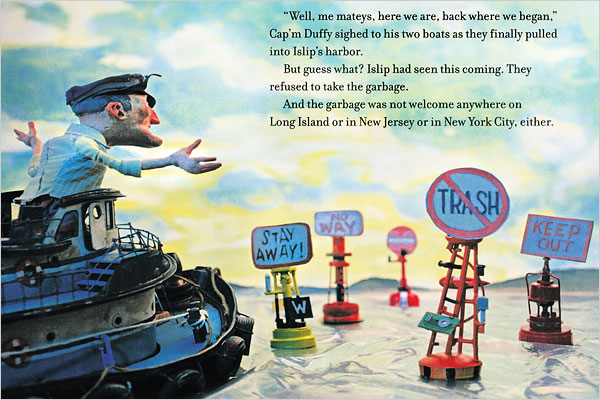
Here Comes the Garbage Barge!
The Times’ 2010 holiday gift guide slide show text efficiently sums the book up as “The story of a barge carrying 3,168 tons of garbage that couldn’t find a home — and how its ill-fated journey helped usher in the recycling era.” Can’t wait to read it. Here’s a link to the longer review with more on that true story, which we’ve mentioned here before.
via the ever-fabulous Ruby Re-Usable
It’s been an unseasonably warm fall in New York, which was perfect last Saturday for a tour of Newtown Creek—the industrial waterway that serves as part of the border between Brooklyn and Queens—with photographer (and Brooklyn native) Anthony Hamboussi who recently published a gorgeous book of photos also called Newtown Creek.
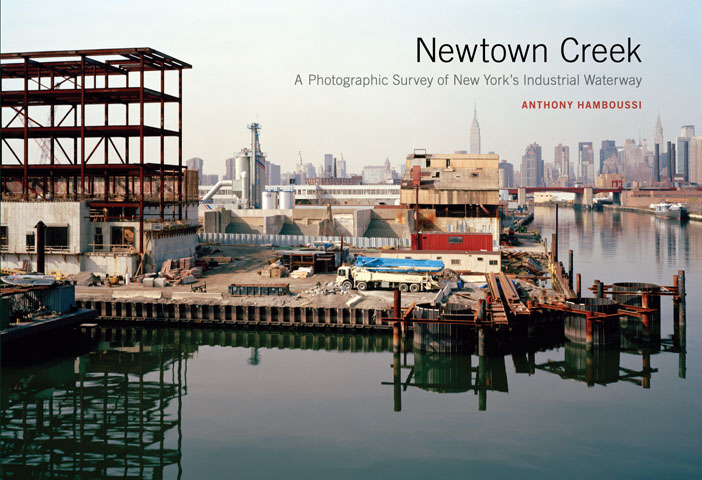
Newtown Creek the book
Tony was nice enough to revisit a lot of the vantage spots he frequented to create the book. We spent around five hours exploring different views of the creek and comparing the sites as they are now to some of the images preserved in his book. It was especially cool to see the huge shiny silver wastewater treatment plant “digester eggs” up close and in person and then flip backwards through the book to recall various points of their construction. If you have no idea what I’m talking about, I encourage you to visit the space between Brooklyn and Queens to see these massive metal eggs that separate sewage from water.
For me, a highlight was getting to see a barge up close. They’re huge!
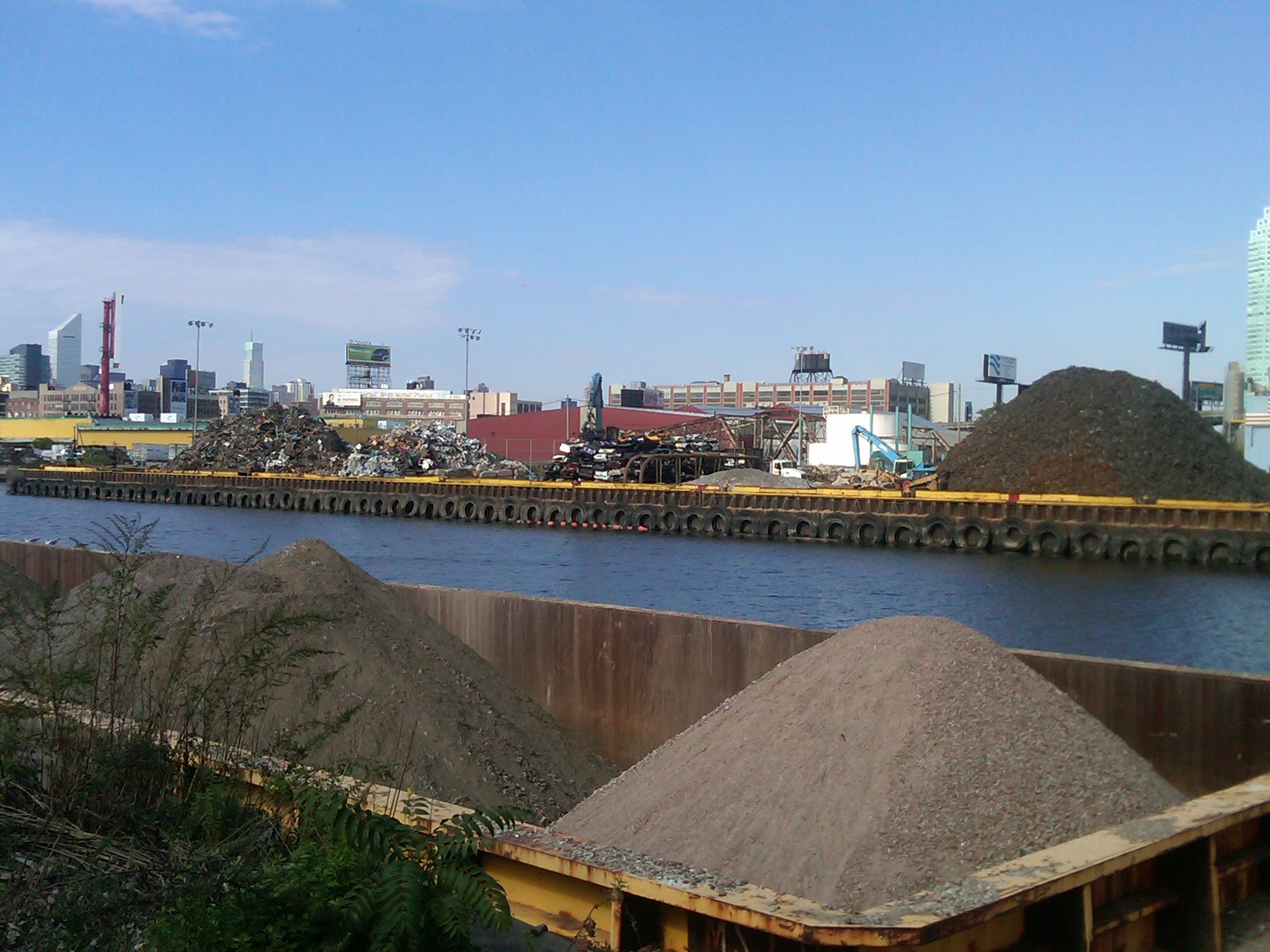
Barge!
We also stopped to peep local graffiti art, like this metal welded piece by the legendary “Revs.” I love how this piece is structured so that the sun itself becomes the tag.

Fuckin Revs
In addition to the predictably industrial bits, we saw some naturally beautiful hidden bits of beach.
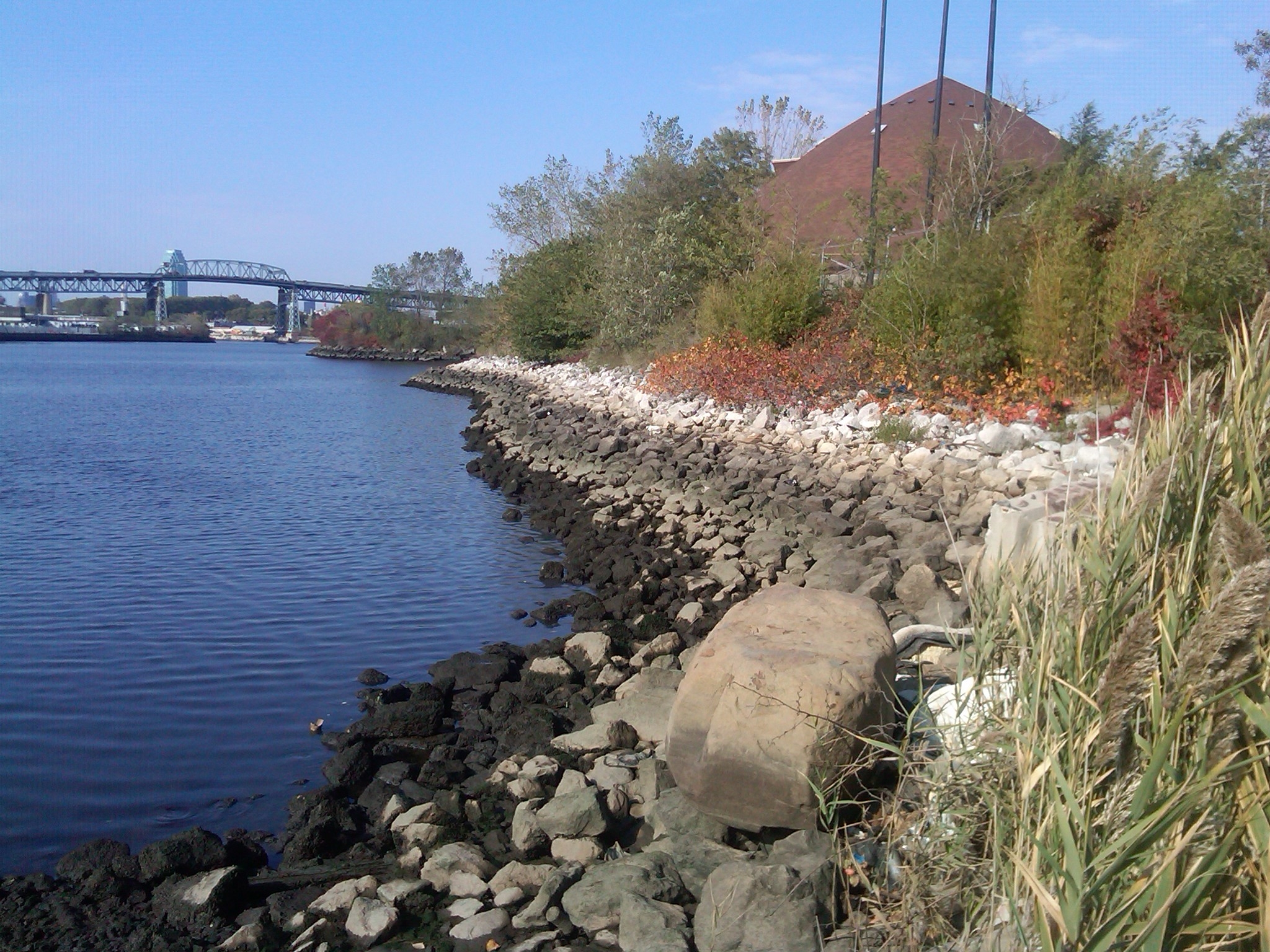
Pretty beach
And stumbled upon art in unexpected places.

Sculptures
All in all, it was a great day. I lost count of how many times we crossed from Brooklyn to Queens or Queens to Brooklyn. It was a lovely interborough adventure. I recommend checking it out for yourself. And whether or not you make the trek in person, I recommend checking out Newtown Creek the book. My five hour tour pales in comparison to the five years Tony spent photographing these in-between and unused spaces. His next project is a study of “La petite ceinture,” the abandoned railway tracks that encircle Paris like “a little belt.” Now THERE’s a tour I’d like to take!
Thanks again, Tony!
Happy Tuesday, trashies. The following is a free excerpt from British journalist Nick Rosen‘s book Off the Grid: Inside the Movement for More Space, Less Government, and True Independence in Modern America, published by Penguin USA this past August. The author has kindly shared this waste-related passage just for us. More on the book and larger “off-grid” movement here.
Or, if you hate reading, you can watch this handy book intro video.
—
From Chapter 3
I should apologize to the reader for returning to the issue raised so eloquently by Bob Reynolds in his letter to the mayor: toilets. It’s a big subject when you are off the grid—possibly the biggest. Everyone who lives off the grid has lost count of the number of times they are asked in a coy, slightly amused way, “So what do you do about, you know, going to the bathroom?” And now the entire drama unfolding on No Name Key has come down to toilets and the acceptability of the forty-two septic tanks and one composting toilet currently dealing with the human waste from the forty-three mainly part-time small family dwellings on the island with its aging population of retirees and second-home owners.
There are just four alternatives that would satisfy the new federal rules designed to prevent the leaching of chemicals and other noxious materials into the soil of No Name Key and then into the water table. Sticking with the status quo is not one of them.
The first is to build a full-scale commercial sewage system to service the forty-three homes. It would require a grid-scale power supply, and once installed it would be able to service a near-infinite increase in the amount of human waste in the small community.
The second option is known as a “thin-pipe” sewage system. It would be operated by electric pumps situated on or under the Bebe Rebozo bridge, but powered from the mainland. The third is the alternative favored by Alicia: a modified version of the septic tank that would meet the new standards. The fourth and final alternative is the composting toilet. This is a well-understood technology that, if correctly managed, produces a harmless material, very similar to rich soil, and can be used to grow organic vegetables. The solar-power faction had tentatively proposed a composter at one point, but had been howled down by the other side.
The one functioning composting toilet on the island is built by Clivus Multrum, a market leader in composting toilets. Although the owner, a postal worker, was out of town when I visited the island, Jim Newton took me to the home because he wanted to show me the huge object, conveniently stored under the raised first floor of the house, which like many on the island rested on stilts in order to reduce potential damage in case of fl oods. This design creates a covered area under the house—a basement at ground level, so to speak. As I walked around to the basement entrance, I passed a huge array of solar panels perched on a wooden pedestal, and a set of four Rolls batteries—the Rolls-Royce of solar batteries. They are known to have a far longer life and to be three times as heavy and four times as expensive as normal deep-cycle batteries. Next to the batteries, a white tank holds the gray water from the house. Gray water is the term for water from sinks, showers, dishwashers, and the like. Once used for washing, it can be used to fl ush a toilet or water a garden.
While most composting toilets are simple, functional, and inexpensive, the Clivus Multrum is the Hummer of composting toilets, a vast and intricate object. The unit in the bathroom is a normal toilet bowl, and a basement of some sort is required because a long, wide pipe travels down from the toilet to an ugly, green-ribbed plastic container. This container stands as tall as a man and takes up fi fteen to twenty square feet of fl oor space, with several doors for different functions. One is used to put in worms; another is used to remove the compost once it has transformed into an earthlike substance. The process can take many months. This is the reason for the large size of the contraption.
“The effluent drops down through this tube”—my escort indicated the green tube entering the composter—“from the potty upstairs.” Jim walked ahead of me toward the silent, brooding object. Once I had raised my video camera, he turned to me gravely and said, “Are you ready? This is not going to be a pretty sight.” He gripped the handle of the smallest door. “Are you ready for this?” he asked again. I nodded. “Now, I’ll lift the lid, but I won’t hold it open for a long time,” he said. The cover came back and hundreds of cockroaches ran for the darkness across a black, tarlike substance that was, presumably, the effl uent. I instinctively looked away, and by the time my eyes returned a second later, Jim had slammed shut the door. How the cockroaches had got there I cannot imagine, as the whole system is sealed. Could it have been via the toilet bowl upstairs?
One other pipe, a narrower one painted white, exited the composter, snaking its way around the basement before disappearing up into the house. I asked what this was for. “It’s an air vent,” Jim told me. “It allows gases to escape, all the way up to the roof. In any system—my own septic tank—gases are produced.”
Jim’s whole body sagged at the thought of the gases being produced. “So instead of letting them out around your home on the ground level, the gases are transported through the pipe to the very uppermost area so they can escape into the atmosphere.”
“What if the wind is blowing the wrong way?” I asked.
“Yup,” he said, looking grim.
By then I had met at least ten of the leading actors in this drama, and although I doubted the sincerity of some of the witnesses, I was still unsure about the detailed rights and wrongs of the matter.
But I knew where to go for an answer…..
—
For more background, here’s a Salon interview with Rosen and a HuffPo piece he wrote.
 everydaytrash