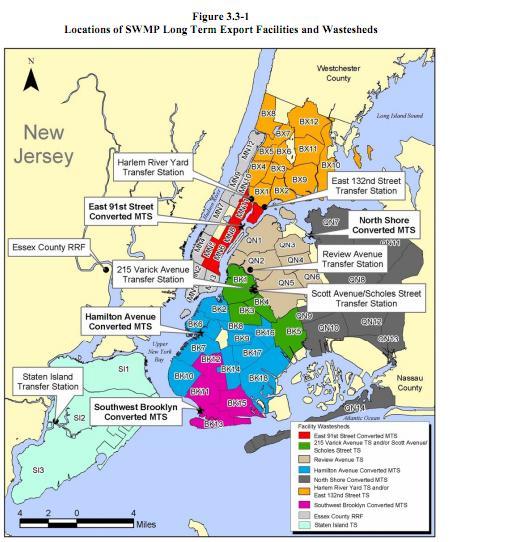
After reading this article, I dug up my city’s solid waste management plan a.k.a. SWaMP to reread this chapter and refer to the map below. More to come. Consider this a heads up, trashies. I may wonk out on you for a post or few.
Marine transfer stations
Wednesday, July 27, 2011The World is Full of Garbage
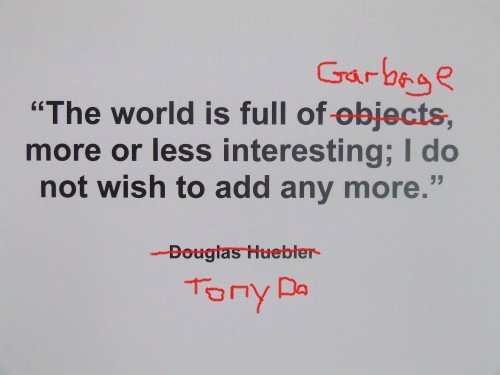
Tuesday, July 26, 2011I met artist Tony Do at a picnic this weekend where we discussed, at length, crunchy rice dishes from our respective cultures (yum and yum) and, briefly, garbage and art (though never garbage art). It wasn’t until emailing after the fact that I discovered Tony himself is a trash artist, as evidenced by this conceptual upcycling of Douglas Huebler‘s famous piece.
Here’s what Tony has to say for himself:
The first generation of conceptual artists like Huebler attempted to de-materialize the art object by displacing it into language. One of the most important consequences of this form of production was the disruption of the process of exchange by which art becomes a commodity, and therefore the process through which art constitutes cultural hegemony. However, for various reasons the displacement of objecthood could not be sustained, resulting in the reintegration of materiality and the transformation of conceptual art into “post conceptual” art. This is where we are today. My intervention into Huebler’s seminal piece is a critique of his desire for pure objectivity (I argue that his displacement of the object is made possible through the sacrifice of subjectivity), and at the same time is a recuperation of his critical method. Through a gesture that is basically a form of recycling, my version becomes a critique of all forms of garbage–both material and conceptual art and as well as non art.
The Edo Approach
Monday, July 25, 2011Japan during the Edo period (1603-1868) faced many of the same energy and environmental resource problems that the Western world faces today—namely shit running out fast.
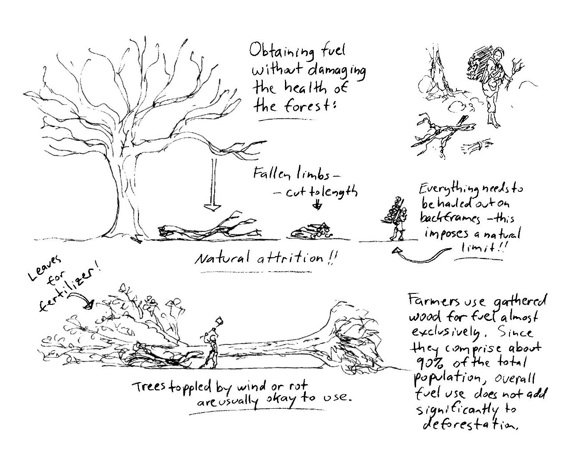
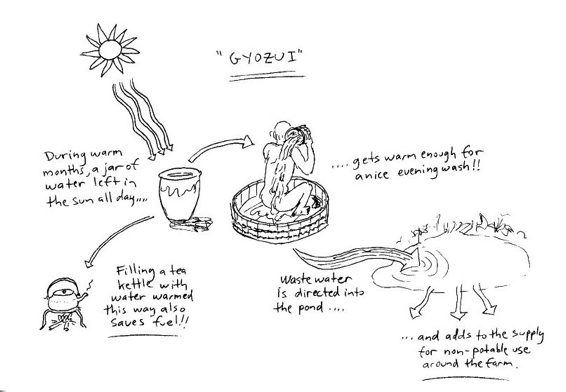
I bring this up because a friend recently lent me an interesting book on the topic, Azby Brown‘s Just Enough: Lessons in Green Living from Traditional Japan. Using emblematic stories (“They are not fables. They are depictions of vanished ways of life told from the point of view of a contemporary observer, based on extensive research and presented as narrative), Brown lays out the life of the farmer, carpenter and samurai illustrated with hand-sketched diagrams of the design and tools employed by each to live as efficiently as possible.
Each of the book’s three parts begins with a description of a particular category of citizen’s life during the period in question followed by these whimsically mapped out drawings, which in turn precede short bulleted chapters on what lessons we modern folk can extract, update and apply to our present day communities. Suggestions range from plant a garden to my personal favorite: “Build homes that are inspirational.”
It’s an entertaining approach to the potentially dry topic of conservation, with the soothing message just enough repeated throughout. Garbage per se comes up infrequently because the Edo days produced little waste and found new uses for byproducts. The best illustration in the book is a centerfold spread of rice production, mapping how every part of the crop is named and used including hulls upcycled into “footwear, hats, aprons, mats, bags, rope, brush and many others!!” (Exclamation points are ok if handwritten next to little pictures of rice stalks.)
For those more digital than literary, Brown taped a talk on the Edo approach at TEDxTokyo. Interestingly, it’s pretty dull. The spirit of the book is hearkening back to a simpler time, which somehow doesn’t translate well to PowerPoint. So, if you’re interested, I recommend you get your hands, literally, on a hardcover copy and flip through the pictures.
Raccoon attacks
Friday, July 22, 2011Oh the hazards of composting. The raccoons are out in Richmond, Canada, attacking people and their pets. Especially the pets. The Vancouver Sun reports:
One theory is the recent advent of the city’s Green Can program, which encourages residents to recycle food scraps — a common source of food for raccoons.
Some believe the scraps are more accessible in the new Green Cans and more odorous than they were previously in regular garbage cans, providing a greater attraction for the raccoons.
Once when I was a kid there were rumors of a rabid raccoon in our neighborhood. My mother tried to keep us from going out on our own and walked around everywhere with a softball bat. More recently, I was walking home in Brooklyn one night and saw a raccoon run down the steps into a Subway station. A train must have just arrived because it came running out a few seconds later, scared off by the small crowd of exiting passengers. I’d hate to be alone on the platform if it ever tried again!
I often wish my city collected food waste for composting. Today is not one of those times.
No more bank envelopes
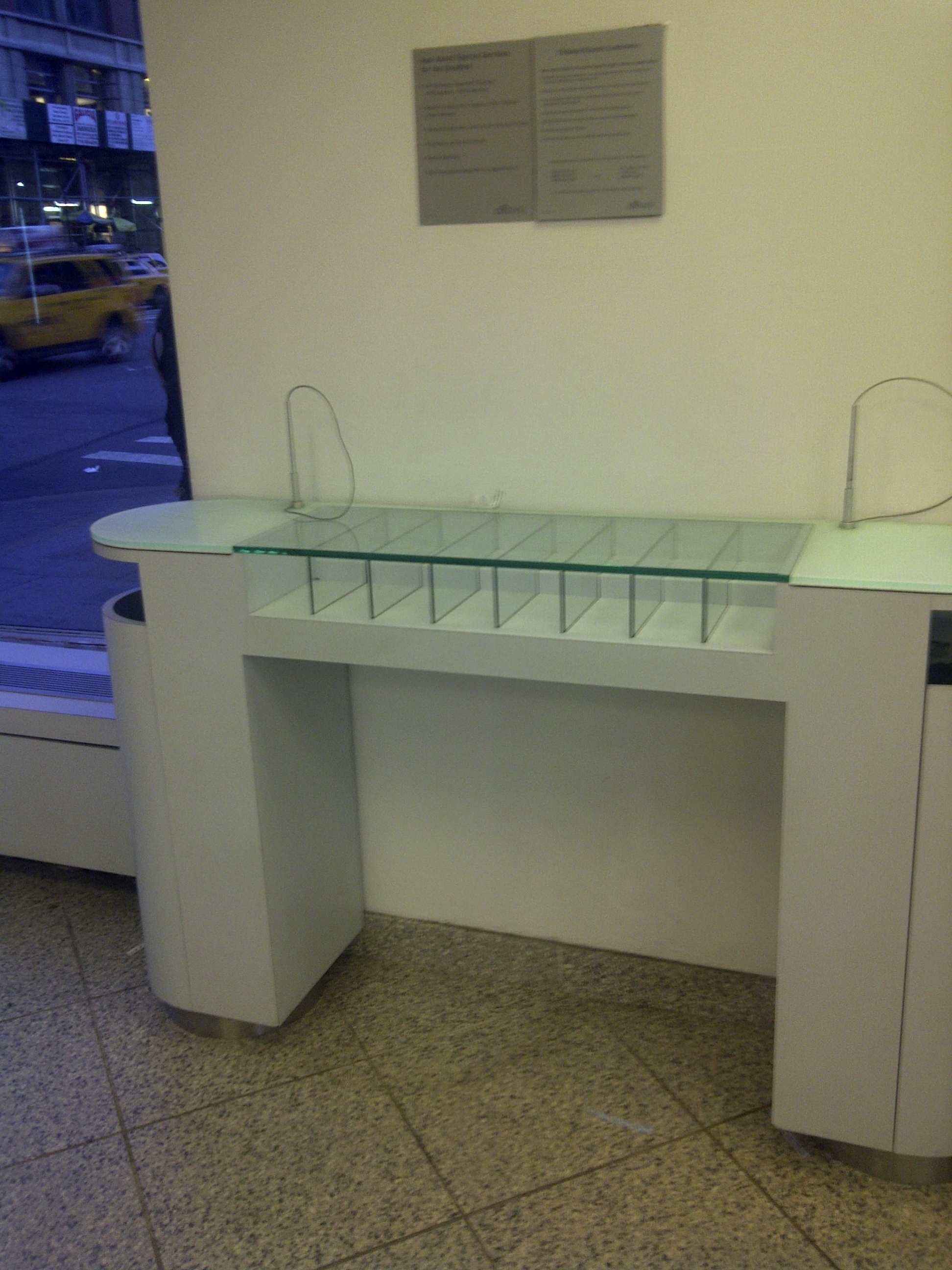
Wednesday, July 6, 2011Last night I stopped by the bank to deposit some checks and was surprised to find all the paper slip slots empty.
Turns out Citibank now lets you stick checks directly into ATM machines without the wasteful and outdated ritual of filling out a deposit slip, adding up the total and sealing them in envelopes. And there you have it, the last bit of math my life required I do all by myself, done.
Consignment shop of the future
Wednesday, June 22, 2011Why buy new baby clothes when you can subscribe?
via The Next Web
Eco Art in Ohio
Friday, June 17, 2011The upcyclers of Marion, Ohio, turned out for a local eco-art competition this week. Check out the winners.
Bottlehead puppets
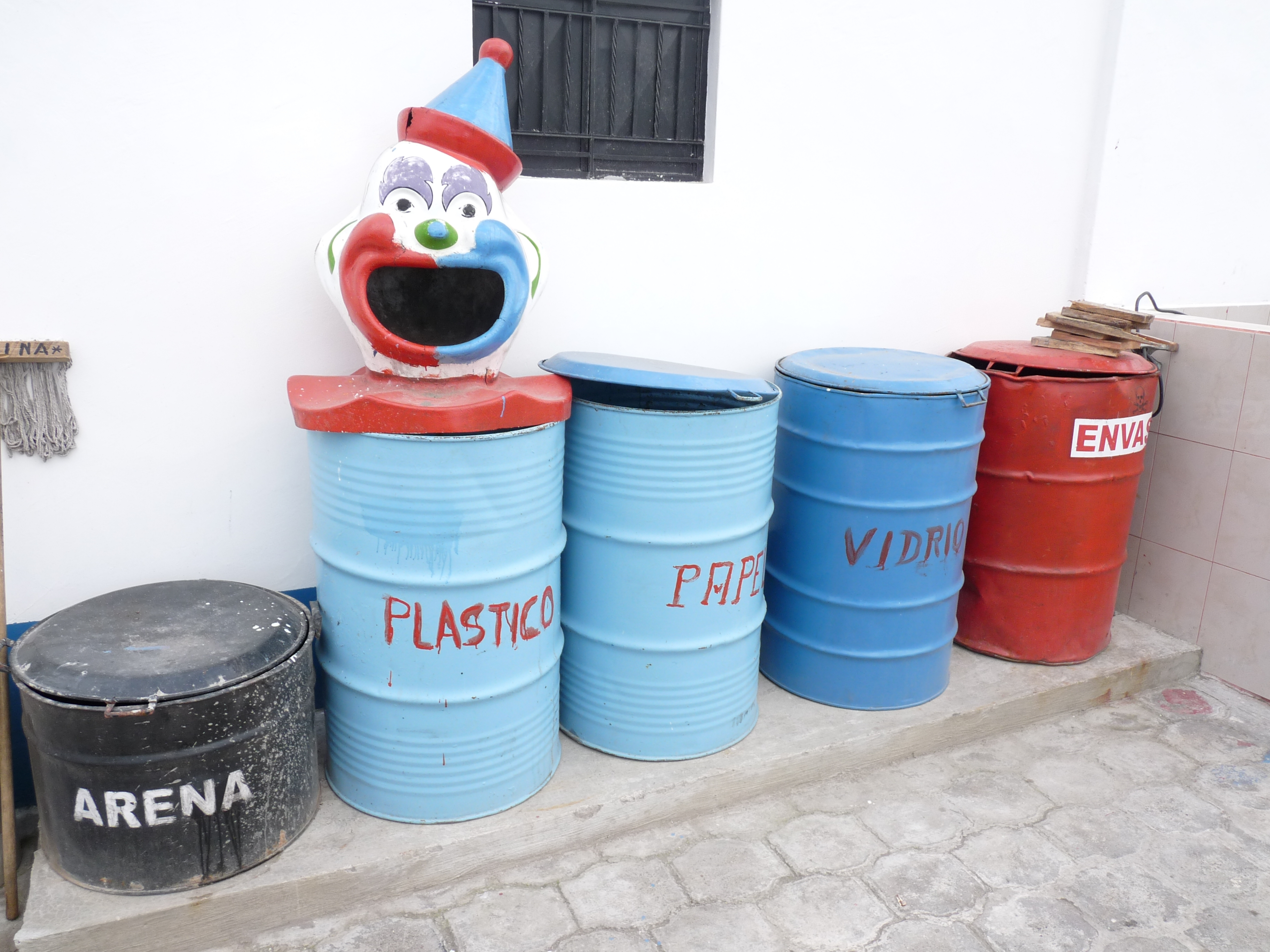
Saturday, June 11, 2011If you are on Facebook and haven’t yet, consider fanning the everydaytrash.com page. You’ll find all kinds of fun bonus material there, like this photo album of sinister Ecuadorian trash cans and the back story on why they’re all shaped like scary clowns and other characters.
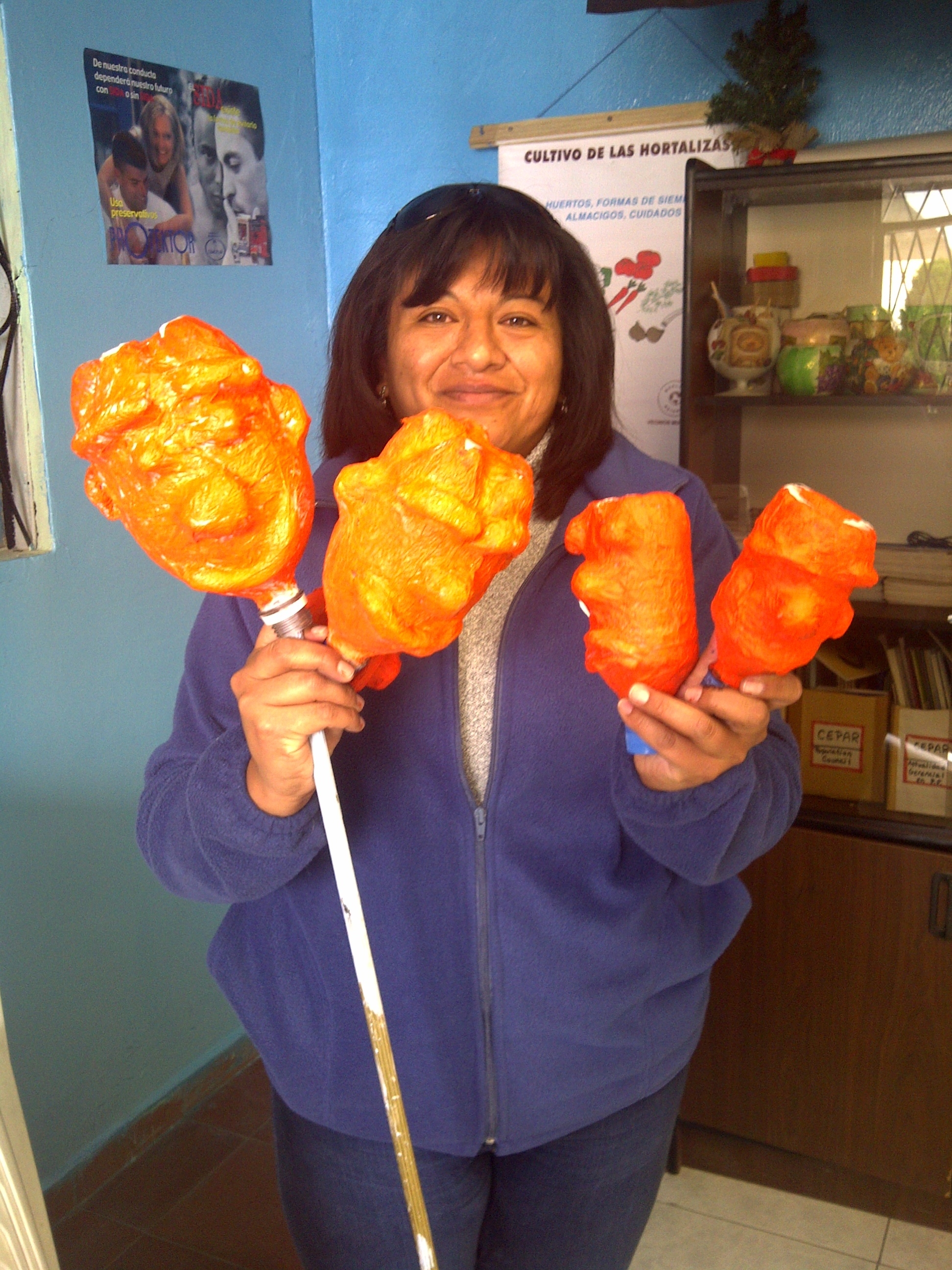
Anyway, I’m still in Ecuador. Today’s trashy discovery: soda bottles recycled as puppets for community theater. In this photo my colleague, Lourdes, displays a range of heads to be stuck on broomsticks and dressed up for community health workshops and other activities. I’m attending a youth outreach day tomorrow and hope to see some of these in action. More to come. Update: photos of kids painting faces on the puppets now posted to Facebook.
Trash Hiatus
Friday, June 10, 2011Apologies for the light posting of late, I’m in Ecuador this week for the day job, where the trash cans are seriously creepy. Updates on Latin American waste to come over the weekend. In the meantime, don’t forget to join the conversation on Facebook.
How NYC recycles paper
Friday, June 3, 2011via GrowNYC
Max Liboiron
Monday, May 30, 2011There’s a fantastic guest post up on Discard Studies, a site run by NYC anthropologist in residence Dr. Robin Nagle. The blog’s tagline is “exploring throw-away culture” and the latest post by artist and PhD candidate Max Liboiron does just that in an essay that asks “Humans: Inherently wasteful, or good sterards? (And, why this question misses the point).” Read it. Then spend some time with Liboiron’s Web site perusing her past projects. Amazing stuff.
The Daily Ocean at sea
Monday, May 30, 2011Sara Bayles‘ blog The Daily Ocean chronicles trash she finds on the beach every day for a year. Recently, she and her husband took nine weeks to join a sea expedition to the Great Pacific Garden Patch. She’s now posting details of the trip and photos in a series of posts before returning to the regularly scheduled program.
Introspective Trash
Friday, May 27, 2011William Rathje at the University of Arizona founded the sociological discipline of garbology, which Wikipedia defines as follows:
[T]he study of (mostly modern) refuse and trash. As an academic discipline it was pioneered at the University of Arizona and long directed by William Rathje. The project started in 1973, originating from an idea of two students for a class project.It is a major source of information on the nature and changing patterns in modern refuse, and thereby, human society.
Or, as a New York Times headline on the topic put it: We Are What We Throw Away.
Recently, I’ve come across three examples (which, by the laws of lazy journalism = a trend) of personal studies in garbology.
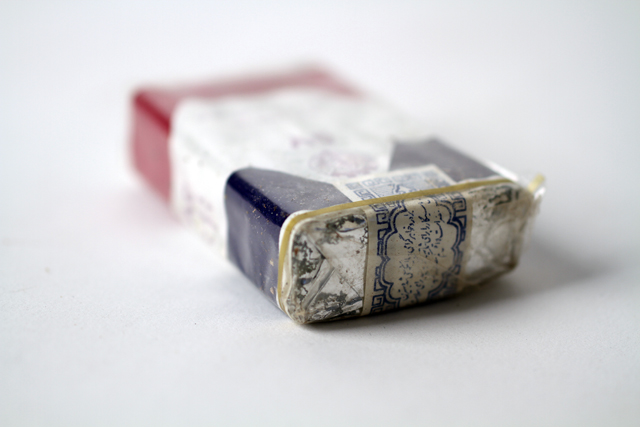
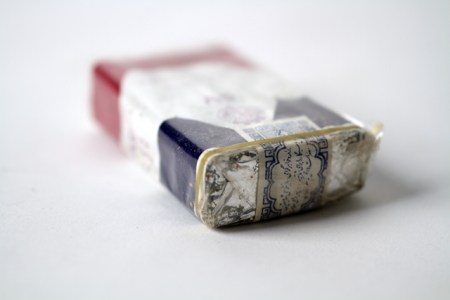
Mac Premo‘s The Dumpster Project, covered here before, documents all the things the artist had stockpiled in his old studio before losing that space. Premo is now cataloging the items, some intensely personal (an early pair of his daughter’s shoes, the invitation to an old girlfriend’s party to christen her wheelchair), some just neat things he collected over the years (Persian smokes pictured here). Premo hopes to procure a dumpster and display all the documented stuff in said dumpster. The piece will either tour as an art exhibit or be left out for collection. Or both.
Writer Chappell Ellison is throwing away her stuff in an effort to live with less. Unconsumption covered her project, which consists of a blog where she posts photos of things she is throwing away, sometimes alongside their stories. The first person to comment on each item gets to keep it.
Writer Porochista Khakpour is selling relics of her past and each piece comes with a story on a tumblelog called One Woman’s Trash. “Trying to be people I was not was a theme of my 20s,” begins a post about a silk romper. The microblog is a for-profit venture presented as more stoop sale than art project, but it’s a creative exercise in garbology nonetheless.
I once threw away all my journals. It was a rash decision I frequently question today. Somehow reading entries on these three sites picks at that scab. What I love about all of these efforts is the thought put into our collecting of things, the stories each item acquires — making it harder and harder to part with over time — and the discipline of each artist to actually get rid of it.
Garbage Revolution
Tuesday, May 24, 2011In case you missed it, Uma Viswanathan had a lovely HuffPo piece last week on a youth program composting organic food waste in Haiti. It’s called the Nouvelle Vie Haiti Youth Corps, a project of the International Association of Human Values.
I don’t know anything about this group, but a glance at their philosophy, here, makes me curious to dig deeper.
This weekend my aunt and younger cousins told me they are planning a trip to Haiti to volunteer at an orphanage. They are a service-oriented family and my aunt was interested in taking her daughters to a developing country for the first time. It was hard, my aunt said, to find a nonreligious volunteer program.
I look forward to hearing about their experience. And to learning more about Nouvelle Vie Haiti’s work on sanitation and other development projects.
Yucca Mountain
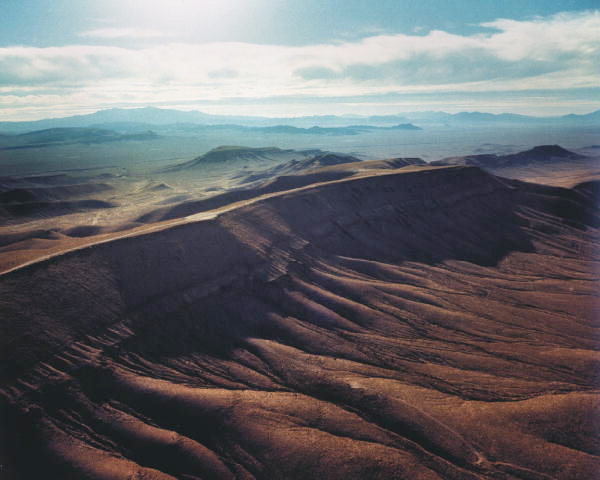
Tuesday, May 17, 2011Nuclear waste. It’s the most controversial kind of trash. Here in the U.S. our government has been talking about different ways to bury nuclear waste for years. Nearly a decade ago, Congress passed a law stating we needed a permanent underground storage facility by the mid-1990’s and later named Yucca Mountain, outside of Vegas, as the chosen spot.
Lately though, the government has been rethinking that decision. For one thing, Japan’s nuclear disaster proved worrisome, causing experts to rethink the whole idea of storing toxic waste in pools.
But Yucca Mountain was the subject of debate long before the earthquake in Japan. It’s a bit of a messy fight to follow. I didn’t quite understand all the pieces until I read this handy list of FAQs published by Reuters. In a nutshell, people in Nevada have long been pissed about the choice of where to put America’s nuclear waste, President Obama campaigned on the promise to block the facility from being built, his administration did indeed block the Yucca Mountain site, inspiring the Government Accountability Office to prepare and release a report stating that politics rather than technical or safety concerns drove the decision.
The report also pointed out that since 1983 the government has spent $15 billion assessing Yucca Mountain, $9.5 billion of which was collected via extra charges on Americans’ electric bills.
We’ll have to wait until early next year to find out what an appointed Blue Ribbon commission suggests we do instead. Our options include finding a new place to dig a hole, looking to the French model of recycling nuclear waste or paying a country like Mongolia to deal with it for us. One would hope the proposed plan includes ideas on creating less nuclear waste in the first place.