One of my favorite NYC blogs, Ephemeral New York, has a great post up today about Manhattan’s ill-fated 13th Avenue. Like so many things in this city, the history of 13th Avenue has a lot to do with trash: it was built on a landfill and, while it existed, was frequented by trash pickers.
Figures from the Swedish governmental institution tasked with keeping track of all possible statistics, Statistics Sweden, show that refuse collecting/recycling is the most common profession among people who divorce. In 2007 (the latest year for which we have complete statistics), over 7% of Swedish married refuse collectors/recyclers divorced.
Not much analysis has been presented with this news, but it is noted that among the top ten, nine professions are blue-collar jobs, with pilots and captains as the only white-collar profession (claiming the runner-up spot).
What we all crave to know of course is what it is about trash work that puts such hard strain on marriages. If anyone knows, do share!
In case you haven’t heard, Mai Iskander‘s film Garbage Dreams (about the Zabaleen people of Egypt and the challenges facing their trash picking community in this modern age) made the Oscar shortlist for documentaries. It is one of 15 films being considered for the honor. Among the 14 other films selected is The Beaches of Agnes by the legendary Agnès Varda who immortalized gleaners in her groundbreaking 2000 film Les Glaneurs et la glaneuse. That’s not one but two kick ass, trashy, female documentarians recognized in a single year. Not bad. Of course, since Varda’s current doc is about herself and not trash, per se, our allegiance lies with Iskander and the Zabaleen. Toes and fingers crossed…
The report goes in to some depth analysis of electronic & electric tra$h, highlighting facts such as the annual turnover of the UK market; UK£2 million (US$ 3,3 million), using the example to paint an overview. Most intriguing conclusion is that actors in the legal market claim that contractors offering free recycling of toxic electronic products probably also operate illegally, as profiting otherwise wouldn’t be possible.
Further, the report gives an image of the incentives of entering the illegal market: Tra$h fat cats buy (for example) an old TV, with the promise that their company will recycle it and sell the parts for profit, but instead sells it in a developing country. Buying the unit will cost US$4 or so, and sell for US$8.
Last but not least, the people behind the report call for more research in order to cast light over these shadowed activities. We most certainly agree to that. Increased efforts of recycling must not be the source of growing international crime (and with that, increased numbers of non-recycled electronics and electrics spewing out toxins once their capacity to entertain finally stops).
Reading this ambitious book review of The Spirit Level: Why More Equal Societies Almost Always Do Better, written by Richard Wilkinson and Kate Pickett, I can’t help but to share the insight that it seems that the more egalitarian a society (be it a nation-state or a state within a nation), the more trash gets recycled by its people. Adding this to the list of the many trashtastic outcomes of redistribution of wealth.
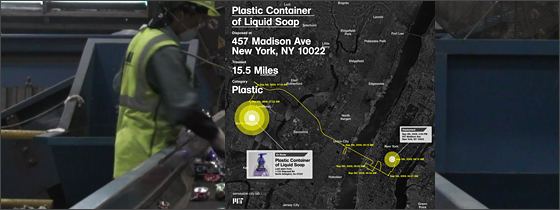
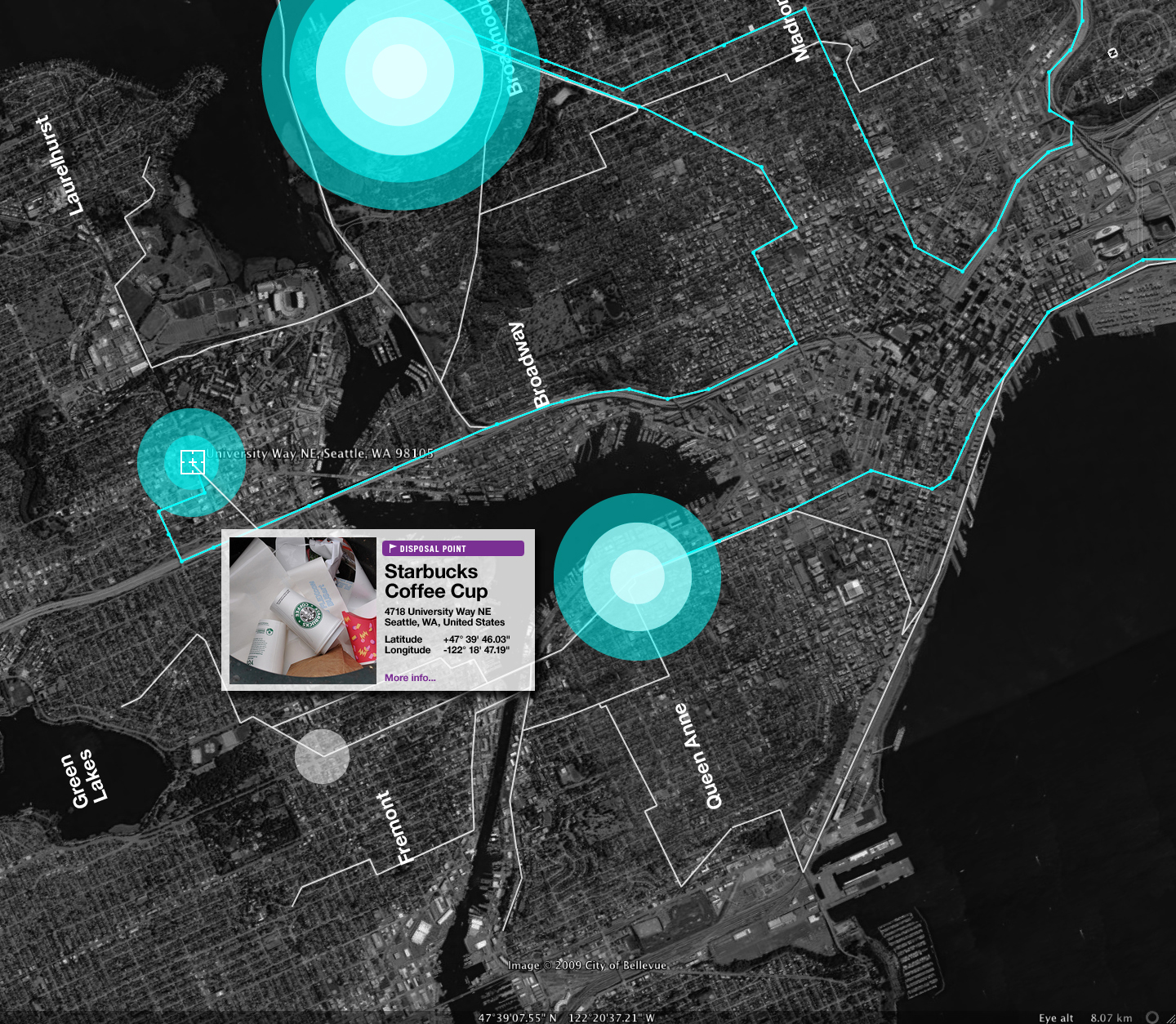
Now through November 7th, the Architectural League of New York brings us an incredible-sounding exhibit at The Urban Center. It’s called Toward the Sentient City and focuses on the use of mobile, sensor and other new technologies in city planning and architecture. A major feature of the exhibition is the Trash Track project from MIT’s SENSEable City Lab, which we’ve lauded here before. Check out the project Web site for images of some of the trash they’ve tracked through NYC and Seattle.
NYC trash
I hope to check out this exhibit before it closes a, because I can’t get enough of trash track and b, because I’m curious about all the other urban computing that’s going on out there. The mobile world truly seems to be exploding and I am constantly impressed by new and innovative applications toward the common good.
Ever thought of why people keep alarming there are too many people on the planet, creating too much trash, but never discuss what happens when we ourselves become trash, in that crude, horrible form of corpses? Swedish marine biologist Susanne Wiigh-Mäsak has, and she is up to something. Actually, she has been for many years, but I just recently learned about it from the September issue of the Swedish magazine Filter (who refuse to publish articles online).
Wiigh-Mäsak started pondering sometime in the late 90’s on the bad logic that we don’t really smoothly return to earth and become shadow and dust, but rather rot in coffins and at long length make it out of the coffins in the form of harmful liquids tainting the soil and subsoil water, or are disbanded all over the atmosphere in cremation. While I personally like the idea of being sent of in particles too small to see, one must admit she has a case.
Wiigh-Mäsak’s sollution, soon to be rolled out by her enterprise Promessa Organic Inc., is to freeze-dry corpses with liquid nitrogen, and then bury them in coffins made of corn starch, just a foot below ground. She further suggests a tree or bush to be planted above the coffin, as primary beneficiary of the soon-to-be-mould corpse and coffin. This new method obviously sparks questions on ethics (“liquid nitrogen” has a rather unethical ring to it, no?), questions to which Wiigh-Mäsak gave this reply, to Filter:
I would like to show [the Swedish IRS] a twenty year old grave. After that, we could discuss ethics.
By now, you surely know all about the super hip Trash Track. For our UK readers, there are possibilities of getting your very own refuse involved! New Scientist are currently accepting applications for UK trash to be tracked, closing September 30th. As there’s only one spot open, make sure to carefully craft that 75 word motivation on what you would like to tag and why. And do let us know what you submit!
Earlier this week the everydaytrash.com team was invited to a screening of “No Impact Man,” a documentary about journalist Colin Beavan, a.k.a. No Impact Man, his spouse Michelle Conlin, their cute-overload daughter Isabella and the family dog Frankie. Behind the documentary are directors Laura Gabbert and Justin Schein, and producer Eden Wurmfeld.
For several years now, Beavan has been updating the world on his No Impact Project—his endeavor to spend one year wasting as little energy and as few resources as possible—via his blog, No Impact Man. The documentary follows Beavan, Conlin, daughter and dog over the course of the project, from November 2006 to November 2007. Throughout four phrases, the family gives up more and more, starting with taking non man-powered transport of any kind, buying anything new (including toilet paper), eating meat, using the elevator. Finally, they shut off the power in their apartment and attempt to live without electricity.
The No Impact Project is framed as a family project, but as the movie reveals, there’s no doubt that its really all about Beavan. As Conlin puts it “It’s called No Impact Man,it’s his project, it’s his book and he’s No impact man, but…the project is our family is doing this.”
Without going too much into detail to spoil the movie for those who plan to see it, we can tell you that the documentary is not so much about how to live without causing further damage to the planet (if you already have a flat in a posh condo and have bought all the laptops and bikes you need that is), but about a marriage in which one partner is very driven to embark on something that affects everyone in the family. Here’s the trailer:
And, as there are two of us, please find below two reviews:
Victor:
Why make a documentary about how a family tries to live emissions-free for a year, but not give you the results on screen? The concpiracy theory would be that the team didn’t want to give out spoilers from the coming book. I don’t think so, I rather believe that Gabbert/Schein/Wurmfeld realised that watching people live eco friendly isn’t terribly exciting on screen (the most action-ridden moment being when the family tries and fails to build an Nigerian pot fridge). What is exciting is the struggle with the contemporary context they’ve locked themselves into. In the end, it boils down to how much of a crazy person you are ready to be percieved as. Easier as freelance writer (Beavan) compared to Business Week writer (Conlin). The message we are left with from No Impact Man is that you probably need very supportive friends.
Leila:
As a documentary about a marriage, “No Impact Man” is pretty entertaining. As a lead-by-example environmental statement, it’s a bit muddy. The film skips along, touching lightly on some of the quotidian debates of the green movement: are cloth diapers really better for the environment than disposable? What are the outer limits of eco-chic (yes to reusable shopping bags, no to no toilet paper), without really saying much. If anything, it’s a nice ad for biking and eating locally. The Union Square green market features heavily and the family spends enviable amounts of quality time scooting and biking around town. Conlin’s transformation from a Starbucks-addicted shopaholic to sustainable supermom is the real story. As she whines then copes and decides what she can and can’t live without, we make the same assessments about our own lives. How embarrassing would it be to mooch ice from the neighbor because you are consciously living without a fridge; or if the whole office knew your husband air dried his bottom as an attempt to save the trees?
Remarkably, there is very little trash in “No Impact Man.” Right away, the family stops creating waste, so little time is spent tracking where waste goes when it leaves the 5th Ave co-op and what impact the family is averting. Aside from some arty close-ups of trash bags and a brief cameo by Sustainable South Bronx founder Majora Carter, trash plays a small role in the film.
Anyway, as someone constantly asked “but what should I do about it” I admire the notion of living out one’s own ideals and the attempt to make personal the huge and often eye-glazing topic of lessening our impact on the environment. But there is a difference between personal and personality-driven and I found Beaven’s project off-putting in its self-absorption. Kudos to this family for eating locally, biking everywhere and spending lots of quality time together not watching TV. At one point Beaven says that when people ask what one thing they can do to make a difference, he says volunteer at an environmental organization because the erosion of community is what is killing us all. THAT point should be better underscored on his blog and in the film. A first step might have been calling the film “No Impact Family”.
In case you missed it, The New York Times printed an ominous and recomendationless editorial on plastic in our oceans on Wednesday. Of particular note:
Now comes what could be more bad news. A new study, announced at a recent meeting of the American Chemical Society, suggests that plastics in seawater break down faster than expected. As they do, they apparently release contaminants, including potentially harmful styrene compounds not normally found in nature.
Swedish Public Radio reports today that with the use of a new filter and new methods (such as taking surface water – plastic floats), a research team has found large amounts of plastic fibres in watercourses in Sweden. With previous findings being between 1 and 20 fibres per cubic meter (approx. 35 cubic feet), the preliminary results of 10,000 fibres per cubic meter are alarming, to say the least.
The research team is currently working on a theory which explains the existence of such high quantities with rubber tyres and synthetic clothes, giving off the fibers. Regarding natural clothes (cotton etc.), they too come steeped in plastic fibres these days, says Fredrik Norén, part of the research team. (Which incidentally is why I wash new clothes before I wear them, letting the big machines at the local laundromat worry about the problem…)
The clothes theory gives a troubling insight into exactly how much plastic we use these days, and for what. It also pushes us to ask “why though?” Any takers on that, feel free to post comments. When the research project is finished, I hope to follow this up.
[As a side note for the linguists out there, can you tell where in this post you find UK English? I had fun writing this up.]
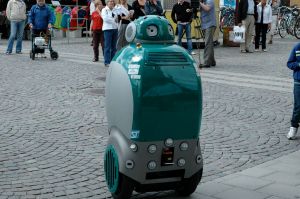
Remember Dustbot, the cute little robots that are being developed to slave for humans who want their trash taken care of? They are now being demonstrated to the public in the Swedish city of Örebro. Swedish fabulous blogger Helena Bergman, originally from Örebro, has captured this for all to see. This is the future everyone (and as the New York Times wrote yesterday, some say this isn’t all fantastic)!
For Dustbot, cobblestone is a piece of cake
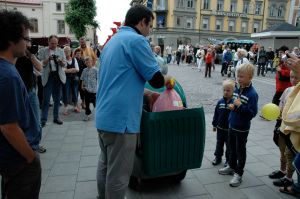
Kids watch in amazement as Dustbot makes a pick-up
Last night, while waiting out service changes and delays on a very muggy Subway platform, my friend Linda and I got to talking about historical muckrackers, specifically, Jane Addams.
Jane Addams
It turns out Addams, in addition to Nobel-prize winning social justice work (including founding the Settlement House movement), was so concerned with the unsanitary conditions of trash piling up on the streets of Chicago’s 19th Ward that she applied to be a garbage collector. The mayor turned her down, but after pestering appointed her to the role of neighborhood garbage inspector overseeing trash collection. Details of this feminist trash story and many other anecdotes from Addams’ life can be found between the covers of Jane Addams: Champion of Democracy by Judith Bloom Fradin.
A group of MIT researchers launched a new project called “Trash Track” today, which will enlist volunteers from New York and Seattle to have their trash tagged with specially-coded wireless markers and tracked through the various waste streams.
Visualization mock-up (simulated) By E Roon Kang at SENSEable City Lab
The project is part of the SENSable City Lab (whose past work includes other sweet visualizations like this map of New Yorkers’ phone calls to the rest of the world). Apparently, we’ll be able to follow along with the migration of trash online. And in September, the Architectural League in New York City and the Seattle Public Library will host exhibits.
The ultimate project goal is thus to encourage us to take a closer look at what we throw away in the hopes that being kept aware of our waste after it leaves our hands motivates us to create less of it in the first place. Neat idea. Let’s see if it works.
They have been sweeping the streets of South Korea. They have disintegrated dust in Japan. They have gathered garbage in Italy. Now, in the Swedish town of Örebro, they will patrol the streets and put terror in the eyes of trash. I speak, of course, of DUSTBOT!
Dustbot
Dustobot is what we’ve all been longing for ever since we met R2-D2 and the other droids in Star Wars. Small, cute and friendly looking robots, slowly finding their way around on wheeled legs, doing stuff for us. Like taking out the trash. The Dustbot aims higher than just convenience though, it’s a one of these super-sophisticated tech project, funded by the European Commission, loads of researchers involed, development of new technique, etc.
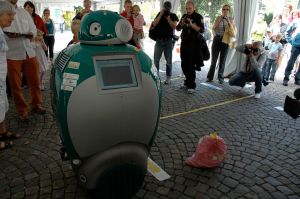
Which of course is all very well. I however believe that the citizens of Örebro will not discuss the details too much, but instead enjoy the future that you can send a text message to Dustbot, and wait for the little bot to come rolling to you, happily swallowing whatever there is you want to get rid of (just don’t forget to tell the Dustbot what it is you’re throwing away, through clicking around for a while on it’s display).



 everydaytrash