Archive for the ‘Trash Politics’ Category

The seagulls of Edingburgh dive for “illegaly presented refuse”

Monday, June 15, 2009

Geoffrey K. Pullum of the Language Log (a blog about languages and linguistics, six years in action, also in hard copy) today presented the world with the most fabulous description of what happens when residents break trash regulations in a city of seagulls. Everyone, this is a mandatory read. To give you a taste:

What the Edinburgh city council finally did, in response to my calls to the Environmental Protection department, was to come round and note sacks that had been put out too early, and they stuck on at least one of them (the one I noticed on Thursday) a small sticky label saying “THIS REFUSE HAS BEEN CHECKED FOR ILLEGAL PRESENTATION.”

Its up to your landlord!

Tuesday, June 9, 2009

Treehugger reports that proposed legeslation in San Francisco opens for harsh fines for residential and commercial building owners who fail to make sure trash from their tenants is recycled, and recylced properly. According to Treehugger, such legislation exists in several places already in the US, but not with fines.

Makes me think of yesterday, when a note was posted at my front door. Intrigued as you always are by notes, I read it, although it was addressed to my landlord. It turned out to be notice of a $300 fine for placing plastic for recycling on the curb on the wrong day of the week.

This focus on building owners is very different to my homeland of Sweden, where, as I have described earlier, the responsability for recycling lies with the individual person. And they say we’re the commies..

Trash = Class

Friday, June 5, 2009

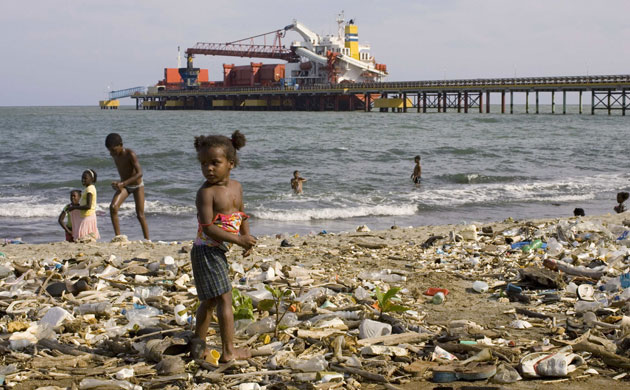
The headline to the latest Guardian UK photo series In Pictures says it all: “World’s poor overwhelmed by rubbish.”

Garbage-A-girl-stands-on--021

Photograph: Eduardo Munoz/Reuters

UPDATE: See also this horrifying slideshow in e-waste in West Africa via Waking Vixen‘s Facebook page.

Landfill lovin’

Thursday, June 4, 2009

Robin Nagle, anthropologist in residence for New York City’s Department of Sanitation, is giving a talk on the Freshkills landfill as a sacred space. This extraspecial event will take place on the North mound at said landfill on Saturday, June 20th, starts at noon. New Yorkers, follow the link to RSVP.

Sweden decides on long term nuclear trash storage

Wednesday, June 3, 2009

Today the Swedish Nuclear Fuel and Waste Management Co (SKB), the entity tasked with finding out where and how to store Sweden’s ultra dangerous radioactive trash, decided on where they will recommend the construction of the long term repository. The winner is Östhammar, a municipality with just over 21,000 inhabitants in southeast Sweden.

At today’s press conference, representatives of the municipality were serious-looking and happy, having beat the municipality Oskarshamn in the race to become nuclear trash spot no 1, they of course talked wide about cooperation, but it’s an ill kept secret that people in power back in Östhammar are jubilant over this decision.

One might find it odd that two municipalities would compete and advocate that they have the best mountain core for nuclear trash, but it just goes to show the power of tra$h, I guess, nuclear being the ultimate trash after all. That, or people are just outright bonkers. To learn all about how the final disposal will happen, check out the 101 on nuclear trash storage at the SKB website.

UPDATE: Follow this link to Swedish newspaper Uppsala Nya Tidning to see pix of Östhammar storage site boss celebrating with cake. The local government commissioner cried tears of joy (yes, she did). Then take a look at the most important YouTube clip ever about #cake. (Many thanx to @gerontedodedon for inspiration.)

Rubbish to Renewables Act of 2009

Friday, May 29, 2009

Pending legislation a long way off from law, but interesting nonetheless. Thoughts on waste to energy incentives?

Bottle bill mania and RFK Jr.

Thursday, May 28, 2009

bottled-waterBottlemania author Elizabeth Royte‘s waste and water blog has been pretty juicey lately. When it comes to single serving water packaged in plastic, the only thing more disturbing than how many plastic bottles are out there is how few people own them. That is, until they sell them to us and the problem of disposing of them becomes someone else’s problem. The question up for debate is whose problem is it? New York’s State Assembly is negociating the answer to that question now with a bottle bill that Royte points out has taken 20 years to see the light of day. But if you’ve been reading the news, you might have noticed that an unlikely pair have teamed up to sue the state over the bill: megaconglomerate Nestle and Riverkeeper Bobby Kennedy Jr. Very curious. Royte explains the drama in a recent post and subsequent update.

See also RFK Jr.’s op-ed in yesterday’s New York Times.

Most horrific trash pix to date?

Tuesday, May 26, 2009

GigaPica, a Dutch website honoring the art of photographic journalism (firmly asking you not to post their pictures on your blog, how very 90’s) has what I believe to be the worse images of trash yet published. It’s just horrible, but really worth a look.

Plastic Vortex

Tuesday, May 26, 2009

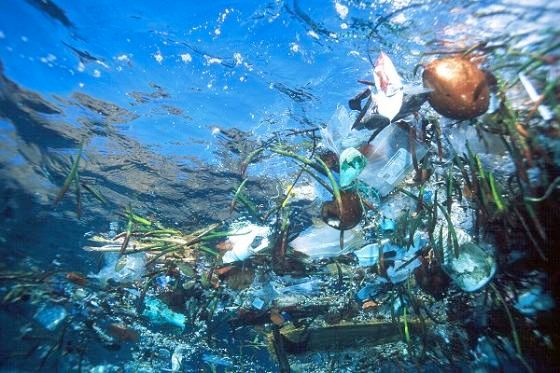
A group of scientists wants to get to the bottom of the Great Pacific Garbage Patch. The AFP reports that the great swirling mass of plastic and other trash between Hawaii and mainland US will be the destination of a 50-day expedition  from San Francisco to the Eastern Garbage Patch and back.

Underwater trash photo via RedOrbit

Underwater trash photo via RedOrbit

The scientists will take special nets with them designed to scoop up samples of even the tiniest plastic debris and will treat their voyage to the vortex  of plastic beneath the sea like a journey into space.

According to RedOrbit:

The United Nations Environment Program has estimated that some 13,000 pieces of garbage exist in every square kilometer of the ocean, but the issue becomes magnified in these ocean vortexes.

Leaders of the trip said the particles have composed a toxic gumbo that threatens the wellbeing of fish in the region.

“That means the little piece of plastic the fish eats is actually a little toxic bomb,” said Doug Woodring, an entrepreneur and conservationist who lives in Hong Kong and will lead the expedition.

A world of shocking odors

Monday, May 25, 2009
Shawn Baldwin for The New York Times

Shawn Baldwin for The New York Times

Great Zabaleen article in the Times accompanied  by a short video and these stellar images by photographer Shawn Baldwin.

It is a world of shocking odors and off-putting sights. But it is their world, the world of the zabaleen, hundreds of thousands of people who have made lives and a community by collecting Cairo’s trash and transforming it into a commodity.

Cabin cleaning goes unpaid

Wednesday, May 20, 2009

Flew across a couple of states on US Airways this morning, and learned that the crazy terrible economic turmoil we’re in has effects you wouldn’t know of unless someone told you. When US Airways started suffering from the economy, all cleaning services by employees or contractors ended, and trash is now taken care of by the cabin crew.

Only problem is that the cabin crew only get paid for the hours from the start of taxi until the seat belt-signs are finally turned off (which in itself is mighty weird, as these people are in the aircraft before anyone else, and leave last). The trash management is unpaid, and there are no incentives to clean very detailed, as you might be running to the next flight you work out, or might be going home. Hence, cabins are dirtier nowadays.

For the record, both flights landed ahead of schedule.

Miss Body Plastik

Wednesday, May 20, 2009

Last night I saw two amazing short films from Haiti as part of fi:af’s World Nomads program. The first and more trash-relevent of the two was the international debut of a feature directed by Louis Ebby Angel and made in collaboration with his fellow students of Ciné Institute, the island nation’s first and only film school. As the name suggests, plastic is a theme incorporated in the plot. You can watch it in its entirety here.

Vodpod videos no longer available.

During the Q&A that followed, the director mentioned he had friends who use plastic in creative ways to draw attention to Haiti’s land and water pollution. He described elaborate costumes for carnival made of salvaged plastic. Rest assured, I am now on the hunt for images!

The second film was an INCREDIBLE documentary called Mrs. Little Bones (Madame Ti Zo) about a nearly hundred-year-old midwife praciticing in the hills of rural Haiti. It was directed by David Belle, founder of Ciné Institute and contains the most amazing closing credits sequence in the history of film. Track it down.

Flipping the flop

Tuesday, May 19, 2009

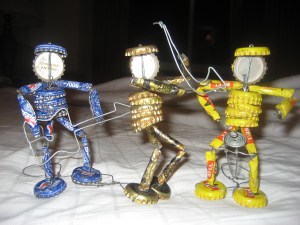
While in Kampala a few weeks ago, I stopped in at one of my favorite stores in the world, Banana Boat, and went on a semi-conflicted shopping spree among their fine upcycled crafts made by women’s collectives from all over Africa. I bought up a dozen strands of Ugandan paper beads for my girlfriends, homemade soap wrapped in homemade paper for my colleagues and a collection of small creatures fashioned out of bottle caps including this three piece band, now residing at my friend’s music studio in Brooklyn.
Bottlcap boogie

Bottlecap boogie

Ok, full disclosure. I went more than once and to more than one Banana Boat location during my week in Uganda. I couldn’t help it. While normally I try to buck the inner American, my desire to consume flares at the sight of trash. The the irony of upcylcing is that it makes me want to buy MORE.

The first wave of  my Banana Boat binge was stopped short by the pricetag on a string of plastic foam beads. The moment I saw them, I knew they were made of old flip flops—likely washed up on the shores of Kenya—and, because of this, I grabbed them up. But then I saw they cost roughly $30 U.S. and I looked again and decided, actually, big foam beads on a short choker strand might be a little too UN chic for my blood. So I set down the hideous necklace and made my way deliberately to the woven basket and cardboard diorama section of the store.

It was hard to walk away. Physically hard, because my urge to buy something was so strong it nearly made me twitchy. The little voices in my head debated the novelty of flip flop jewelry versus the reality of its ugliness, the feel good return of purchasing upcyled crafts from women’s collectives versus my uneasiness with the price, the uniqueness of the product versus the fancy UniquEco logo. One of the necklaces had a tag declaring “flipflop (i was)”. I took note of the confirmation that these were indeed flipped flops upcycled by Kenyan fishing communities. And I took note of the all lowercase tagline and pretentious use of parentheses. Ugh, I thought, branding.

I left the store feeling very proud of my resolve.

The next day I dropped $50 on a hot pink rhino doll/statuette from the same company. It’s adorable with a sleek and marbled hide created by a fused pile of flip flops of similar but not identical colors. This, I thought, will liven up my bookshelf. Or hip up my office. It carries a message that is both political and fun. It will make for a cool blog post and spread envy among my friends. I NEED this.

More tales to come of Kenya and consumption.
Trash Rebellion

Monday, May 18, 2009

It’s been a trashy day for The New York Times. Here’s another featured item on young yuppies in Pakistan cleaning up the Ghalib Market area in Lahore. They use Facebook to organize Sunday meetings of a club called “Responsible Citizens”. Cool initiative, though I think the story itself stretches it a bit with the political context. See what you think.

Trash on the Tigris

Monday, May 18, 2009

Check out this visual diary from the Times. It’s three days old, but I somehow missed it.