I just saw this amazing reggae recycling video on Visible Trash. Little Shiva always finds the quirkiest stuff. And why does everything sound better in a Caribbean accent??
Archive for the ‘Trash Politics’ Category
dash weh yuh trash
Wednesday, January 28, 2009Tire Furniture
Wednesday, January 28, 2009
Brazilian nonprofit makes furniture from scrap tires
Keith R. over at The Temas blog sent me this link to photos he’s posted from a Brazilian organization called Vida Amiga whose members take old tires and fashion them into furniture, then sell the furniture. Recycling plus skills building = double sustainable. I love stories that involve selling things made of trash. Thanks for the link, Keith!
P.S. The post includes a fantastic roundup of past Temas posts on creative recycling.
Lagosian bottle opener
Monday, January 26, 2009Ok kids, I’m back from Nigeria. The most everydaytrash-worthy item I came across while on the road in ever-resourceful Africa? This handy bottle opener pounded out of a piece of Aluminum tubing that once served to line the windows of a nearby building.
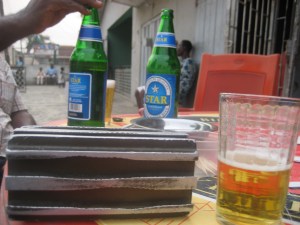
Pounded aluminum bottle opener
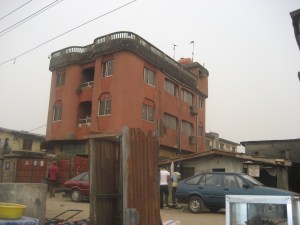
Neighborhood building
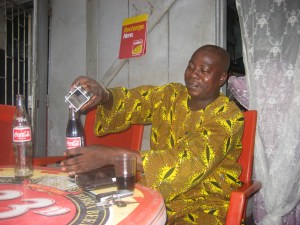
Bottle opener in action
Just look at all those leverage-producing surfaces, perfect for industrial use at such establishements as this roadside bar where I passed several lovely hours before my flight home.
Optimistic Trash
Wednesday, January 21, 2009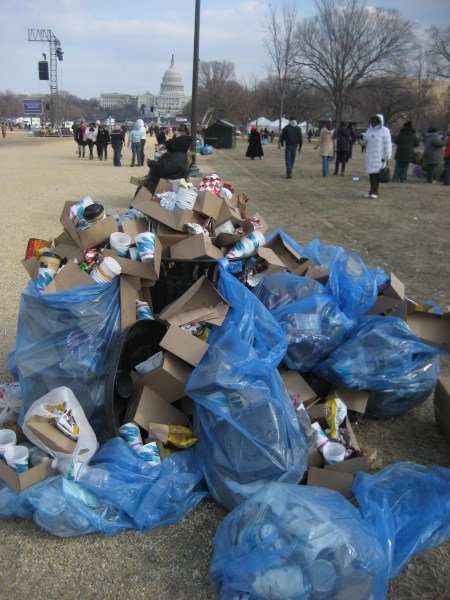
I took a little road trip to DC these past 24 hours. Getting to and from the National Mall without losing my people was chilly madness, but worth it to shed a few layers of pessimism, if only for the afternoon. Enjoy the rest of the week, I’ll be back Monday if not before.
xoxo
Leila
Redefining Trash
Saturday, January 17, 2009By defining coal as a solid waste, the town of Babylon, Long Island is able to tap into sanitation funds to give its residents cash upfront for energy-efficient renovations. The Times reports:
A few weeks ago the Chamberses became the first residents in Babylon to have energy-efficient improvements completed.
Any of Babylon’s 65,000 homeowners who qualify can receive up to $12,000 worth of energy-efficient work done by employees that the town contracts with.
Very cleaver, Babylonians.
Trash as Punishment
Tuesday, January 13, 2009I don’t care if she is a felon mandated to pick up road side trash, Michelle Rodriguez will always have my fandom because Girl Fight rocked my world.
 And that cartoon of a surf movie Blue Crush might have been something if she’d been cast as the lead. I mean seriously, which one looks like she could plausibly be a champion surfer born and raised in Hawai’i—blond twig or buff brown girl?
This shot reminds me of that entertaining week in ’07 when we asked ourselves each morning how Naomi Campbell could keep forgetting she had community service and dress for the runway instead.
The Penguin
Sunday, January 11, 2009UPDATED POST: A while back I got a Penguin soda machine in the mail, thanks to the PR peeps representing Soda-Club. The pitch: reduce soda can and plastic bottle waste by making your fizzy drinks at home. The catch: SAMPLE SIZED Soda-Stream flavor syrups come in plastic pouches that can’t be recycled.
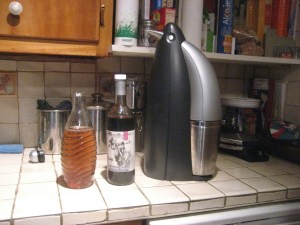
Penguin and shrub
Beth over at Fake Plastic Fish came to ethical terms with this dilemma by sticking to the company’s water flavorings, which come in little glass bottles instead of plastic. Trouble is, I don’t drink much plain or flavored seltzer (unless you count vodka sodas at bars). I tried out a couple of the sample syrups that came with my machine. Root beer, too sweet. Diet cola, tastes JUST like Diet Coke, which I shamefully love. But I put off posting on the Penguin because, honestly, once I went through the diet coke samples, I only used the thing once to make some lemony water for friends.
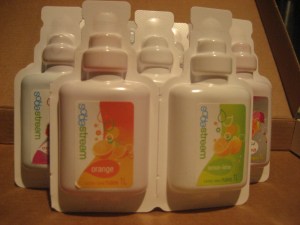
flavor packs
I was all set to write just that: I guess it’s cool, but I would never have bought it if it weren’t free and I never use it. BUT THEN, my wonderful mother gave me an extraordinary gift: a large bottle of raspberry shrub, a fruit vinegar syrup used to make my all time favorite carbonated drink. Suddenly I’m using the Penguin all the time and sans guilt since shrub can be purchased in bulk and in glass. SODA-CLUB ALSO SELLS BULK SIZES IN BETTER PACKAGING.
Therefore, it is with great enthusiasm and several reservations that I recommend the Penguin. On the plus side, it’s very easy to use, a cute design—you carbonate the water by depressing the beak and the whole thing squeeks when its ready—and you can make delicious shrub whenever you want. On the flip side, it takes up a lot of counter space and it’s expensive (starter kits begin at $200 plus shipping). THOUGH CHEAPER, SMALLER MODELS ARE AVAILABLE.
Recommendation to Soda-Club: if you’re going for an eco-marketing campaign, DON’T SEND PLASTIC SAMPLES TO GREEN BLOGGERS.
Note to self: save money by mixing vodka sodas at home more often or—moment of genius—vodka shrubs.
DIY SUV
Saturday, January 10, 2009AfriGadget has a lovely post up for the new year featuring photos by photographer TMS Ruge of Project Diaspora. This is a car made out of an empty oil bottle with wheels cut from old flip flops.
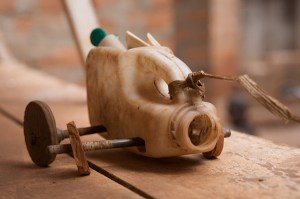
Other charming evidence of resourcefulness can be found at the AfriGadget Flikr pool.
Bottle Bike
Monday, January 5, 2009Check it: some kids from Appalachian State University made a bike out of used plastic bottles as part of a Google-sponsored trash challenge. And won!
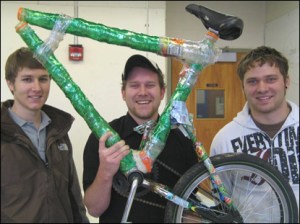
Here’s the YouTube of the “Green Machine” in action. Warning, the stilted narration may flash you back to seventh grade English class. All worth it, though. Congrats, guys.
Photo by Monte Mitchell for the Winston-Salem Journal
Trash-o-saurus
Sunday, December 28, 2008 Oh no. The economic meltdown may kill trashosaurus, the one-ton star of Stratford, Connecticut’s Garbage Museum. In fact, the whole museum may tank. Currently, the educational institution runs on funding from a regional recycling consortium. But in these tough financial times, a half dozen local towns have pulled out of the consortium to send their recycling elsewhere and thus funding for the museum has been slashed.
No word on what this means for the Trash Museum in Hartford. Here’s to hoping trashosaurus finds alternate funding/an adoptive home. And here’s to the Constitution state. Kudos, Connecticut for having—for the moment at least—not one but two museums dedicated to trash.
P.S. Trashosaurus weighs one ton to represent the amount of trash created by the average American. This cracks me up. Photo via the Connecticut Resources Recovery Authority.
Holiday roundup roundup
Tuesday, December 16, 2008
Tips for a trash-free season from around the garblogosphere:
- For your convenience, Constructables has compiled holiday-themed how-tos for DIY gifts as well as a complete collection of homemade wrapping ideas;
- Threadbanger lists fun ornament projects;
- Oxfam suggests a number of “unwrapped” gifts in the form of animal sponsorship and the like;
- Curbly finds some festive uses for plastic bottles; and
- Riverwired provides links to waste free holiday cards (I guess those snippets I’ve been reading about how Facebook killed the holiday card aren’t true).
Candle holder photo via Curbly via Apartment Therapy
Goods for Good
Saturday, December 13, 2008
Children at a school outside of Lilongwe. Photo by Soraya Darabi
I’ve had Malawi on the brain this week. To be honest, it’s partially guilt because I couldn’t make it to the Gala 4 Good last week, a fundraiser for Goods for Good. Goods for Good is an organization with a simple mission: to connect surplus goods from the U.S. with Africans who could use them. They get American companies to donate things like pens, pads and excess fabric that would have rotted in warehouses or been thrown away or destroyed and ship those materials to Malawi (they also work in Liberia).
What I love about G4G is their focus on sustainability. They don’t just drop off boxes of crap in the capital city and hope that the overstretched government of Malawi figures out how to distribute them equitably (that would be more like exporting trash than helping anyone). Instead, they set up partnerships with established community organizations and schools and take care to sort and match the goods with ongoing programs in need of support. So the excess fabric becomes school uniforms, the pens get to teachers and students and donated clothes make it onto the backs of AIDS orphans.
Over their tenure, G4G has rescued nearly 100 tons of goods and connected it with over 500,000 orphans and vulnerable children in Malawi and Liberia. When you consider that half of young people who leave school in Malawi say it’s because they couldn’t afford the materials to keep going, that’s more than recycling. It’s lifesaving.
One of the reasons I get all ooey gooey about Malawi is because I’ve spent some time there and have remained in awe of Malawians’ resourcefulness under the severe constraints of limited resources. In the poorest of poor countries, community organizations provide the services the government cannot. Like caring for orphans (1/4 of adolescents in Malawi has lost one or both parents).
And the reason I get ooey gooey over Goods for Good is because I feel personally connected to their work through Brigitte, their program director and one of my sister Soraya’s best friends from high school. I know Brigitte to be supersmart and incredibly caring. Last year she spent months in Malawi setting up and strengthening partnerships with well-run local organizations to assess the needs of Malawians and ensure the most efficient distribution of donated materials. If you’ve ever worked in international development you know this kind of planning is not the norm. In Malawi, it’s hard to find internaitonal interventions that aren’t a) one-off and unsustainable or b) clouded by the ugliest representation of religion.
Soraya visited Brigitte in Malawi last November and took the photo above while accompanying her on a round of visits to G4G partners. On that day, in addition to pads of paper, the girls brought a couple jumbo bags of lollipops for the students at this school. What you see are a bunch of kids who have never had a lollipop. The reason they’re all looking in different directions is becaues they’re not quite sure what to do with them. I so wish I had video of this cross-cultural encounter!
Dung
Tuesday, December 9, 2008
Ngorongoro crater, Tanzania


A zoo in England recently dropped £150,000 on a poo-converting machine to make compost out of elephant and other dung available to them via their permanent residents. I don’t like zoos. Seeing animals in small and smelly spaces, much like seeing old people alone on park benches, makes me sad and uncomfortable. I guess it’s a good thing that this particular zoo will save the waste produced on site and use it to beatify the space and feed the animals by turning it into fertilizer for feed crops and other plantings on the grounds.
Then again, I might just be biased because, as you may recall, I already have a favorite elephant dung recycling program: the Paper Making Education Trust (PAMET) in Malawi. Here is a sample of their lovely stationary.
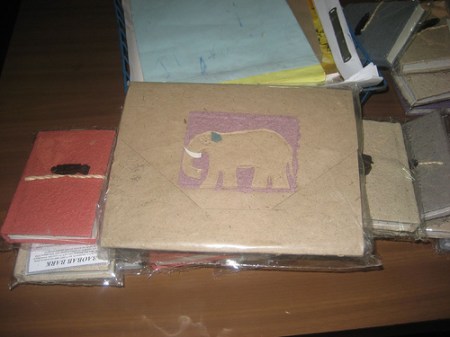
PAMET headquarters, Blantyre, Malawi
And here is a sample of the dung and paper bricks they make and sell as low-cost fuel for homes (a product clearly endorsed by Jesus).
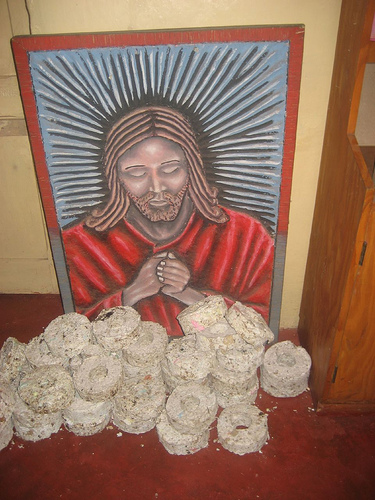
Jesus and PAMET poo bricks
PAMET makes the world a better place by providing jobs and job training and recycling elephant dung from a game park. They collect old school exercise books and other discarded paper and use it (mixed with dung and other plant fibers) to make stationary sold at relatively high prices by Malawian standards. I love the idea that people employed by PAMET use the cash recooped from dung mixed with old school materials to send their kids to school.
I also recently discovered a Thai group called simply Elephant Dung Paper whose main purpose is more elefocused. The proceeds from their paper goes back into conservation. Here is a handy chart of how recycling poo leads to “fat and healthy elephants” (who in turn produce more dung which in turn leads to…).
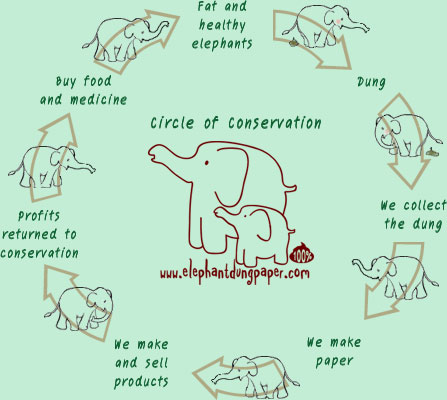
via elephantdungpaper.com
And of course, the best known of the genre is The Great Elephant Poo Paper Company whose “poo-tique” you can visit online. Consider this my nod to holiday gift guide blog posts.
The recession will not be recycled
Monday, December 8, 2008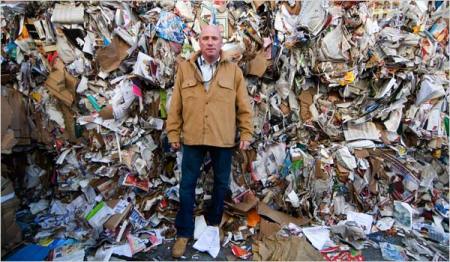
Jodi Hilton for The New York Times
Uh oh, looks like trash ain’t worth what it used to be. The Times reports today that recycled materials like plastic and cardboard, once sold as scap for a profit, are piling up because no one wants to buy junk anymore. It’s a development that sadly takes a big bite out of a cost/benefits argument for public recycling programs. Cities don’t seem to be cutting back on collection just yet, but the figures are dramatic.
On the West Coast, for example, mixed paper is selling for $20 to $25 a ton, down from $105 in October, according to Official Board Markets, a newsletter that tracks paper prices. And recyclers say tin is worth about $5 a ton, down from $327 earlier this year. There is greater domestic demand for glass, so its price has not fallen as much.
Apparently China used to buy a lot of our junk but stopped doing so when the economy turned. Perhaps the conversation can now turn to reducing the amount of junk Americans create in the first place.
Reblogging: We are what we eat
Monday, December 1, 2008Anna over at Bring Your Own is one of the first green bloggers I started to follow when I launched everydaytrash over two years ago now. BYO focuses on our disposible culture and its consequences. It was through trading links with blogs like BYO that I came to the self-realization that my own blog had an environmental—and not just political and artistic—theme. Anyway, Anna took a short break from updating BYO last summer in order to sail accross the Pacific Ocean on JUNK, a ship made of plastic bottles. The stories she and her colleagues returned with are both fascinaitng and devastating. Check out this post on the growing problem of plastic winding up in the bellies of fish. Here’s a photo ripped from that post, click through for the full thing complete with a video from the ship.
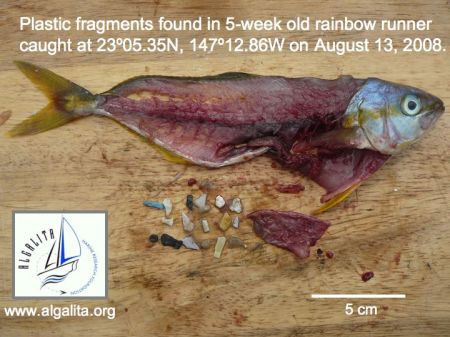
While the photo is kind of gross, I find the rainbow of plastic bits morbidly pretty. Someone should make awareness-raising jewelry out of this stuff, like post-apocalyptic pearls. Or maybe not. Wouldn’t want to start a for-profit plastic fish frenzy. Just from eyeballing the fragments in this sample, it looks like this fish ate pieces of over a dozen different plastic things that ended up floating in the ocean. It’s strange to imagine where those bits started out: action figures, food containers, toothpaste caps…
 everydaytrash