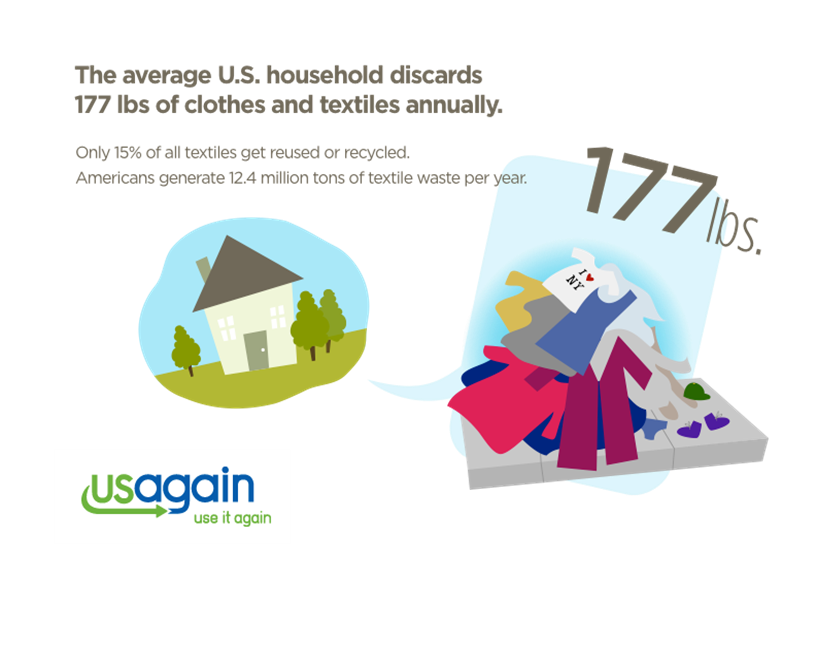
via USAgain
via USAgain
It’s been so long since I’ve done one that you may have forgotten that Weekly Compactor is our cutesy term for a roundup of links. This week, please enjoy clever upcycling tips recently shared across the blogosphere:
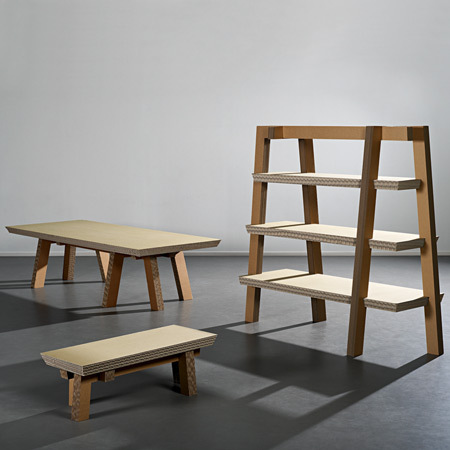
Arno Mathies' cardboard furniture via Curbly
A bunch of people shared ideas on how to reuse old blue jeans. I have to say though, I have yet to see anything cute or stylish made out of old denim. Have you? By all means share links and ideas in the comments. I have a feeling there are far better industrial reuses for jeans than trying to squeeze a second fashionable life out of them. After all, the washes and colors are objectively so universally similar in virgin form, yet subtle differences act as dramatic markers of class, taste and hipness…
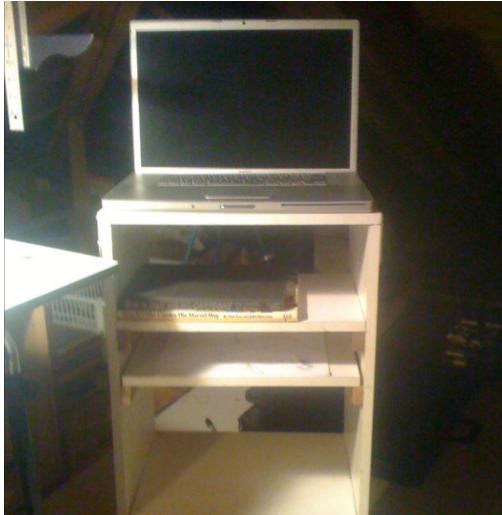
Check out this project carried out Calabrese style by my bandmate, Flex Unger aka Pasquale Cangiano, whose upcycling skills and self-built recording studio and we’ve featured here before:
What is Calabrese Engineering you ask ? What are the rules of Calabrese Wood Working ? Rule #1 never use rules or a ruler ! I found all this wood in the trash and crafted a computer stand / flat files for drawings to go near my drafting table so I can have a clear drawing surface and be online at the same time. I used no ruler at all and did all the measuring with the wood itself and eyeballed everything else. Yeah its a bit lopsided and make shift but that is the Calabrese style of building taught to me by my Grandfather he used no rulers either 🙂 Big Up’s to my band mate Leila Darabi’s Everyday Trash can I get a reblog ?
Click through for a slide show. Note the music that accompanies the photos is that of the modern son of Calabria and made in a warehouse in Brooklyn. More traditional regional music — I have learned from Flex — sounds like this. Or like children screaming.
The library at the Brooklyn Museum switched over to an online book archiving system and thus have no more use for the cards in their old card catalog. So they’ve been giving them away to artists, art of the book design students and, more recently, anyone who let’s them know what they plan to do with the cards. I wrote in and requested a bunch and arranged an appointment to pick them up. Stay tuned for literary upcycling updates.
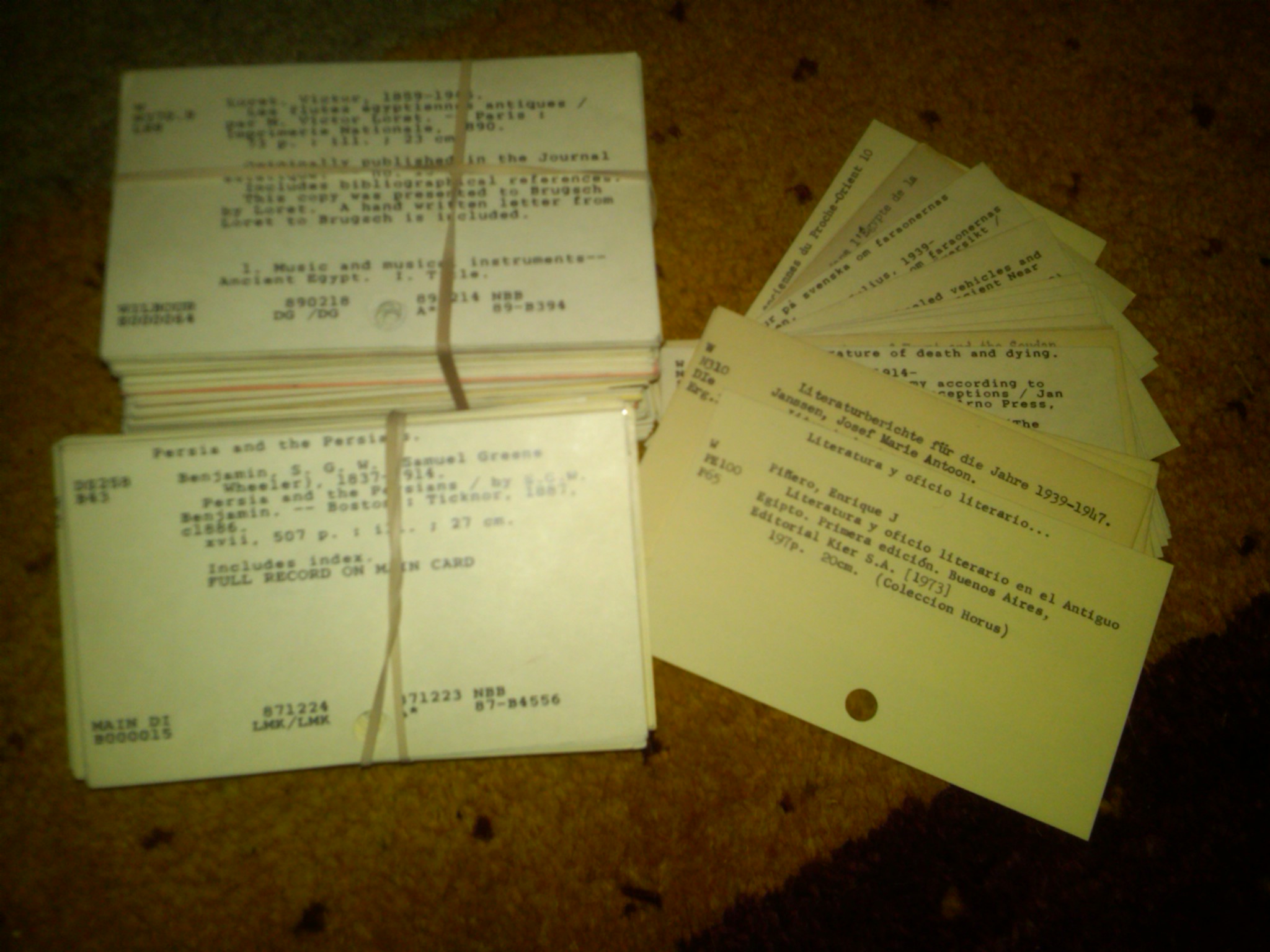
Cards
I tried to pick cards that had some personal significance, which was not as hard as I’d imagined it would me. More on that later. In the meantime, when’s the last time you watched Party Girl?
Adorable video and post from the always-inspiring AfriGadget.
I love TED Talks. My friend Leah (thank you!) just sent me this one. It’s adorable and informative. I think you’ll dig it, too. It’s this guy, Dan Phillips, explaining how he makes neat houses from salvaged materials. He shows photos, but also gets high brow about it all, explaining that the real problem is our need for things to look the same.
Happy Tuesday, trashies. The following is a free excerpt from British journalist Nick Rosen‘s book Off the Grid: Inside the Movement for More Space, Less Government, and True Independence in Modern America, published by Penguin USA this past August. The author has kindly shared this waste-related passage just for us. More on the book and larger “off-grid” movement here.
Or, if you hate reading, you can watch this handy book intro video.
—
From Chapter 3
I should apologize to the reader for returning to the issue raised so eloquently by Bob Reynolds in his letter to the mayor: toilets. It’s a big subject when you are off the grid—possibly the biggest. Everyone who lives off the grid has lost count of the number of times they are asked in a coy, slightly amused way, “So what do you do about, you know, going to the bathroom?” And now the entire drama unfolding on No Name Key has come down to toilets and the acceptability of the forty-two septic tanks and one composting toilet currently dealing with the human waste from the forty-three mainly part-time small family dwellings on the island with its aging population of retirees and second-home owners.
There are just four alternatives that would satisfy the new federal rules designed to prevent the leaching of chemicals and other noxious materials into the soil of No Name Key and then into the water table. Sticking with the status quo is not one of them.
The first is to build a full-scale commercial sewage system to service the forty-three homes. It would require a grid-scale power supply, and once installed it would be able to service a near-infinite increase in the amount of human waste in the small community.
The second option is known as a “thin-pipe” sewage system. It would be operated by electric pumps situated on or under the Bebe Rebozo bridge, but powered from the mainland. The third is the alternative favored by Alicia: a modified version of the septic tank that would meet the new standards. The fourth and final alternative is the composting toilet. This is a well-understood technology that, if correctly managed, produces a harmless material, very similar to rich soil, and can be used to grow organic vegetables. The solar-power faction had tentatively proposed a composter at one point, but had been howled down by the other side.
The one functioning composting toilet on the island is built by Clivus Multrum, a market leader in composting toilets. Although the owner, a postal worker, was out of town when I visited the island, Jim Newton took me to the home because he wanted to show me the huge object, conveniently stored under the raised first floor of the house, which like many on the island rested on stilts in order to reduce potential damage in case of fl oods. This design creates a covered area under the house—a basement at ground level, so to speak. As I walked around to the basement entrance, I passed a huge array of solar panels perched on a wooden pedestal, and a set of four Rolls batteries—the Rolls-Royce of solar batteries. They are known to have a far longer life and to be three times as heavy and four times as expensive as normal deep-cycle batteries. Next to the batteries, a white tank holds the gray water from the house. Gray water is the term for water from sinks, showers, dishwashers, and the like. Once used for washing, it can be used to fl ush a toilet or water a garden.
While most composting toilets are simple, functional, and inexpensive, the Clivus Multrum is the Hummer of composting toilets, a vast and intricate object. The unit in the bathroom is a normal toilet bowl, and a basement of some sort is required because a long, wide pipe travels down from the toilet to an ugly, green-ribbed plastic container. This container stands as tall as a man and takes up fi fteen to twenty square feet of fl oor space, with several doors for different functions. One is used to put in worms; another is used to remove the compost once it has transformed into an earthlike substance. The process can take many months. This is the reason for the large size of the contraption.
“The effluent drops down through this tube”—my escort indicated the green tube entering the composter—“from the potty upstairs.” Jim walked ahead of me toward the silent, brooding object. Once I had raised my video camera, he turned to me gravely and said, “Are you ready? This is not going to be a pretty sight.” He gripped the handle of the smallest door. “Are you ready for this?” he asked again. I nodded. “Now, I’ll lift the lid, but I won’t hold it open for a long time,” he said. The cover came back and hundreds of cockroaches ran for the darkness across a black, tarlike substance that was, presumably, the effl uent. I instinctively looked away, and by the time my eyes returned a second later, Jim had slammed shut the door. How the cockroaches had got there I cannot imagine, as the whole system is sealed. Could it have been via the toilet bowl upstairs?
One other pipe, a narrower one painted white, exited the composter, snaking its way around the basement before disappearing up into the house. I asked what this was for. “It’s an air vent,” Jim told me. “It allows gases to escape, all the way up to the roof. In any system—my own septic tank—gases are produced.”
Jim’s whole body sagged at the thought of the gases being produced. “So instead of letting them out around your home on the ground level, the gases are transported through the pipe to the very uppermost area so they can escape into the atmosphere.”
“What if the wind is blowing the wrong way?” I asked.
“Yup,” he said, looking grim.
By then I had met at least ten of the leading actors in this drama, and although I doubted the sincerity of some of the witnesses, I was still unsure about the detailed rights and wrongs of the matter.
But I knew where to go for an answer…..
—
For more background, here’s a Salon interview with Rosen and a HuffPo piece he wrote.
What up New York? Looking for a positive way to spend the afternoon of 9/11? Why not mosey down to Bed-Stuy for the grand opening of the Brooklyn Free Store? A bunch of local artists/scavengers/dumpster divers have claimed an abandoned lot and taken to using it for the swapping of skills and stuff on weekends. I plan to check it out for myself this Saturday. Hope to see you there.
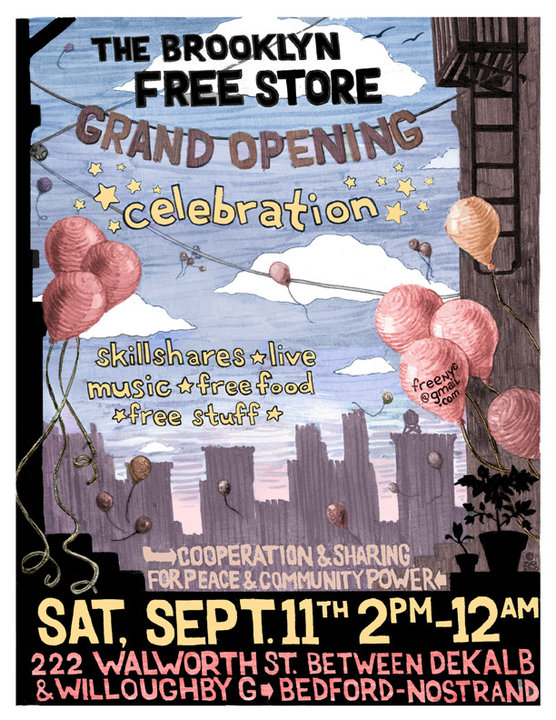
Grand Opening Announcement
Look out hipsters, dumpster pools have gone mainstream—for several Saturdays this summer, the city is closing off part of Park Ave so that people can swim in pools made from old trash receptacles. While Vic and I did lament not getting invited to take a dip in one last summer when we kept hearing about hidden pools in Brooklyn, I can’t imagine anything less fun than stripping down to a swim suit and aqua dumpster diving with strangers on Park Ave. A for effort, though, New York City.
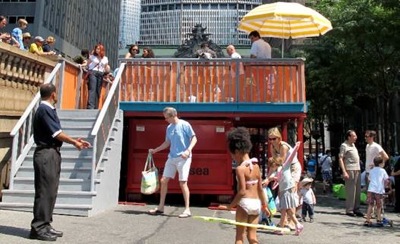
Photo by David Belt via Green Picks blog
via Green Picks blog (thanks for the tip, Brendan!)
You know how in movies set in Vegas the dealers are forever opening new decks of cards? Well, that happens in real life, too. And one resourceful designer thought of a clever way to reuse those cards: as the building material for a chair. Benjamin Rollins Caldwell and colleagues at BRC designs created the “Deuces Wild Chair.” It comes in two colors: red cards and blue cards. One question remains: how much does something like this cost? To view the company’s price list you have to register as a store. I’ll try calling when I have a moment. In the meantime, if you find out, spill!
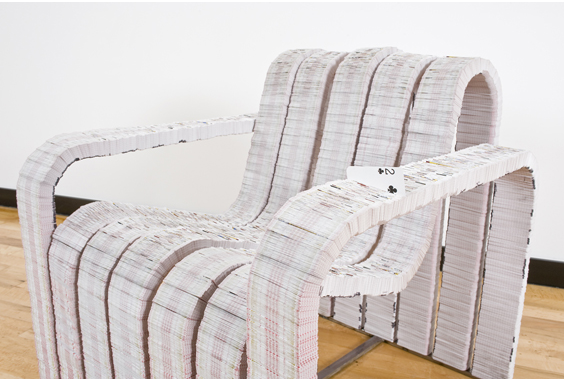
Deuces Wild Chair from BRC Designs
via Greenopolis
Adorable. via Boing Boing via unconsumption
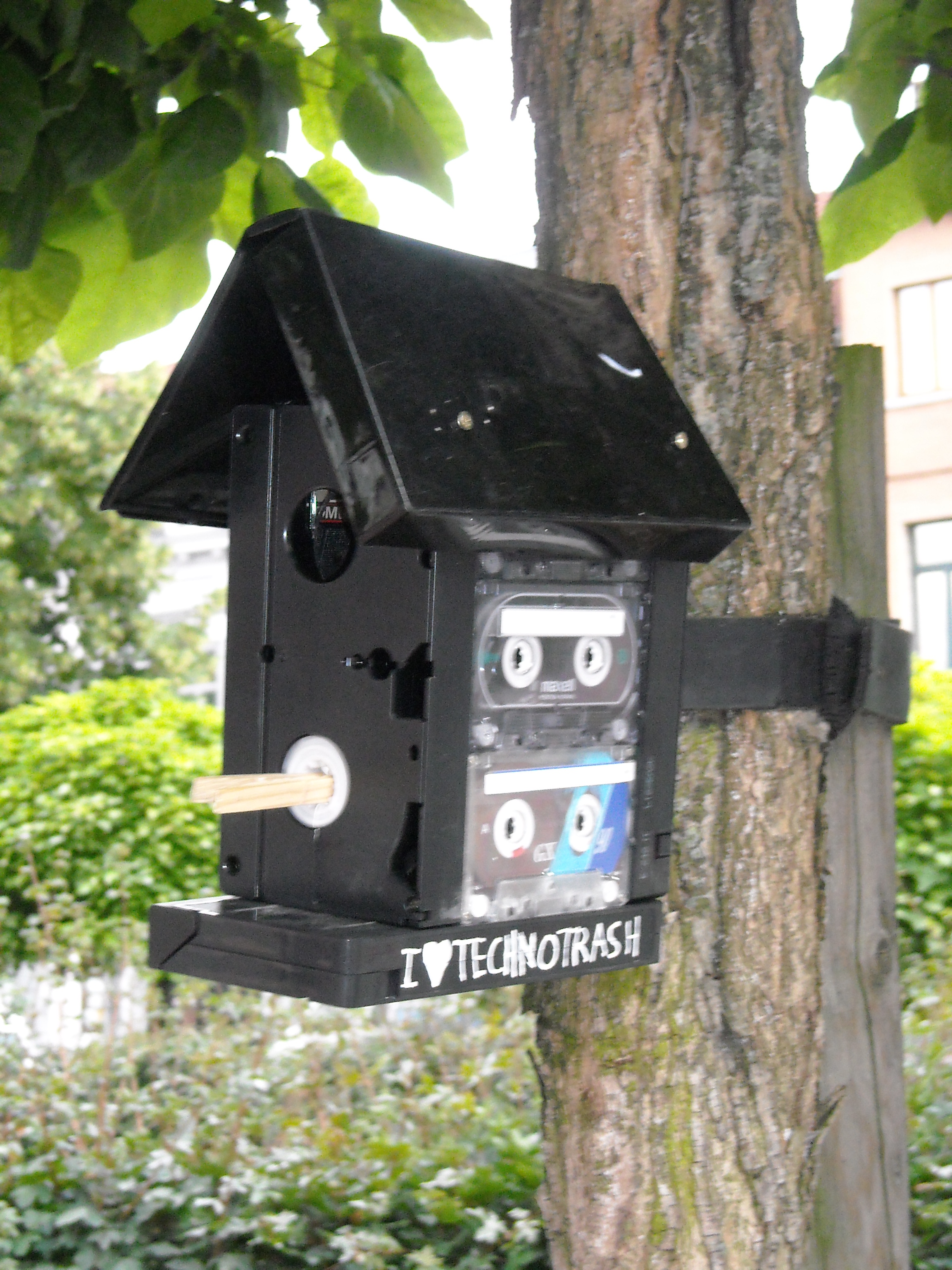
Spotted in Belgium
I spotting this inhabitat post via unconsumption. Matter of Trust, a San Francisco-based nonprofit dedicated to repurposing existing goods to prevent excess consumption will take your dog or cat hair and send that superabsorbant stuff to the Gulf of Mexico to help clean up the oil spill. Rad.
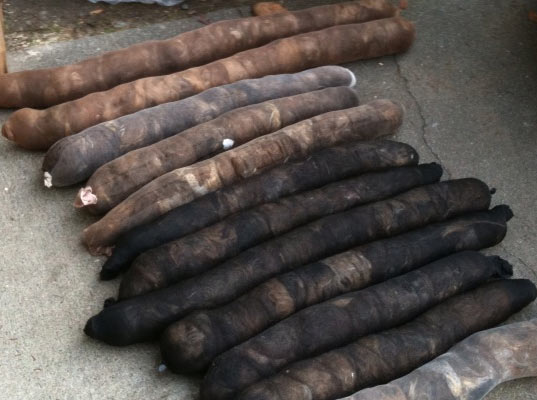
photo via inhabitat
Scientific American reports that despite an increased interest in recycling plastic, most Americans have to hunt around for places that will take back hard plastic items like ski boots.

Ski boots - photo via bumps.com.au
Click through for a list of resources on where to recycle at the end of the post—handy for anyone getting rid of equipment as the ski season draws to a close.
Don’t know what to do with your career come August? Why not sign up to a 1-year program in upcycling design? Can’t believe I haven’t seen this before:
In the fall of 2008, Eskilstuna College started a course on sustainable development and recycling technologies. The course runs over two semesters and is intended for students who wants to work both theoretically and practically with the creation of new products from recycled materials.
You will have to work with practically everything from furniture restoration to the jewelry manufacture and use your imagination and creativity and you will certainly gain new insights into what sustainability really means.
This is really as cool as one thinks. [Apply here.] The work of this years trashtastic students can be followed at their blog, and their flickr. Personally, I’ve got my eyes on this vinyl record fruit bowl:

Vinyl record fruit bowl
The student will stage an end-of-the-year exhibition, open 27 May-20 August, at the college in Eskilstuna, so if you pass through Sweden, be sure to make a detour. In Stockholm, creations can be purchased at swop:art.
 everydaytrash