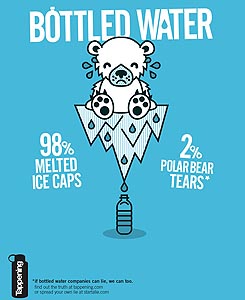
Just stumbled across this badass anti-bottled water campaign featured on Cool Hunting. If the water companies can twist the truth, environmentalist might just twist it back. Only with more style. Click through for the full CH post. This is my favorite.
CORRECTION: In the original post, I incorrectly assumed the Laila in the film was Laila Iskandar Kamel, the award-winning advocate, because I had heard about this famous Laila who worked with the Zabaleen. As it turns out, there are two Laila’s dedicated to this valient cause. This Leila apologizes for the error.
—
It’s been a trash-packed weekend, kids. After an amazing afternoon at the University of Trash on Saturday, I headed down to the IFC Center today for a noon screening of Garbage Dreams, Egyptian filmmaker Mai Iskander‘s documentary about three young men growing up Zabaleen in Cairo. New Yorkers, take note, it’s playing through Thursday as part of DocuWeeks 2009. And if you’re in LA, there’s a docuequivalent. Here’s the trailer for those who missed it the first time we posted it.
The story follows teenagers Adham, Nabil and Osama as well as Laila, a social worker who runs The Recycling School, a place where young community members learn about everything from safe recycling practices to how to negotiate a fair contract with local residents to collect their trash. I won’t give away the whole plot, but a lot of the conflict centers around the fact that after 100 years of depending on the Zabaleen, the city of Cairo signs contracts with foreign waste hauling companies who threaten the trash pickers’ way of life. It’s an emotionally pulling conflict. My natural instinct is to root for the Zabaleen to win out and remain the city’s trash collection system, but it’s hard to feel good about all that comes along with that profession…life in a garbage slum, generation after generation working harder for less money, dangerous contact with sharp and toxic materials…
You never hear from the Egyptian government in this film. Or from the foreign waste companies. And I was never quite sure who was buying the plastic and metal recycled by the Zabaleen. The film left me curious about many things—not the least of which is the source of the often repeated stat that Cairo recycles 80% of its waste thanks to the Zabaleen. After watching the film, I believe it, but would like to know how it was calculated. Overall, though, the film accomplishes its main objective: to put a human face on a group of invisible people. Check it out and let me know what you think.
P.S. My favorite part is when two of the boys visit Wales to observe recycling in a developed country as part of some government program or something and one says to the other: “Dude, did you see that? That car just slowed down to let someone cross the street!” Spoken like a true Caireen.
PingMag, a sleeping Tokyo-based magazine about design, posted a long and very interesting piece about the art of Leo Fitzmaurice in April 2007. I was enlightened by a friend only this weekend, and feel that even though it’s dated, you have to check out the trashy relational art of plastic garbage bags, conference flyers and french fries boxes! Examples shown below, but check out the post!
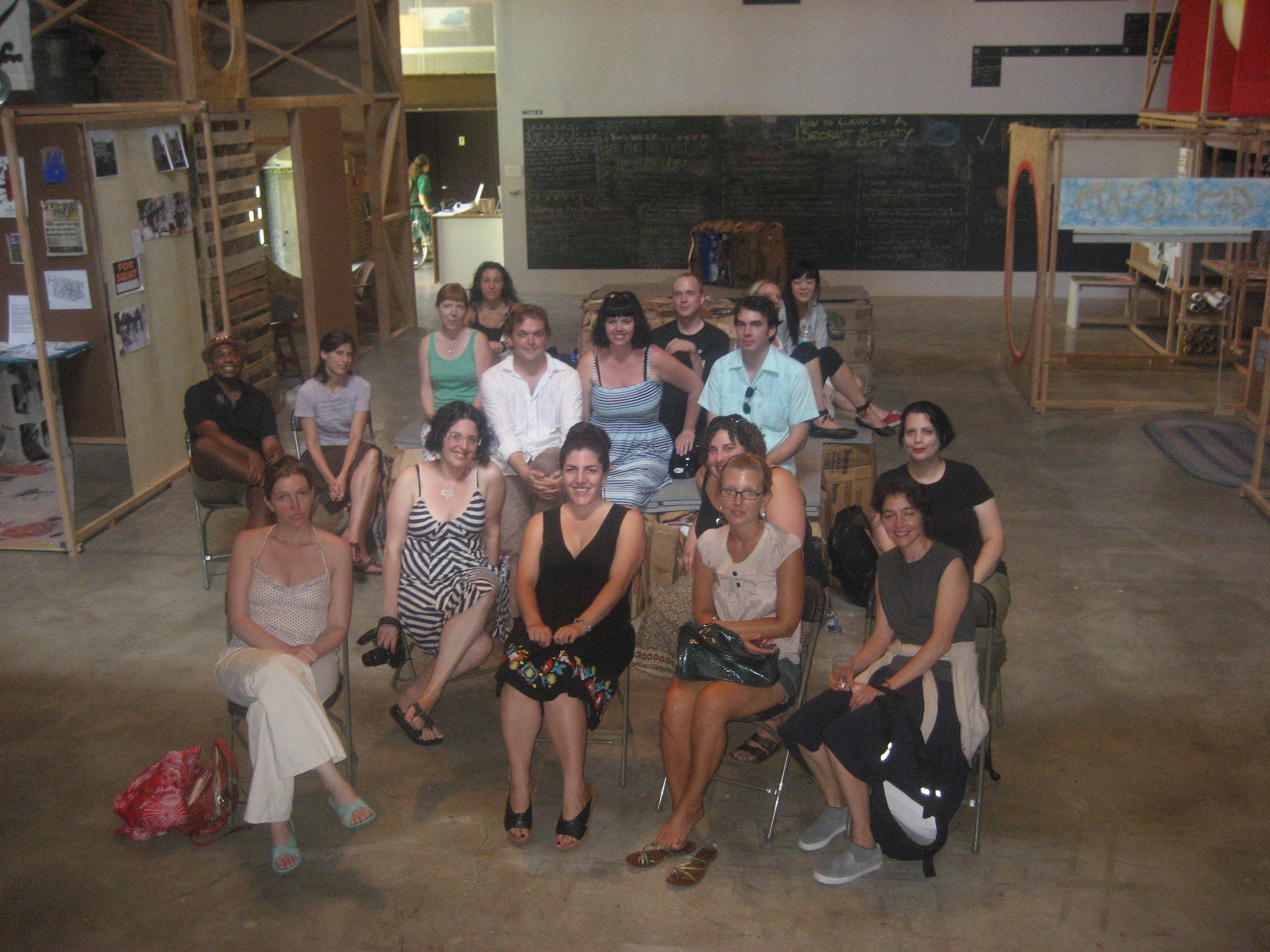
In case you missed it, the everydaytrash.com team headed out to Long Island City, Queens yesterday to participate in the interactive installation project “University of Trash” created by Michael Cataldi and Nils Norman. Our contribution was a quick overview of some of the ways we and other garbloggers talk and track trash online followed by an informal conversation about trash and consumer culture. It was a fantastic event. We were very pleased by the supportive turnout (just look at how many people trecked all the way to Queens for everydaytrash.com) and thrilled by the contributions everyone made during the open discussion. We learned a lot. Afterward, many of us headed to the new beer garden on the border of Long Island City and Astoria. We learned a lot there, too.
Here are links to the blogs I shared as well as some of the other resources and inspiration points Victor and I mentioned. Thanks again to all who came. It was great to see you IRL.
Garblogging links:
There are many ways to approach trash online. Everydaytrash.com is the broadest of garblogs, posts on our site can cover any topic as long as there’s a trash angle. The following are a few examples of other blogs I love that address trash in a variety of ways.
There are people who track their own waste like Sustainable Dave of 365 Days of Trash. Dave’s 365 days are up, but his blog lives on as a wonderful resource for how to create less trash. For example, take a look at the bag he carries everywhere he goes and the tools of waste reduction within.
There is also a whole subgenre of garblogs focused on plastic. My favorite of these is Beth Terry‘s Fake Plastic Fish. Beth covers all kinds of cool plastic topics and at the top of her homepage you can always find a little chart of her monthly plastic use.
And of course, there are trash artists who can take a dull dry topic like solid waste management and make something fun and wonderful out of it. I consider Ruby Re-Usable of Olympia Dumpster Divers and Little Shiva of The Visible Trash Society my closest colleagues in the field of garblogging. Their work constantly inspires me and has consequently inspired a number of everydaytrash.com posts. Sometimes we even collaborate. See also Cynthia Korzekwa‘s Art for Housewives.
In addition to artists making things out of garbage, there are also a few photographing trash in its native habitiat. Last Night’s Garbage is a wonderful blog to add to your reader—emphemeral photos paired with found text are uplodaed a few times a week. I didn’t have a chance to share these at the University of Trash, but Gutter Envy and Garbager also post trash photos.
And then there are the Upcyclers, taking recycling to a new level by finding reuses for objects that may be even better than the first use. Victor and I contribute to an Upcycling portal, which I encourage you to check out. Some of my favorite upcycling examples come from the Etsy Tashion street team. I’ve also been transfixed lately by artist Robert Fontenot‘s Recycle LACMA project.
Beyond upcycling there are blogs that focus on our consumer culture and point up the waste chain to ask if we could produce less stuff in the first place. The unconsumption tumblog run by Rob Walker (of the Times magazine column Consumed) and collaborators is full of interesting nuggets that fall under this theme.
And, of course, there are a ton of amazing DIY blogs that discuss and teach you how to make things yourself to create less waste and reuse scraps and trash. Some of my favorties are Instructables (which allows users to upload their own instructions on how to do and make things), the hip sewing blog Threadbanger, the ReadyMade Magazine blog, and the Make Magazine blog.
Which leads me to the scariest subset of garblogs, the green shopping blogs. I have mixed feelings about these sites becuase they all point to things I WANT and feel I NEED and want to HAVE because they are made out of sustainable products and trash. I try hard not to, but sometimes I look at Great Green Goods (which has a series of great green spinoffs for babies, pets, weddings and more). These sites are good to find trashy and geen substitutes for things you would have bought anyway.
I also love to peruse style sites like the wonderful blog Fabulously Green. But again, it makes me want to shop.
Finally, I want to share a few internaitonal garblogs just to point out that these conversations are taking place all over the world. I absolutely adore the site AfriGadet run by Hash of White African, a blogger and tech guru and several collaborators. The tagline says it all “Solving everyday problems with African ingenuity,” which more often than not involves upcycling.
Keith R. of the Temas Blog covers trash in Latin American. And the nonprofit Goods4Good keeps a Tumblog of their work repurposing excess from American companies in Africa and Asia.
There are many, many more links I could include here but I think the list is already a bit overwhelming. Let me just throw in some of Victor and my top recommended trash resources.
There’s the amazing animated video on the consumption chain, The Story of Stuff.
There’s the book Skräp by journalist Mattias Hagberg, which is in Swedish so I’ll share the link to his interview with Victor.
And there are the books Garbage Land and Bottlemania and the blog of their author, Elizabeth Royte, primordial guides for anyone who hopes to understand this massive topic.
Thanks again to the Sculpture Center and Michael Cataldi for making this talk possible. We hope to follow up on the dynamic discussion that took place and look forward to more in person everydaytrash.com events.
To keep up to date on all our trashy activities, fan the blog on Facebook and share the link with your friends!
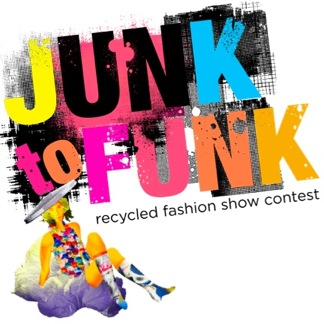
The Portland-based arts collective Junk to Funk is hosting its fourth annual recycled fashion show contest. Check out the call for artists for details, the deadline is October 14th.
Junk to Funk
Can’t wait to see what amazing trashion designs you people come up with. If we can’t rid the world of waste, we might as well wear it!
The US government Car Allowance Rebate System (CARS), or as its been nicknamed, Cars for Clunkers, has just lifted off, but it looks like it will be running for a lot shorter period than the posted November 1st deadline. The purpose of CARS is to “energize the economy, boost auto sales and put safer, cleaner and more fuel-efficient vehicles on the nation’s roadways,” through giving auto dealers the possibility to offer up to $4,500 discounts to people trading in an old car (which must be demolished) when buying a new one. NPR (along with other news outlets) reports today that the program is running out of money. $1 billion is apparently small potatoes when everyone wants a hybrid. House Democrats now hope to add another $2 billion to keep this tra$hy car campaign up and running.
In Sweden, a program with similar ambitions existed up until recently, through which a $1,350 voucher was made available to those buying an “eco-car”, i.e. one of those supposedly less environmentally damaging ones. At the moment, it seems that instead of extending the program, buyers of eco-cars will be have their auto tax waived for the first five years.
Of course, the idea of eco-friendly cars is still more or less humbug. Further, scraping used cars produces a lot of metal trash (or rather, tra$h), along with lead, sulphuric acid and mercury, that needs to be taken care of. Whether this is included in the plans to energize the economy and boost the auto industry, I don’t know. Regardless, I’d rather see another $2 billion invested in public transportation (starting with the horribly malfunctioning US railroad system).
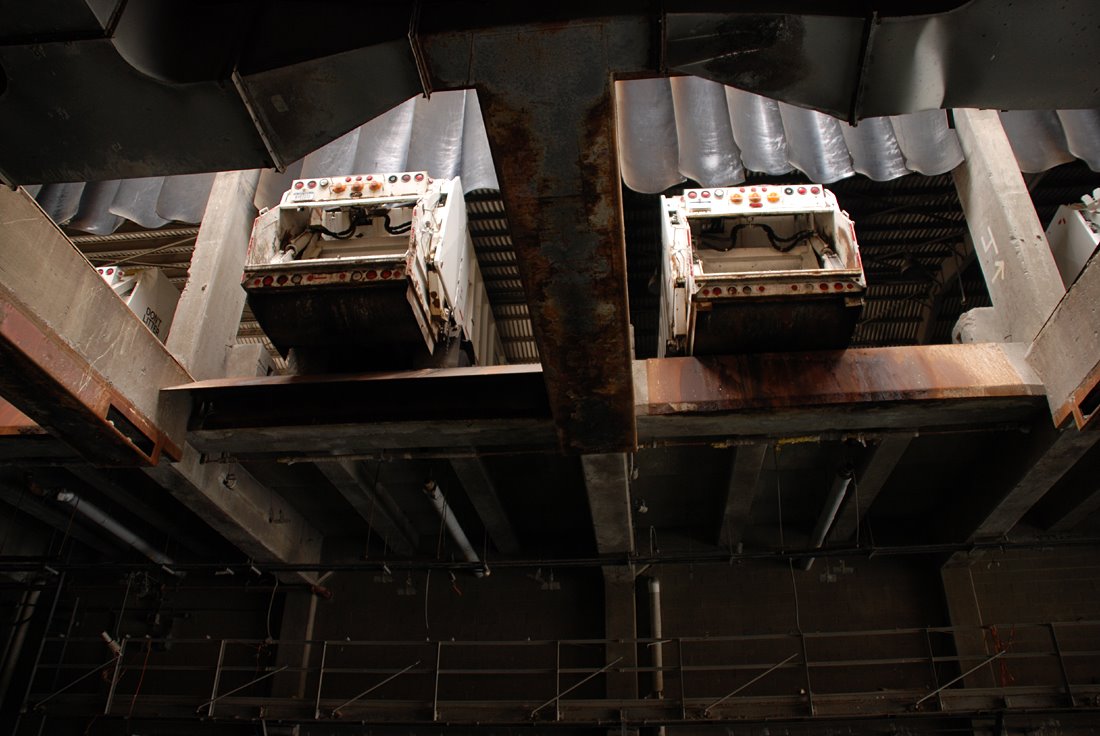
Filmmaker, photographer and location scout Nathan Kensinger publishes two photo essays per month on his blog dedicated to “the abandoned and industrial edges of New York”. In yesterday’s offering, he turned a gritty eye to the Hamilton Avenue Marine Transfer Station, which was decommissioned with the closing of the Fresh Kills landfill, but is now open for bids from solid waste management companies should any be interested in retrofitting the space.
Courtesy of Nathan Kesinger Photography
As it is summertime and as I am obsessed with this shit, I have been spending a lot of time lurking about the abandoned and industrial edges of the city. Luckily, I have friends who enjoy similar pastimes.
But in addition to a general interest in the waterfronts around my home, I have a particular soft spot for marine transfer stations because they were at the heart of my entree into the world of trash and subsequent life as a garblogger. As a journalism student at Columbia, it was following the debate over whether or not to reopen a nearby marine transfer station that opened my eyes to the fact that New York had no longterm solid waste management plan and that the impact of that absence of planning hit poor people first.
I got REALLY into that story. Once, while canoeing on the Gawanus Canal, I even tried to paddle into the Hamilton Avenue Marine Transfer Station. That was five years ago. And as Kensinger’s post points out, the thing is still standing there, useless and empty (he also brings up the whole superfund Gowanus deal, which is about the millionth reminder that I need to read up on that). Anyway, useless though it may currently be, this space sure does look nice in Kensinger’s photos. I recommend clicking through to see them all.
More on marine transfer stations and my trash as class awakening after the jump. Jump!
Blogger Therese J. Borchard published an intruiging post today (also on Huffington Post) about how trash nights equals sex nights in her household (that’s Monday and Thursday). The post could also be seen as a story of how a dinner party gets swamped by discussions on different local policies on when trash is picked up. All in all its a bit weird, but one just have to love passages such as
A year or so ago, I got fed up with my mate’s constant begging for sex, so one night I asked him point blank, “What is the minimal number of times a week that you need sex in order to be satisfied?”
“Twice. Absolute minimum.”
“Fine,” I said. “You get Monday and Thursday. If you don’t beg any other night.”
It then occurred to me that Monday and Thursday evenings were trash night. We drag out all of our rubbish and recyclables from the last few days and leave the stuff on the curb … to be picked up at 5 a.m. the next day, when the trash truck compressors will try to wake up our slumbering kids.
Yes, trash night is sex night in our household. Clearly a “Seinfeld” episode in the making.
This concept … of a scheduled sex session … was so intriguing to the other birthday guests that trash talk dominated the entire conversation for the rest of the evening.
“What about bulk pick up?” one asked.
“And what if you miss a day?” asked another.
“Eric’s lucky,” said the guy crossing his legs. “Our trash is only picked up once a month.”
This just in from Brazil’s Secretariat for Social Communications (SECOM): The hazerdous waste found in Brazil and shipped back to the UK last week may have been labeled as recycling materials, though the containers turned out to hold diapers, animal feed packages and other nastiness. In response, Brazil is envoking international law on the matter. According to Em Questao, SECOM’s online newsletter:
The Ministry of Foreign Affairs has asked Brazil’s Permanent Delegation in Geneva to report the traffic of hazardous waste from the UK under the terms of the Basel Convention. On July 23, 2009, Minister Celso Amorim spoke with British Chancellor David Miliband, who said the subject will be given the required attention. Amorim stressed Article 9 of the Convention, which says that the exporter shall bear responsibility for returning the illegal shipment to the country of origin. The Ministry of Foreign Affairs, Ministry of the Environment and IBAMA are still evaluating the need for additional measures.
The Fellowship for the Interest of Dogs and their Owners (FIDO), “serving Brooklyn’s off-leash community” have had some trash-related gripes lately. Follow the drama here. Thanks for the heads up, Elizabeth.
Swedish Public Radio reports today that with the use of a new filter and new methods (such as taking surface water – plastic floats), a research team has found large amounts of plastic fibres in watercourses in Sweden. With previous findings being between 1 and 20 fibres per cubic meter (approx. 35 cubic feet), the preliminary results of 10,000 fibres per cubic meter are alarming, to say the least.
The research team is currently working on a theory which explains the existence of such high quantities with rubber tyres and synthetic clothes, giving off the fibers. Regarding natural clothes (cotton etc.), they too come steeped in plastic fibres these days, says Fredrik Norén, part of the research team. (Which incidentally is why I wash new clothes before I wear them, letting the big machines at the local laundromat worry about the problem…)
The clothes theory gives a troubling insight into exactly how much plastic we use these days, and for what. It also pushes us to ask “why though?” Any takers on that, feel free to post comments. When the research project is finished, I hope to follow this up.
[As a side note for the linguists out there, can you tell where in this post you find UK English? I had fun writing this up.]
Also from City Room/NYT: The electronics industry sues to block new recycling requirements (we take this as good news because that means the law is having an impact;
Buffalo and Philly get Big Belly solar powered trash compacting recepticles; and
Missing Ohio kids found alive in the trash (morbid but true fact: while we almost never post them, we come across a lot of baby in the trash stories that end another way, it’s so refreshing to read a happy ending in this one).
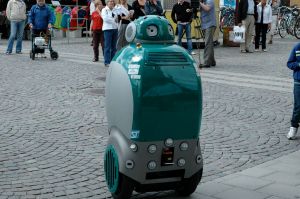
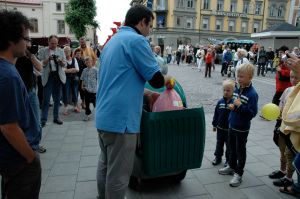
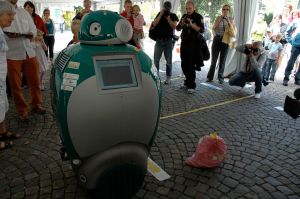
Remember Dustbot, the cute little robots that are being developed to slave for humans who want their trash taken care of? They are now being demonstrated to the public in the Swedish city of Örebro. Swedish fabulous blogger Helena Bergman, originally from Örebro, has captured this for all to see. This is the future everyone (and as the New York Times wrote yesterday, some say this isn’t all fantastic)!
For Dustbot, cobblestone is a piece of cake
Kids watch in amazement as Dustbot makes a pick-up



 everydaytrash