Gomibako

Friday, October 10, 2008 by

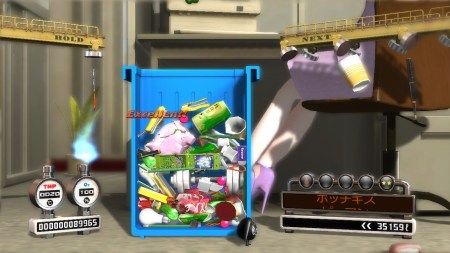
Dumpster Toaist just shot me this amazing tip, a trash-themed game called Gomibako was debuted for Playstation at the 2008 Tokyo Game Show.

Here’s what the Gamespot review had to say: “Think Tetris, but with garbage. That’s the simplest description of Gomibako, a PlayStation Network puzzle game we found in the Sony booth here on the show floor of the 2008 Tokyo Game Show. It’s a bit early for proclamations–we’re only halfway through day one of TGS–but we can safely say that Gomibako is one of our favorite games of the show so far.”

How to compost a horse carcass

Wednesday, October 8, 2008 by

What do you do when your trusty Rocinante kicks the bucket?  Perhaps not a great concern for Brooklyn-based readers, but in Colorado and other rugged places, apparently dead horses end up in landfills.  Or rendered, which sounds like made into glue but does that even happen anymore?  Anyway, the best way for green riders to honor their fallen companions is to cover them up with a 50/50 mix of hay and manure and let them disintegrate into usable soil.

More on horse composting can be found at the Denver Horse Examiner.  Or if you live in Oklahoma, you can attend this how-to seminar.  And of course, the more common link between horses and compost is that their poop is an excellent ingredient to a good pile.

This reminds me, has anyone seen Harry Potter in Equus yet?

Horse silhouette via Karen’s Whimsy

Trashy honeymoon idea

Tuesday, October 7, 2008 by

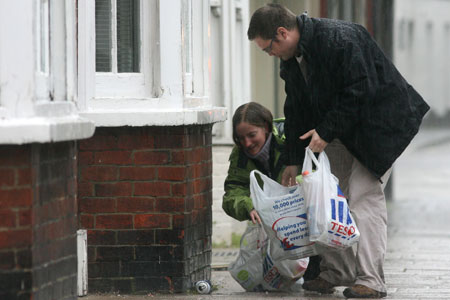
Strapped for travel cash?  Follow this British couple’s lead and redeem cans for miles.

Photo ripped from Metro.co.uk

Waste Man

Sunday, October 5, 2008 by

“Some works are made in wax to be cast in bronze; this was made in domestic waste to be cast in fire.”—Antony Gormley on his Waste Man project (photo ripped from artist’s site)

Via the Belgian blog Sculpture, a resource for art students studying sculpture at Beaux Arts in Brussels.

Chikumbuso

Sunday, October 5, 2008 by

While in Zambia this week, I came accross a straw hamper in the waiting area of the Swedish embassy in Lusaka labeled “Chikumbuso“.  It was decorated with an HIV ribbon woven from plastic bags and had a sign on it saying any old plastic bags placed in the hamper would be used to make new woven bags.  It turns out Chikumbuso is a community center that serves widows, single mothers, grandmothers and orphans by running a school for the children and teaching women income-generating skils (such as how to make a bag out of old plastic bags).  I tried to find the place online before leaving, but alas was not able to arrange a visit.  I did find this sweet little video of the women singing, though.

Photo by LearnServe International, found on Flickr

Weekly Compactor

Sunday, October 5, 2008 by

This week in trash news:

  • A former street child from Kenya cleans up the neighborhood;
  • Message to people who put messages in bottles, don’t toss them in the ocean;
  • U.S. fines a Korean company for dumping oily waste;
  • Padre Island, Texas is getting trashed; and
  • Allied Waste tries out recycling incentives in Minnesota.

Photo of Texas beach debris ripped from the A.P.

Metaphorical trash

Tuesday, September 30, 2008 by

Check out these trash bags shaped like kids to raise awareness for street children.  PS posting may be light this week, I’m in Zambia with iffy Internet.

Fancy Trash

Thursday, September 25, 2008 by

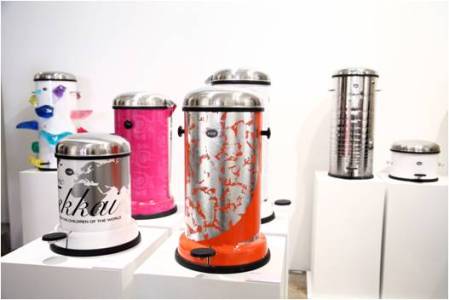
Famous people designed and sold their fancy trash cans recently to help the hungry and children.  Check it.

Photo by Sara Jaye Weiss for Startraks, ripped from Media Bistro. 

Chris Jordan, trash photographer

Thursday, September 25, 2008 by

kw

I discovered photographer Chris Jorndan‘s series “Intolerable Beauty: Potraits of American Mass Consumption” via a helpful tipster yesterday.  The panel above is ripped from the artist’s stock images on his site and links back there, where you can view a wide selection of his work.  I highly recommend a click through.

Here’s some of what Jordan has to say about these landscapes of consumption:

“Exploring around our country’s shipping ports and industrial yards, where the accumulated detritus of our consumption is exposed to view like eroded layers in the Grand Canyon, I find evidence of a slow-motion apocalypse in progress. I am appalled by these scenes, and yet also drawn into them with awe and fascination. The immense scale of our consumption can appear desolate, macabre, oddly comical and ironic, and even darkly beautiful; for me its consistent feature is a staggering complexity. “

Trashtastic Tuesday with Erica Dolland

Tuesday, September 23, 2008 by

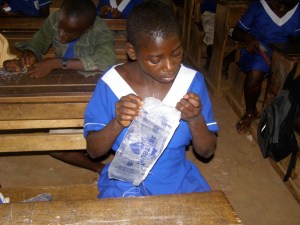
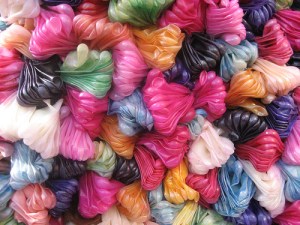
  Last week I had catch-up drinks with Erica Dolland, an old friend from high school who just returned to New York after a couple years working in Ghana.  I told her I now have a trash blog.  She told me that among other amazing activities she had undertaken since we last hung out, she taught Ghanaian kids to fashion handbags out of the plastic bags water is sold in throughout Africa.  And so another trashtastic tuesday was born.  Expect to see much more everydaytrash coverage on the privatization of water  in the coming weeks.  I’m all riled up and have some cool stuff to share.

everydaytrash: How did you get the idea for the project?

Dolland: It was a two-fold interest from needs I identified in the community: environment preservation and income generation.  Running water is not accessible in many of the rural areas of Ghana, and its not distilled.  Therefore, Ghanaians resort to purchasing water bags to consume drinkable water but then dispose the bags on the ground when finished. I’m a huge environmentalist!  One thing that is so captivating about Ghana is that the country occupies a beautiful, serene, lush green landscape.  But there are minimal efforts and initiatives dedicated to environmental conservation.


In Ghana, women are also severely marginalized and their employment opportunities are scarce due to a myriad of social injustices. You have a segment of population that can’t participate and is impoverished.  I wanted to create a project that would generate income for women and their children, as well as improve environmental conditions.


everydaytrash: Who participated?

Dolland: I opened the workshops to people in the community who were interested in learning how to make the bags to generate additional income for themselves.  I had a lot of receptiveness to the project from Ghanaian youth in the community.  I don’t think a lot of adults were keen on carrying around former trash, but the kids thought it was cool.  I really only expected girls to be interested, since they are groomed at a young age to take interest in catering and sewing activities.  Much to my surprise though, boys expressed the same level of interest.  I ended up conducting several workshops in the local elementary and junior high schools.  The younger students definitely had a harder time, since they weren’t as adept to using a sewing needle–that’s right, no sewing machines here, way too expensive–but they ended up creating a functional bag to carry school supplies in.  Their teachers even loved the idea and participated in the workshops.


everydaytrash: Is it ongoing?

Dolland: I was sent to Ghana by an organization called The International Foundation of Education and Self-Help.  The over riding mission of the organization is to “help others, so they can help themselves.”  When I conceived the project I wanted to make sure it was sustainable after I left.  It was mandatory that anyone who participated in the workshop was required to to teach someone else in the community. When people would come to my house asking for one-on-one lessons, I’d say “Nope, find so and so, she’ll teach you how to make it.”  It is my hope that people will expand on the basic construction that I taught them to create even more unique bags.

everydaytrash:  Sweet.  We’ll look out for them!

__

Workshop photos supplied by Erica.  Photo of Erica tutoring ripped from her Facebook page.

Condom redux

Friday, September 19, 2008 by

  Happy Friday.  In lieu of a weekend news roundup, I give you an article so ridiculous it stands on its own.  According to this dubious report in Pakistan Daily, Chinese companies are recycling used condoms into colorful hair ties.  Now I’ve heard of creative reuses for EXPIRED condoms that have NEVER BEEN USED.  Fair enough.  But used condoms?  While I know the claims that a recycled latex hair tie could give someone AIDS are totoally bogus, the psychological factor is just a little tough to get past.  For the same reason I would rather wear a sweater knit from sheep’s wool than dog’s hair and would rather fertilize my garden with animal poo as opposed to human manure.  It may not make sense—color me urban and sheltered—but I am not in control of my personal ick factor.  But I tangent.  The whole reason I was googling condoms and recycling and coming across articles like this little piece of comedy is beacuse I’ve been thinking a lot about green sex this week.  It’s an uncomfortable reality that latex condoms add up and end up in landfills.  The alternatives aren’t great.  There are less convenient methods and less effective condoms.  In discussing this with a friend this week, we agreed that there’s a real need for biodegradable condom.  You know, one that actually works.

[The photo is one I took at the Toronto AIDS Conference in 2006, a close-up of a very fabulous dress.]

Trashtastic Tuesday with Tracey Smith

Wednesday, September 17, 2008 by


  This week I got a chance to communicate with Tracey Smith, British journalist and author of the new Book of Rubbish Ideas.  I know, I know, it’s Wednesday already and not Tuesday.  The tardys are racking up and we’re not even through September…

— 

everydaytrash:    I see you’ve founded International Downshifting Week in England.  What is downshifting and what’s this holiday all about? 

Smith:  I put IDW together a few years ago following my own huge downshift back in 2002.  Downshifting for me is about giving a positive embrace to living with less and cutting back on your time and finance budgets too. 

Remember, the more money you spend, the more time you have to be out there earning it and the less time you get to spend with the ones you love. 

Downshifting can have a positive impact on your mental health and well being, your pocket, your relationships and of course, your bin!  Living more sustainably means you’ll be encouraged to cook from fresh and put those peelings in the composting bin, which will make a huge difference to what you throw away.

There’s a heap of information on the website – take a look at this site and don’t forget to read the Downshifting Manifesto!
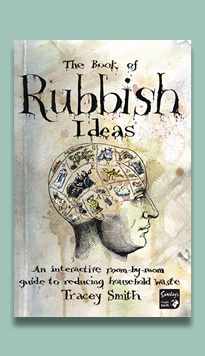
everydaytrash:  The Book of Rubbish Ideas will be out soon with ideas for greening every room in the house.  Can you leak us a teaser?  We read a lot about our bathrooms and kitchens and their impact on the environment.  What can we do to downshift, say, our bedrooms?

Smith:  That’s really easy! If you take a look at the website for the book, you can read the entire Introduction, Kitchen and Study chapters via a clever magazine gadget thingie – techno really isn’t my bag, but even I could work out how to use it, so it must be simple!  

As for bedrooms, some of my favourite tips from the book include: 

Crocs have become one of the biggest-selling shoes. They have a successful recycling scheme in America, and will soon be starting a similar scheme in the UK. Your old Crocs are recycled back into new shoes and donated to people in need around the world. Visit their site for details of the American project.

• Soft glowing, low-energy LED lights are perfect for the whole house and particularly gorgeous in the bedroom. They will save you money and some come with lifetime guarantees on the bulbs/lamps. The oldstyle filament light bulbs or lamps are not recycled yet, but things could change, so check with your local recycling centre ormunicipal site to see what their protocol is and check out Vessel for details of their range of eco-lighting.

• Get your sewing kit out and customise some of your outfits. It’s great fun and easy to do. Find your nearest haberdashers and buy some patches, sequins, mirrors, crystals and braid to liven up your wardrobe.

everydaytrash:  What’s your next trash journalism project?

Smith:  Actually, I’m taking a short breather to a tour for the book and am talking to a couple of publishers about exploring other sustinable living topics, so I’m sure the pen won’t be out of my hand for long.

I wholehartedly believe that if we all start making small and simple changes to our everyday lives, we’ll be able to effect enormous change.  Not only that, but we’ll also be able to help our children find the right, green groove too.

To buy the book at a reduced rate and to read Tracey’s blog on more Rubbish Ideas, check the site.

Portrait provided by the author, book cover ripped from her site, Indonesian kids w/Crocs ripped from Croc’s Web site.  

Note: everydaytrash thinks recycling Crocs is a good idea, concedes that they are comfy for nurses, applauds the company for donating the product in countries where shoes are scarse but is still disturbed by the ubiquity of those strange rubber shoes around Brooklyn.  
 

Little Orange Kitchen

Sunday, September 14, 2008 by

The Etsy Trashion Blog has a  nice little interview with Laura of Little Orange Kitchen on her salvaged paper designs (photo of hot Frida wallet ripped from Etsy).

Trashionistas

Friday, September 12, 2008 by

Organicasm has compiled a handy list of the Top 50 Green Fasion and Design Blogs. [Full disclosure, everydaytrash made the list.]

Ella…ella…ella

Friday, September 12, 2008 by

You may have noticed that I like umbrellas.  I especially enjoy creative ways to reuse the cheap ones that break, like this skirt.  ReadyMade has instructions on how to make one of your own.  It’s twirly.  Also, I love that they left the little strap hanging in the one pictured.