Posts Tagged ‘zero waste’

rag pickers

Wednesday, January 24, 2007

rag.jpg The Hindu reported today that rag pickers, beggars who collect trash and sell off reusable bits of it in India, are sneaking into dumps. Toxic contamination can’t keep them out of the rubbage yards and can’t stop them from burning trash in search of metal scrap to sell.

The image of these clandestine fires led me to search the Internet for more rag picker trivia. I found this decent overview describing the tough but honorable profession of collecting what would otherwise be wasted and somehow forging it into a living. And then I found this article declaring recycled bags made by Indian beggars to be all the rage in London.

longest night

Sunday, December 24, 2006

sunrise.jpg Friday was the longest night of the year, a holiday observed by the watered down decedents of the Persian Empire by staying up late reading poetry with our families. We didn’t celebrate this year, but today some Iranians I had never met before came to my mother’s apartment. They admired the bulbous brass lamp hanging above the dining room table (now housing a light bulb instead of an oil dish), the old tile on display, a samovar. We drank tea from small glass cups rested in silver holders and discussed the ill-preserved Empire from which they had emigrated and the cherished objects imported and restored in the years since.

It was a valuable lesson in zero waste and recycling.

If the fragile inlay of a mosaic picture frame buckles in the humidity of this non-desert land, wet it down to mold it back into place. Worn antique embroidery should be protected behind glass and mounted on walls. Draw the shades when leaving the house to keep the sun from bleaching silk-woven carpets. Miniatures of kings holding court, couples reclining on plushy cuddler recliners and horses charging can be displayed in shadow boxes built from small shelves covered in black velvet and fitted to a large antique frame. Simple Persian bedspreads can be cut and sewn around cheap pieces of foam to create a luxurious Bedouin effect in any living room, much cheaper than purchasing furniture when one first arrives in a new country.

I looked around at the things that covered the floors and shelves and walls of the rooms I grew up in and saw them for the first time as symbols of a nomadic culture, started long ago on another continent, but carried on by me and my sister as we dutifully cart our carpets and picture frames from one New York apartment to the next. These things were built to weather skirmishes and sand storms. They were designed to be portable. And to last.

recycled tires

Monday, December 11, 2006

tire.jpg  Once upon a bizarre summer job, I found myself gripping for a film crew hired by the University of Minnesota to make a documentary about wetlands management.  For one shoot, we got up early to attend a demo in the middle of a swampy area where people with ideas for reducing the impact of logging trucks had gathered to share their inventions.

The demo included two sections: actual bridges, for which groups had put together more conventional crossings and ground covering.  The ground covering group was a real mixed bag of entrepreneurs and environmentalists.  Local rangers marked off a large circular track and each participant covered one section of the track with his or her materials.  Next, a logger drove a huge truck around and around over all of the materials.  Finally, a team from the university lifted up the covering materials and assessed the damages.  It was a surreal experience: watching a pristine area of nature be destroyed in order to mitigate future destruction of a much larger area.  One of the more memorable ideas came from a man named Lenny whose master plan it was to unroll huge spools of flattened old tires on the wetlands and have the trucks drive over them.  Most of the other ideas involved wood chips, plastic tarp or some combination of the two.  Lenny had developed his tire carpets as a way for the army to clear land fields.  It was remarkably effective, he said, to drive a tank through unwinding old tires and detonating old mines.  Sadly, the army didn’t want to buy his product because if and when they did clear fields, they preferred seeking out and collecting mines (a more costly process).

Now, I only have Lenny’s word to go on for all of this, so let’s all swallow our salt now.  The only thing I know for sure is that unprocessed old tires are no good for protecting wetlands from logging truck damage and that Lenny was a creative old guy with an unusual product that needed a home.  I don’t know what ever happened to Lenny, but I hope he hooked up with the IWMB, because they have a ton of ideas on their site for what to do with old tires.

give more, waste less

Friday, December 8, 2006

reintrash.gif  While I’m usually the first to trash DSNY initiatives, I have to admit their waste-reducing gift ideas are excellent.  I especially like the notion of giving entertainment, we don’t take advantage enough of the arts around us.

Speaking of art, I’m not sure it’s entirely necessary to spend tax dollars creating clip art to demonstrate waste-reduction principles.

bittersweet news about polyethylene terephthalate

Tuesday, December 5, 2006

pet-bottles.jpg Plastics News, in a piece picked up by Waste News (yes, the trash media industry is that large and that specialized), reported this week that while recycling of resin made from used PET is on the rise, it has yet to make a dent in mass consumption of plastic bottles. Polyethylene terephthalate, better known as PET, is “a thermoplastic polymer resin of the polyester family“. The mass throwing away of PET products is a real shame when you consider that they could be melted down and reincarnated as carpet, clothing, hypoallergenic pillow stuffing and all kinds of other neat products. Not to mention the creative uses people have found for raw PET, such as the building and construction products extensively reported over at the The Temas Blog.

coo coo for coco products

Wednesday, November 22, 2006

coconut-2.jpg  While I was out of town and slacking on my garblogging duties, my colleague Keith over at The Temas Blog was busy rounding up all the possible uses for coconuts under the sun for a two-part series on recycling their shells.  In part one, he informs us of the problem of coconut waste clogging landfills in Latin America…all those discarded husks drunk dry and tossed aside (there’s even a Utube video to demonstrate the draining and enjoying of a fresh coconut).  Then, in part two, he offers an exhaustive compilation of coconuts reimagined.  I know what you’re thinking, but you’d be amazed at all the coco byproducts out there: seat upholstery for cars, carpet padding, rope and, of course, art.  It’s inspired stuff.  

iFrod

Friday, November 3, 2006

Check it, Stay Free! magazine is doing with broken iPods what I want to do with used bridesmaid dresses.

Always a bridesmaid…

Wednesday, November 1, 2006

uglydress_1902_11609825.jpg In my quest to find a use for my small collection of bridesmaid dresses, I came across uglydress.com and just had to share. The three red dresses I’ve sported down the aisle are not that bad in the grand scheme of things one might have to buy, alter and wear in public on behalf of a friend getting married. But they aren’t exactly reusable, either.

Just what are we supposed to do with the dress when the pageant is over? I refuse to throw them away and I don’t know any little girls with dress-up boxes (and wouldn’t encourage this sort of gender-specific dress-up item anyway).

My mother, always hopeful about these things, suggested I have the skirt of my last bridesmaid dress shortened and that I wear the apple-red satin ballgown as a cocktail dress. With a triple-layer of black lacey stuff under the skirt and a halter neck, the cocktail party I wore that thing to would have to be on ice (in which case I wouldn’t have right muff for the occasion anyway).

So, I’m left with the aforementioned halter gown, a maroon seperates number (the top of which presumably could be used as the shell of a suit, if I had the sort of job that required wearing suits), a spaghetti strapped ankle-length dress that might have been reusable if it didn’t constitute the physical proof of that time my cousin joined the navy, married a stripper and forced me to be the “red” in their patriotic-themed ceremony. Also, it’s just a little too orange, which always kills a red dress.

I know there are used dress sites, but I’m looking for something bigger and badder ass to do with my collection. An installation project perhaps? A hipster crafts project? Please post any and all ideas as comments.

another tale from the road block

Thursday, October 26, 2006

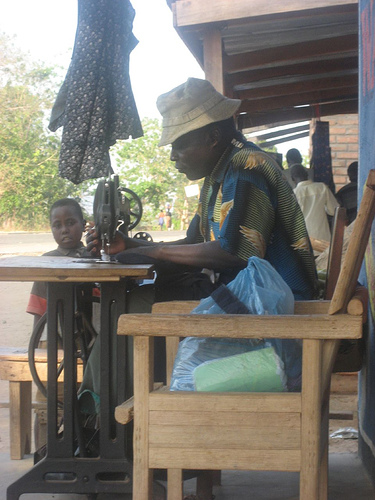
tailor.jpg

This will be my last African trash post for a while, or at least the last anecdote from Malawi that I post lest you start thinking the focus of this trash blog has become way too narrow, wonky and/or new agey. Never fear. I actually didn’t return with as many trash stories as I had anticipated for two possible reasons. One, I was working the whole time in my non-trash-related capacity as a nonprofiteer and two, (to state the screamingly obvious) people don’t throw much away in Africa.

I didn’t even see a trash fire, though I looked for them. A couple of times I saw smoke in the distance, but when I asked, the people around me explained that the dry season was ending and they were burning back the fields to prepare them for the pre-rainy season planting.

Most of what I saw were stories of zero waste and recycling. While sitting in front of Ivy’s convenience shack near the road block just south of Kande Beach, I watched a tailor appear out of nowhere and set up his sewing machine on the porch. He pulled out a bag of rags and started piecing them together, remaking old shirts into patchwork swaths of fabric to become new clothing or mending smaller tears in blouses and pants to make them good as new.

The whir of the tailor’s machine lay a pleasant track of ambiant sound beneath the layered murmors of children playing in the dirt road, women chatting while shopping for maize, men gossiping with the tailor and chatting up the women and the forestry worker from the road block coming by to charge his cell phone. I was reading Garbage Land, starting it really, and had just come to the part where the author is describing her quest to produce less waste than the average American.  In this chapter, she guiltily throws away old clothes because she already has too many rags and has no other use for the battered cloth.

And then I had one of those useless Western moments that feel like epiphanies, but are really just recognizing the obvious for the first time.

Yes, I thought, we do throw too much away and that would never happen here. What I should do about this sad fact, remains a mystery. Or rather a challenge. One I hope to explore tangibly here–back amidst the excess of America–with this blog.

Campus Sustainability Day

Wednesday, October 25, 2006

csd-logo-2006.jpg From the president of Columbia University:
Dear fellow members of the Columbia community:

On Wednesday, Oct. 25, Columbia joins other colleges and universities around the country in marking Campus Sustainability Day–an event designed to spark discussion and action to reduce the environmental footprint of college campuses. Columbia’s students, faculty, and staff have a long-standing commitment to responsible environmental stewardship–and this day is an opportunity not only to reflect on our accomplishments to date, but to build on them for the future.

The event will take place from 11:00 a.m. to 4:00 p.m. on Low Plaza and will feature information tables, sustainability kits, and a live Webcast from 12:30 p.m. to 2:30 p.m. linking us with campuses nationwide.

Columbia researchers have led the way on environmental issues worldwide–from El Nino to asthma in urban neighborhoods, climate change, and environmental policy making. Locally, Mayor Bloomberg recently announced an expansion of Columbia’s efforts to advance environmental protection–New York City’s engagement of the Earth Institute to advise its new Office of Long-Term Planning and Sustainability.

This semester, working together as a community, we are taking a fresh approach to thinking about and managing our own environmental impact, with the establishment of the Office of Environmental Stewardship, under the direction of Nilda Mesa. We have a number of new initiatives getting underway. Among these are:

* Examining ways to reduce our energy consumption, limit our greenhouse gas emissions, and obtain power from renewable energy sources in the future;

* Incorporating environmental and energy enhancements in new construction projects at Columbia;

* Improving our recycling practices and establishing composting programs;

* Launching a Sustainability Advisory Council that will include academic, administrative, and student members;

* Expanding the Environmental Stewardship Web site to serve as a virtual forum for exchanging ideas and tips related to the environment and our daily lives.

The address of the site is www.columbia.edu/cu/environment. I invite you to join our celebration of Campus Sustainability Day. It is a good step toward working together as a University to help preserve and enhance the environment of our campus, our community, and our planet.

Sincerely, Lee C. Bollinger

elephant dung paper

Wednesday, October 18, 2006

elephant-butts.jpgelephant-dung.jpgelephant-dung-processing.jpgelephant-dung-paper-finished.jpgelephant-dung-paper.jpg

Update: photos!

Excuse the delay, I’ve returned in a daze from Malawi and my jet-lagged brain is having trouble re-sizing photos for everyday trash.

So trust me when I say I have pictures of elephants and of their dung and of that dung being processed and of the beautiful handmade paper that results from the process.

The elephants I saw at a well-stocked game park called Liwonde. The paper-making from their dung I saw in the city of Blantyre, a pleasant little town with purple flowering trees and even a side-walk or two (in sharp contrast to the dirt roads throughout the rest of the country).

PAMET is an NGO in Blantyre set up by a British woman and now Malawian-run that collects discarded bits of paper and cardboard and shreds it, along with plan fibers, elephant dung, burlap sacks and baobab bark to make thick and delicate sheets of paper from one or all of those ingredients. They also have an educational program whereby they teach others to make paper or briquettes to heat their homes by packing it all into disks. I took a photo of an old school exercise book on the floor of the old paper stock room waiting to be made into pulp for new stationary. It’s a wonderful cycle if you think about it: making new paper out of an old exercise book in order to sell and then be able to afford school fees and a new exercise book.

I made a solo roadtrip to the rural north of the country and along the way talked to many, many Malawians, all of whom mentioned bad economy and expensive school fees as factors holding them and their country as a whole back in this world.

Oh, and no I didn’t see Madonna. In fact, Madonna didn’t come up once in conversation while I was there except in the form of emails from home.

Photos coming soon. And by the way, it’s nice to blog again. I missed you all!

Minnesotans against trash

Friday, September 29, 2006

hdpledge.jpg  While in Minneapolis for a friend’s wedding, I was standing in line at a gift shop when I noticed a green guide to the Twin Cities.  The guide compiled tips on organic shopping, along with coupons for local green vendors.  I noticed a promo for the Web site reduce.org and decided to check it out when I got home.  As it turns out, reduce is a great site chock full of simple tips for cutting down on waste at home and at the office.  You gotta hand it to those (sometimes) progressive upper Mid-Westerners!  And the advice isn’t specific to Minnesota, it could be follwed anywhere in the U.S.

The Humanure Handbook

Thursday, September 28, 2006

humanurecover.jpg  After writing here about composting toilets, I felt a little guilty about dismissing them as yuppy outhouses so I decided to look just a little more into home and office use.  After contemplating a place to begin research, I found the answer right here on the sidebar: howtocompost.org.  In the comments, I also found a link to The Humanure Handbook by Joseph C. Jenkins, a catch-all volume with punny chapter titles with tons of information about the ecological, practical and spiritual benefits of turning human feces into soil fuel (I recommend the section entitled “Deep Sh*t” in which he speaks to a humble nunnery).

But are these composting toilets practical?

In a later chapter, Jenkins predicts:  “The toilets of the future will also be collection devices rather than waste disposal devices. The collected organic material will be hauled away from homes and composted under the responsibility of municipal authorities, perhaps under contract with a private sector composting facility.”

Until then, we city dwellers might have trouble fitting  a bulky toilet with a composting chamber into our tiny apartments and anyone without a serious compost pile will have some serious problem solving to do when it comes time to empty the john (you farm people, however, had best get to it setting a green example).  Advocacy step one includes community composting and adding human waste in municipal recycling collection. 

just trash

Tuesday, September 26, 2006

radio.jpg The folks at Justice Talking, the NPR news magazine that examines global issues through a legal lens, took a long, hard look at trash this week. Of particular note are a liberal-Libertarian debate on whether to mandate or pay people to recycle and commentary from a trash lawyer. Check out the program’s website for an interview with trashie author Elizabeth Royte on exporting and reducing trash, lessons from Colorado on defining and building a “zero waste” community and a fantastic sidebar of recommended reading.

the temas blog

Monday, September 25, 2006

casa.jpg  In case you haven’t noticed, the real value in everyday trash isn’t the content of the posts per se, but the wonderfully dense sidebar of wide-reaching resources in garbology.

Today’s recommended click-through is The Temas Blog where environmental issues affecting Latin America are broken off into bite-sized chunks and translated for our convenience by fellow garblogger, Keith R.

Check out his recent post on casa PET in Brazil where two-liter soda bottles are recycled as building materials for homes.