
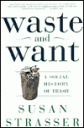
 Susan Strasser’s bio describes her as “a historian of American consumer culture.” Her book, ‘Waste and Want: A Social History of Trash’ covers America’s tranisiton from a thrifty,resourceful culture to one whose definition of “trash” has vastly expanded.
—
everydaytrash: In your book, you say that trash is defined by our sorting processes. How have those processes/our definition of what is trash/disposable evolved in the developed world?
Susan Straser: The sorting process that creates trash varies from person to person, and it differs from place to place. Some people are more frugal or sentimental than others; some cultures value saving things – the Scots have this reputation – while nomadic people, who must travel light, save less. Above all, sorting is an issue of class: wealthy people can afford to be wasteful, while the poor scavenge for materials to use and to sell.
But the sorting differs also according to skill. Repair ideas come more easily to people who make things. If you know how to knit or do carpentry, you also understand how to mend a torn sweater or repair a broken chair. Even at the end of the nineteenth century, when factory production was well established, many Americans possessed the skills and consciousness required for repairing. Now making and repairing things have become hobbies, no longer typical and on their way to being exceptional.
Most Americans produced little trash before the 20th century. Goods were sold in bulk; even in cities, people practiced habits of reuse that had prevailed in agricultural communities; durable items were passed on or stored in attics or basements; broken things could be brought back to their makers, fixed by somebody handy, or taken to people who specialized in repairs. In cities, ragmen worked the streets, usually buying bones, paper, old iron, and bottles as well, and selling the junk to dealers who marketed it in turn to manufacturers. This trade in used goods amounted to a recycling system that provided raw materials for industrial production. It faded with the institution of municipal trash collection, new papermaking technologies that substituted wood pulp for rags, the mechanization of bottle-making, and the rise of giant modern meatpackers who marketed massive amounts of byproducts to fertilizer companies.
everydaytrash: Is it possible to curb or reverse that trend?
Strasser: I do not think we will revive the stewardship of objects and materials that was formed in a bygone culture of handwork. I do like to think that new ideas of morality, utility, common sense, and the value of labor have begun to emerge, based on the stewardship of the planet and of its natural resources. Recycling and composting programs are now recognized as viable options; activists have pressured both government agencies and corporations to create such programs and to reduce waste at the source. Some businesses and agencies have responded only under pressure; others have cooperated, usually persuaded by environmentally concerned managers in their own ranks. After decades of assuming that public policy and corporate profit-making would send us always in the direction of saving time and trouble, some people and enterprises have begun to promote practices that require more of both. Recycling has been successful, and not because of market incentives.
evreydaytrash: How do different cultural beliefs about charity affect the amount of waste we produce?
Strasser: Giving old things to the poor has long been a common act of charity, practiced by individuals and by organized groups. During the decades around the turn of the 20th century – the same period when municipal trash collection was being established, encouraging middle-class people to throw things out – new kinds of charities began to accept donated materials. The personal relationships fostered by dealing directly with beggars yielded to a new sort of benevolence: giving things to organizations like Goodwill and the Salvation Army. These organizations offered impoverished people jobs, spiritual salvation, and a chance to be consumers, and they provided the better-off a virtuous outlet for unwanted things, free from social discomforts. The organizations also fostered new ways of thinking about the sorting process: people could now avoid the trouble of repair, getting rid of unwanted things without having to define them as worthless.
everydaytrash: In researching your book, what were some of the most interesting stories of reusing and repurposing that you came across?
Strasser: The stories and ideas were endless, and endlessly amazing to me. People used broken crockery and glued shattered glass back together. Leftover food was regarded as a resource, often even leftovers on people’s plates. Some practices – such as “turning” thinning sheets by tearing them down the middle and sewing the outer edges – are mentioned so often in so many advice books that we may regard them as commonplace. Butterick and other pattern manufacturers sold patterns for pieces of dresses – collars, cuffs, skirts, and sleeves – so that women could renovate dresses that they deemed old-fashioned. New buttons or trimmings were an even easier fix. The wealthiest women sent their old clothes back to Paris couturiers to be remade and brought back into style.
everydaytrash: Is there a modern-day equivalent of the rag picker?
Strasser: There are literally modern rag pickers in third-world countries. In the developed world, contemporary recycling systems offer some analog to the post-consumer recycling of the ragpicker, the rag-and-bone man, and the paper mill.
###
Waste and Want is available from the publisher, ask your local independent bookstore to order you a copy.

 Hands down the best part about having a trash blog is that my weekly web searches lead me to other people out there doing similarly bizarre work on trash-related matters. And sometimes, when I’m very lucky, other trashies trolling the Internet stumble accross this site and contact me. Such was the case recently when I received a very nice note from the (not so) amateur photographer behind the wonderful new art garblog,
  Carl’s Jr. uses
 Happy first day of Spring!
 Hello from Hong Kong. The lovely YMCA here provides broadband in every room, so before my 24 hour Internet card wears off, I thought I’d post this photo from today’s jet lagged excursion to Central Hong Kong. Not much to report, trash-wise, though I do want to report on the long flight over. The kind flight attendants at Cathay Pacific ask each guest if s/he would like an eye shade instead of providing one in the little kit with toothbrush and travel socks. I’d like to believe this is to cut back on wasted materials. In honor of this, perhaps-minor-in-the-grand-scheme-of-things-though-still-noted-and-appreciated gesture, I plan to make myself a travel smock when I get home using my sizable-and-formerly-useless eye mask collection. Stay tuned for more Asian trash stories when I hit the main land…
 From March 3rd through March 18th I’ll be in China chillin’ with the family, testing the accuracy of my definition of “Chinese food” and, because I can’t help it, taking pictures of trash and the people who move it, live in it and profit from it. Though I can’t promise regular posts from the People’s Republic, I can offer a much better solution: Kimberly!
 This week in trash news:
 Check out this
  Even though it didn’t win an Oscar, I think you’ll appreciate
  The
The 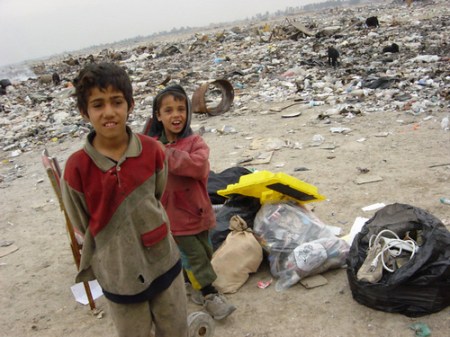
 Looks like
  everydaytrash