Remember the Naples trash crisis? Photographer Gigi Cifali has an incredible series to help if you don’t. Click here to see it, it’s the box all the way to the right called “NAPLESREMAINS”. He also has some supercool shots of abandoned pools, so poke around—the artist’s bio says he was trained as a topographer but got bored staring at landscapes just to record their size.
Thanks for the tip, Jenny! I look forward to any juicy Naples trash gossip you stumble upon.
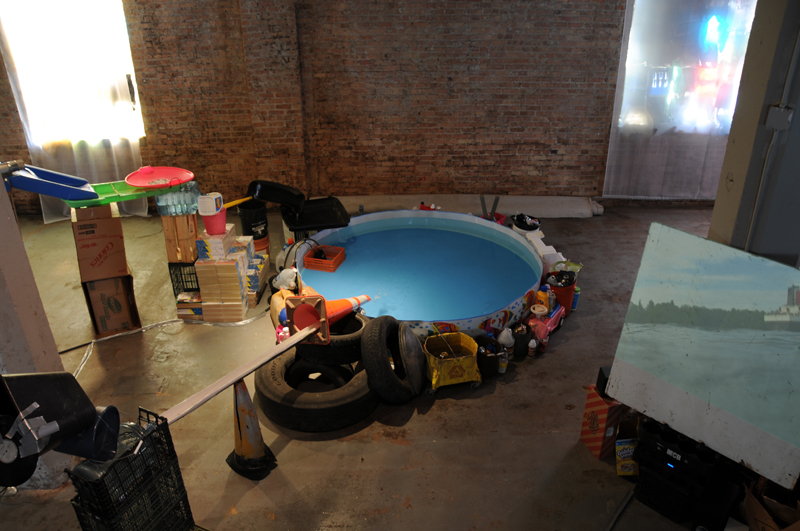
Paul Lloyd Sargent is an artist who spreads his time around New York State—from Brooklyn to Syracuse to Clayton—making “rivers” out of trash which he displays in local galleries.
Example of a "trash river"
According to Sargent, this project aims “to comment on the way we artificially manage natural waterways in the U.S. Typically I go to a community along the Great Lakes or St. Lawrence River and do some sort of official or guerrilla trash clean-up, then use the stuff I find to build an installation I call Freed: Maquette for an American River. It’s a long story as to how I got here (based on a history I share with Abbie Hoffman up on the St. Lawrence River) but that’s the short of it.”
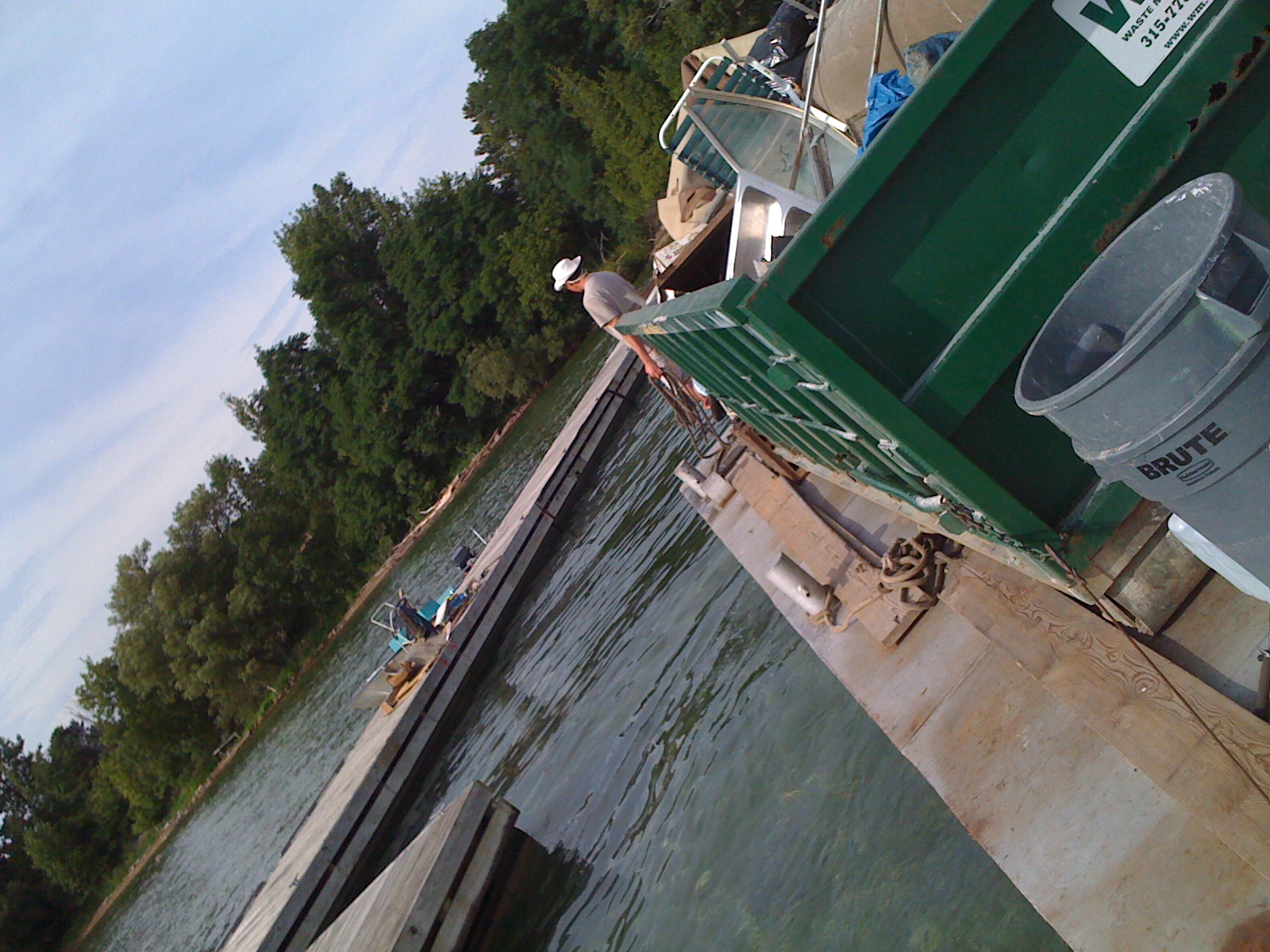
To collect materials for the project, Sargent and a “crew of river rats” navigate barges down the river, collecting trash collected under people’s waterfront homes.
River rat barge
The latest trash river will be constructed in Clayton, New York between the last week of August and Labor Day weekend. We look forward to updates on the work and its impact.
These trash rivers remind me of an installation trash artist Donna Conlon did once for which she made a river of plastic water bottles along the steps of an art museum in Costa Rica.
Thanks for the tip, Media. And thanks, Paul, for the photos and inspiration!
From August 19th to September 26th, gallery Under Minerva in Park Slope (656 5th Avenue) open their gates for the exhibition Is This Recyclable? Ad text reads
Artists in various media utilize found objects, recycled materials, ready-made objects and non-traditional materials for the creation of their artwork.
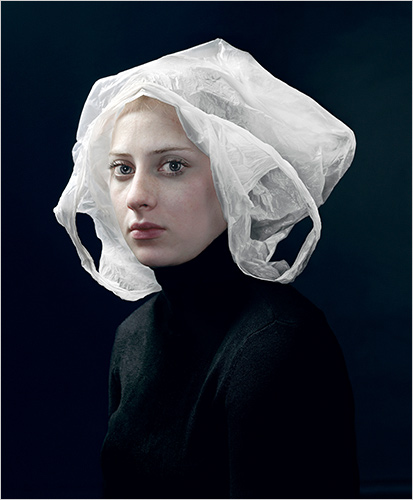
For the 400th anniversary of Henry Hudson‘s accidental discovery of the greatest city on Earth, Kathy Ryan, director of photography for The New York Times Magazine has curated a show up now at the Museum of New York City of contemporary Dutch artists asked to update their classical tradition. Behold: The. Very. Best. One.
Foam Fotografiemuseum Amsterdam and Robert Mann Gallery via nytimes.com
It’s called “Bag” and is one of several Hendrik Kerstens‘ portraits of his daughter on exhibit.
I humbly suggest that this become a traveling show, because I can think of no more logical future for this collection of works than a sojourn at the Rijksmuseum Amsterdam Schipol.
I forgot to mention this morning, that Trash Wars joins a motley crew of trash-themed video games. There’s the Japaense game Trash Panic now available from Play Station, there was that kid who made a Donkey Kong-like garbage collector game for a school project, and then there was the TrashCade, a more literal take on the subject. Know of any others? Send them our way!
UPDATE: I should have Googled before hitting publish. Trash, the game, has a post-appocalyptic theme wherein trash is used as building material. And check out this amazing overview of how trash cans are used in video games from the user-edited site Giant Bomb.
In video games, Trash cans do not serve their tradition purpose. Relatively few games employ a mechanic for the disposal of trash. Rather, whenever trash cans are featured in video games, it is mostly for the purposes of weaponry or cover.
PingMag, a sleeping Tokyo-based magazine about design, posted a long and very interesting piece about the art of Leo Fitzmaurice in April 2007. I was enlightened by a friend only this weekend, and feel that even though it’s dated, you have to check out the trashy relational art of plastic garbage bags, conference flyers and french fries boxes! Examples shown below, but check out the post!
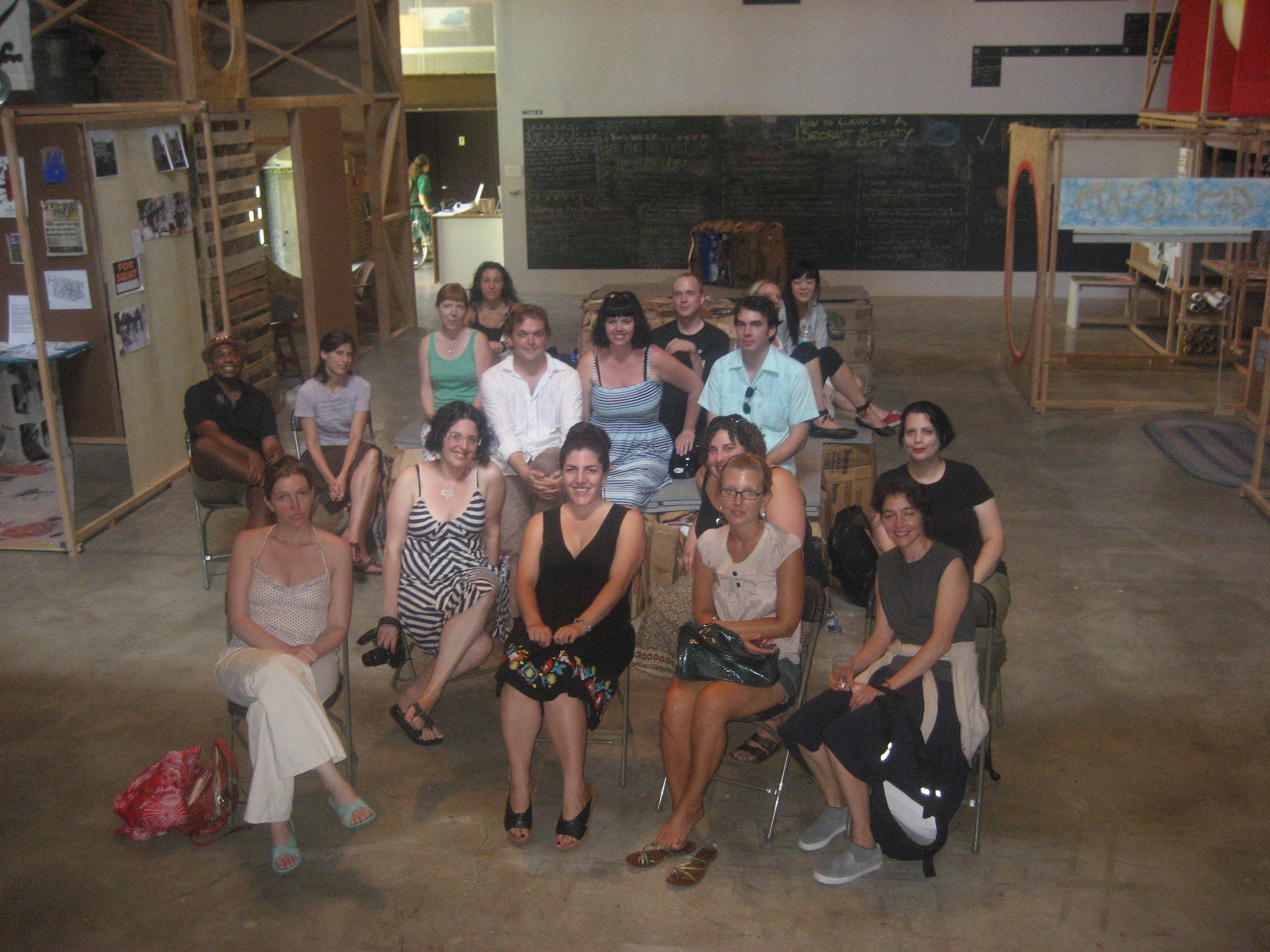
In case you missed it, the everydaytrash.com team headed out to Long Island City, Queens yesterday to participate in the interactive installation project “University of Trash” created by Michael Cataldi and Nils Norman. Our contribution was a quick overview of some of the ways we and other garbloggers talk and track trash online followed by an informal conversation about trash and consumer culture. It was a fantastic event. We were very pleased by the supportive turnout (just look at how many people trecked all the way to Queens for everydaytrash.com) and thrilled by the contributions everyone made during the open discussion. We learned a lot. Afterward, many of us headed to the new beer garden on the border of Long Island City and Astoria. We learned a lot there, too.
Here are links to the blogs I shared as well as some of the other resources and inspiration points Victor and I mentioned. Thanks again to all who came. It was great to see you IRL.
Garblogging links:
There are many ways to approach trash online. Everydaytrash.com is the broadest of garblogs, posts on our site can cover any topic as long as there’s a trash angle. The following are a few examples of other blogs I love that address trash in a variety of ways.
There are people who track their own waste like Sustainable Dave of 365 Days of Trash. Dave’s 365 days are up, but his blog lives on as a wonderful resource for how to create less trash. For example, take a look at the bag he carries everywhere he goes and the tools of waste reduction within.
There is also a whole subgenre of garblogs focused on plastic. My favorite of these is Beth Terry‘s Fake Plastic Fish. Beth covers all kinds of cool plastic topics and at the top of her homepage you can always find a little chart of her monthly plastic use.
And of course, there are trash artists who can take a dull dry topic like solid waste management and make something fun and wonderful out of it. I consider Ruby Re-Usable of Olympia Dumpster Divers and Little Shiva of The Visible Trash Society my closest colleagues in the field of garblogging. Their work constantly inspires me and has consequently inspired a number of everydaytrash.com posts. Sometimes we even collaborate. See also Cynthia Korzekwa‘s Art for Housewives.
In addition to artists making things out of garbage, there are also a few photographing trash in its native habitiat. Last Night’s Garbage is a wonderful blog to add to your reader—emphemeral photos paired with found text are uplodaed a few times a week. I didn’t have a chance to share these at the University of Trash, but Gutter Envy and Garbager also post trash photos.
And then there are the Upcyclers, taking recycling to a new level by finding reuses for objects that may be even better than the first use. Victor and I contribute to an Upcycling portal, which I encourage you to check out. Some of my favorite upcycling examples come from the Etsy Tashion street team. I’ve also been transfixed lately by artist Robert Fontenot‘s Recycle LACMA project.
Beyond upcycling there are blogs that focus on our consumer culture and point up the waste chain to ask if we could produce less stuff in the first place. The unconsumption tumblog run by Rob Walker (of the Times magazine column Consumed) and collaborators is full of interesting nuggets that fall under this theme.
And, of course, there are a ton of amazing DIY blogs that discuss and teach you how to make things yourself to create less waste and reuse scraps and trash. Some of my favorties are Instructables (which allows users to upload their own instructions on how to do and make things), the hip sewing blog Threadbanger, the ReadyMade Magazine blog, and the Make Magazine blog.
Which leads me to the scariest subset of garblogs, the green shopping blogs. I have mixed feelings about these sites becuase they all point to things I WANT and feel I NEED and want to HAVE because they are made out of sustainable products and trash. I try hard not to, but sometimes I look at Great Green Goods (which has a series of great green spinoffs for babies, pets, weddings and more). These sites are good to find trashy and geen substitutes for things you would have bought anyway.
I also love to peruse style sites like the wonderful blog Fabulously Green. But again, it makes me want to shop.
Finally, I want to share a few internaitonal garblogs just to point out that these conversations are taking place all over the world. I absolutely adore the site AfriGadet run by Hash of White African, a blogger and tech guru and several collaborators. The tagline says it all “Solving everyday problems with African ingenuity,” which more often than not involves upcycling.
Keith R. of the Temas Blog covers trash in Latin American. And the nonprofit Goods4Good keeps a Tumblog of their work repurposing excess from American companies in Africa and Asia.
There are many, many more links I could include here but I think the list is already a bit overwhelming. Let me just throw in some of Victor and my top recommended trash resources.
There’s the amazing animated video on the consumption chain, The Story of Stuff.
There’s the book Skräp by journalist Mattias Hagberg, which is in Swedish so I’ll share the link to his interview with Victor.
And there are the books Garbage Land and Bottlemania and the blog of their author, Elizabeth Royte, primordial guides for anyone who hopes to understand this massive topic.
Thanks again to the Sculpture Center and Michael Cataldi for making this talk possible. We hope to follow up on the dynamic discussion that took place and look forward to more in person everydaytrash.com events.
To keep up to date on all our trashy activities, fan the blog on Facebook and share the link with your friends!
The Portland-based arts collective Junk to Funk is hosting its fourth annual recycled fashion show contest. Check out the call for artists for details, the deadline is October 14th.
Junk to Funk
Can’t wait to see what amazing trashion designs you people come up with. If we can’t rid the world of waste, we might as well wear it!
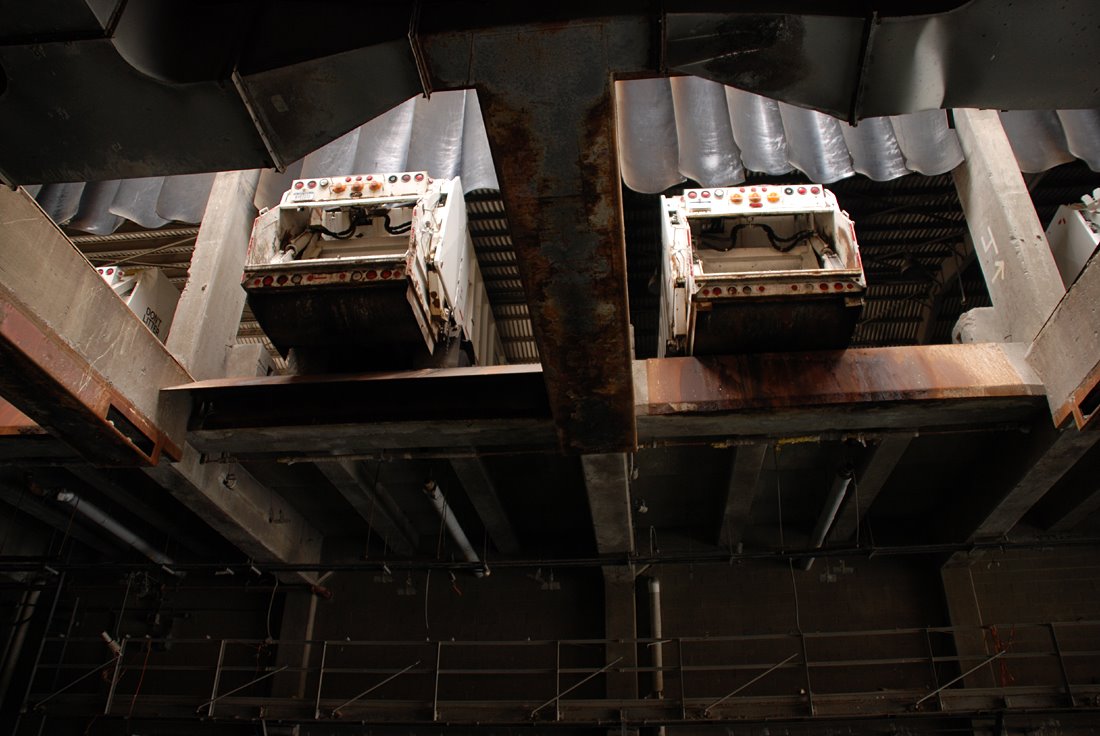
Filmmaker, photographer and location scout Nathan Kensinger publishes two photo essays per month on his blog dedicated to “the abandoned and industrial edges of New York”. In yesterday’s offering, he turned a gritty eye to the Hamilton Avenue Marine Transfer Station, which was decommissioned with the closing of the Fresh Kills landfill, but is now open for bids from solid waste management companies should any be interested in retrofitting the space.
Courtesy of Nathan Kesinger Photography
As it is summertime and as I am obsessed with this shit, I have been spending a lot of time lurking about the abandoned and industrial edges of the city. Luckily, I have friends who enjoy similar pastimes.
But in addition to a general interest in the waterfronts around my home, I have a particular soft spot for marine transfer stations because they were at the heart of my entree into the world of trash and subsequent life as a garblogger. As a journalism student at Columbia, it was following the debate over whether or not to reopen a nearby marine transfer station that opened my eyes to the fact that New York had no longterm solid waste management plan and that the impact of that absence of planning hit poor people first.
I got REALLY into that story. Once, while canoeing on the Gawanus Canal, I even tried to paddle into the Hamilton Avenue Marine Transfer Station. That was five years ago. And as Kensinger’s post points out, the thing is still standing there, useless and empty (he also brings up the whole superfund Gowanus deal, which is about the millionth reminder that I need to read up on that). Anyway, useless though it may currently be, this space sure does look nice in Kensinger’s photos. I recommend clicking through to see them all.
More on marine transfer stations and my trash as class awakening after the jump. Jump!
Also from City Room/NYT: The electronics industry sues to block new recycling requirements (we take this as good news because that means the law is having an impact;
Buffalo and Philly get Big Belly solar powered trash compacting recepticles; and
Missing Ohio kids found alive in the trash (morbid but true fact: while we almost never post them, we come across a lot of baby in the trash stories that end another way, it’s so refreshing to read a happy ending in this one).
I just discovered my favorite RSS feed of the summer via Flavorwire: Recycle LACMA. It’s the blog of artist Robert Fontenot who heard the Los Angeles County Museum of Art was getting rid of a bunch of stuff in its costume and textile collection, bought up over 50 of those pieces at auction and is now reimagining each one into an entirely different object.
Hand woven linen textile wastepaper basket
Checking out the blog each day is like an advent calendar of upcycling. Today, for example, he posted this fab wastepaper basket fashioned from an old piece of Turkish embroidery. Trashtastic.
The real it thing in lower Manhattan this summer seems to be the High Line. What was commercial traffic for meat packers et al. between 1934-1980, nothing between 1980 and last year, is now a hip, weed-ridden concrete-heavy park, with a view, stretching from Washington & Gansevoort to 10th & 20th. On top of this, more park is currently being developed.
Having visited said park Sunday night, I must confess I’m sold. You have to be impressed by such clever upcycling and the courage to plant weeds and not orchids. And of course, the echo of history is something else for a train nerd such as myself.
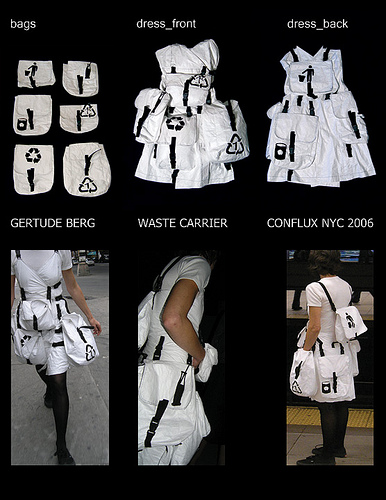
Austrian-born, Boston-trained trash artist Gertrude Berg made this video of a woman picking up trash with high heels on the streets of Bushwick, Brooklyn as a comment on the hypocrisy of gentrification: outsiders descend on an industrial neighborhood, gut and polish the insides of buildings while the streets remain as trash-strewn as ever.
This project reminds me of a similar venture my friend Myra designed in college called “Trash Bellies”. She has been promising since the beginning of this blog to dig up photos of that work. Myra, are you reading this? Send me pictures!
Note: Conflux 2009 will be held this September. And it’s not too late for artists to get involved. Sumbissions are due Agusut 15. I wonder what urban and trashy wonders the next event will hold!
This post was made possible by a tip from a supercool attendee of the NYC Repro Health Happy Hour. Thanks, tipster!
To commemorate the 60th anniversary of the Universal Declaration of Human Rights last year, the office of the High Commissioner of Human Rights at the UN collaborated on an Art for the World project to make a series of videos inspired by that document. This environmentally-themed clip highlights the reuse of plastic bags in Africa to create traditional Djembe drums: 2,000 drums = 20 tons of recycled plastic and offsets 20 tons of wood, which would otherwise have been used to make the instruments.


 everydaytrash