via GrowNYC
Archive for the ‘TRA$H’ Category
How NYC recycles paper
Friday, June 3, 2011via GrowNYC
Yucca Mountain
Tuesday, May 17, 2011Nuclear waste. It’s the most controversial kind of trash. Here in the U.S. our government has been talking about different ways to bury nuclear waste for years. Nearly a decade ago, Congress passed a law stating we needed a permanent underground storage facility by the mid-1990’s and later named Yucca Mountain, outside of Vegas, as the chosen spot.

Yucca Mountain
Lately though, the government has been rethinking that decision. For one thing, Japan’s nuclear disaster proved worrisome, causing experts to rethink the whole idea of storing toxic waste in pools.
But Yucca Mountain was the subject of debate long before the earthquake in Japan. It’s a bit of a messy fight to follow. I didn’t quite understand all the pieces until I read this handy list of FAQs published by Reuters. In a nutshell, people in Nevada have long been pissed about the choice of where to put America’s nuclear waste, President Obama campaigned on the promise to block the facility from being built, his administration did indeed block the Yucca Mountain site, inspiring the Government Accountability Office to prepare and release a report stating that politics rather than technical or safety concerns drove the decision.
The report also pointed out that since 1983 the government has spent $15 billion assessing Yucca Mountain, $9.5 billion of which was collected via extra charges on Americans’ electric bills.
We’ll have to wait until early next year to find out what an appointed Blue Ribbon commission suggests we do instead. Our options include finding a new place to dig a hole, looking to the French model of recycling nuclear waste or paying a country like Mongolia to deal with it for us. One would hope the proposed plan includes ideas on creating less nuclear waste in the first place.
Euro e-waste ends up in West Africa
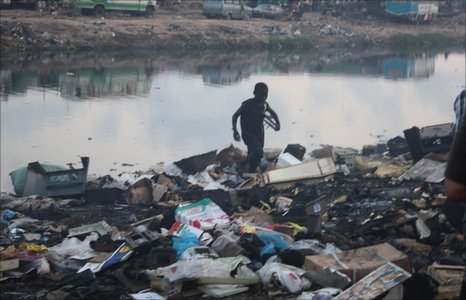
Monday, May 16, 2011BBC’s Panorama reported this excellent piece on electronic waste from the UK illegally dumped in West African countries like Ghana. (Thanks for the tip, Nic!)
BBC
The end section on taking responsibility hits the nail on the head, pointing out that while African governments legislating restrictions is one piece of the puzzle, the key piece is holding those at the source of the e-waste responsible in places like the UK.
You may recall that discovering that his e-waste ended up in Ghana was part of Swedish journalist Mattias Hagberg’s motivations in writing his book Skräp. Here’s a link to Vic’s interview with Hagberg and to a photo slideshow published later by a Swedish paper.
The Catch
Wednesday, May 11, 2011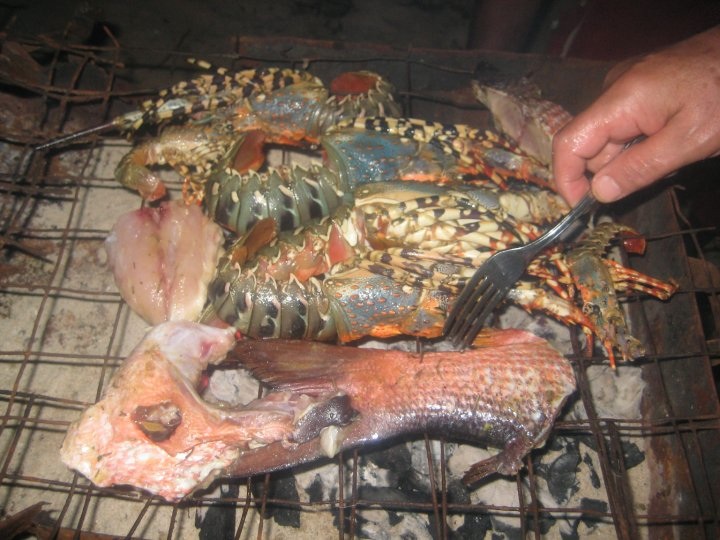
Snapper, lobster, my dad's hand
Which is a better motivator to get people to change their behavior: fines or incentives? The EU banks on incentives.
Problem: fishermen working EU waters toss back up to two-thirds of what they pull out of the ocean—over 100 million tons of edible fish per year—because the fish are either already dead or they want to make room for more valuable ones.
Solution: The EU’s first thought was to ban this practice and instate fines for dumping dead fish in the ocean. Unsurprisingly, this plan was unpopular with fishermen. Plan B is a new project to pay fishermen for the plastic debris they bring back. The EU will pay to subsidize this program until it takes off, after which the idea is that the sale of recyclable plastics will underwrite the initiative. Think it will work?
Check out Triple Pundit‘s excellent piece on the topic.
via GOOD, thanks for the tip, Dan!
Earth Day
Friday, April 22, 2011Happy Earth Day. To celebrate, I just watched the CBS News special on the very first Earth Day on YouTube. It ends somberly, as you can see here. And in some ways, not much has changed since 1970. Except, maybe, that environmental advocates have, in part, become more chic. One thing that struck me, watching these vintage clips, is how focused the activists were on big corporations and the major perpetrators of waste and pollution. That seems like a stark contrast to the hundreds of Earth Day emails and press releases I received this year, all pimping green products and encouraging very individualized actions geared at reducing my own little footprint. Did you do anything for Earth Day?
Pirates
Thursday, March 31, 2011You may have read that a prison just for pirates opened recently, financed with UN money and appropriately located in Somaliland, the self-declared autonomous region of Somalia.

Somali pirates arrested by French commandos, photo via justfoodnow.com
A UN rep laments that they needed to build the prison because while countries will hold trials for stateless people, like pirates roaming the high seas, no one wants to make room for them in their prisons. So the UN decided to build one special.
This story, making the news wire rounds, puts Somali pirates in particular back in the international spotlight. It’s been a while, but you may recall the international melee a few years back when pirates off the coast of Somalia kept kidnapping Europeans and demanding high ransoms for their return. The most interesting part of the story, from a trash perspective, is that these pirates claimed to be defending African waters from the illegal dumping of toxic chemicals by huge European corporations.
As Bloomberg reports, the class, trash and power issues run deep:
Pirates operating off the coast of Somalia carried out 15 of the 16 hijackings at sea this year, according to figures released by the International Maritime Bureau’s Piracy Reporting Center on March 24. There are currently 28 seized vessels with 576 hostages held by Somali pirates, the bureau said.
Piracy has flourished off the coast of the Horn of African nation, where a two-decade long war has left the country with no effective government and a moribund economy. Remittances from overseas workers of about $1 billion a year are the country’s main source of revenue, according to the London-based charity World Vision, which runs health, water and education projects in Somalia.
Wasted clothes
Wednesday, March 30, 2011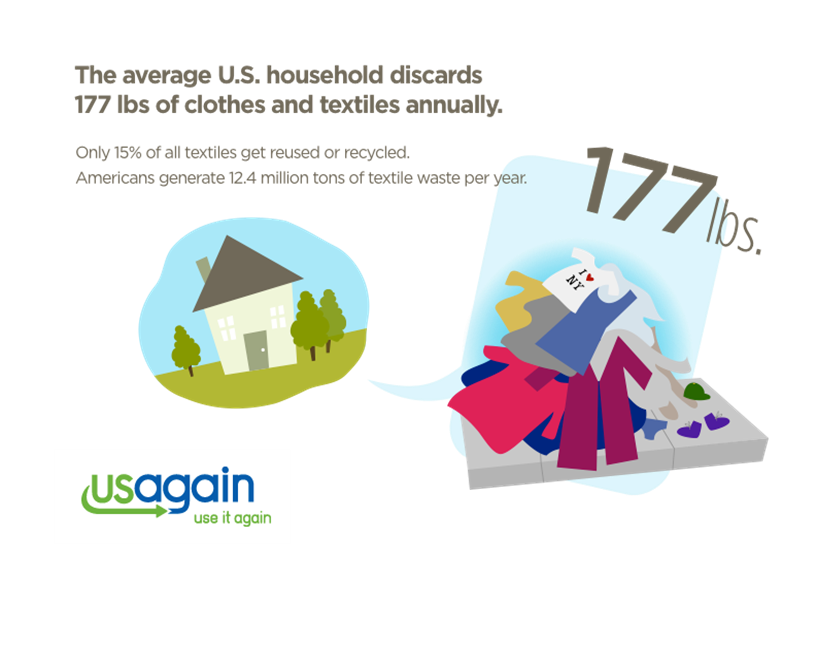
via USAgain
Counterbalance
Wednesday, December 15, 2010WITNESS, the organization that “uses video to open the eyes of the world to human rights violations” made this short educational piece on trash pickers in India. Much like the dilemma at the center of Mai Iskander‘s film Garbage Dreams, trash pickers in India are seeing their livelihoods threatened as the government signs more and more contracts with foreign private waste hauling companies. This short and sweet video compares and contrasts New Dehli where trash pickers’ work has been eclipsed to New Dehli where the NGO Chintan has worked to integrate traditional trash pickers in waste and recycling collection even as the city modernizes its systems. But you don’t have to take my word for it…
Click here for more in this WITNESS project.
Carnival trash
Sunday, October 24, 2010Our Brazilian friend Joana sent us this link to the blog Global Garbage, which has some amazing photos of post-Carnival beach/ocean trash. UPDATE: here’s that link in English (thanks Fabiano!).
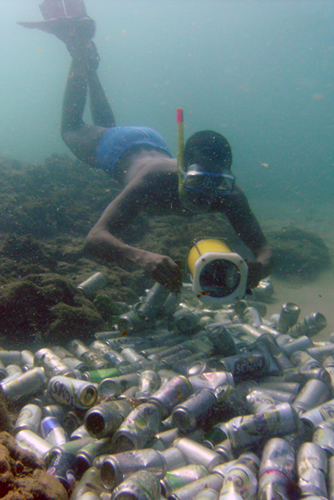
via Global Garbage blog
Joana translates that Carnival in Bahia, Brazil this year involved a crowd of two million on the streets (20% tourists from Brazil and abroad) who generated a billion reais ($600 million) in profits and 30 tons of trash. After the party, Catadores de lixo (Brazilian gleaners) collected cans to sell to local recycling companies, some going so far as diving in the ocean to collect the cans that ended up underwater. The source blog, Global Garbage, says and English version is coming soon. Can’t wait! Obrigado, Joana!
Trashtastic Tuesday: Nick Rosen’s Off the Grid
Tuesday, October 12, 2010Happy Tuesday, trashies. The following is a free excerpt from British journalist Nick Rosen‘s book Off the Grid: Inside the Movement for More Space, Less Government, and True Independence in Modern America, published by Penguin USA this past August. The author has kindly shared this waste-related passage just for us. More on the book and larger “off-grid” movement here.
Or, if you hate reading, you can watch this handy book intro video.
—
From Chapter 3
I should apologize to the reader for returning to the issue raised so eloquently by Bob Reynolds in his letter to the mayor: toilets. It’s a big subject when you are off the grid—possibly the biggest. Everyone who lives off the grid has lost count of the number of times they are asked in a coy, slightly amused way, “So what do you do about, you know, going to the bathroom?” And now the entire drama unfolding on No Name Key has come down to toilets and the acceptability of the forty-two septic tanks and one composting toilet currently dealing with the human waste from the forty-three mainly part-time small family dwellings on the island with its aging population of retirees and second-home owners.
There are just four alternatives that would satisfy the new federal rules designed to prevent the leaching of chemicals and other noxious materials into the soil of No Name Key and then into the water table. Sticking with the status quo is not one of them.
The first is to build a full-scale commercial sewage system to service the forty-three homes. It would require a grid-scale power supply, and once installed it would be able to service a near-infinite increase in the amount of human waste in the small community.
The second option is known as a “thin-pipe” sewage system. It would be operated by electric pumps situated on or under the Bebe Rebozo bridge, but powered from the mainland. The third is the alternative favored by Alicia: a modified version of the septic tank that would meet the new standards. The fourth and final alternative is the composting toilet. This is a well-understood technology that, if correctly managed, produces a harmless material, very similar to rich soil, and can be used to grow organic vegetables. The solar-power faction had tentatively proposed a composter at one point, but had been howled down by the other side.
The one functioning composting toilet on the island is built by Clivus Multrum, a market leader in composting toilets. Although the owner, a postal worker, was out of town when I visited the island, Jim Newton took me to the home because he wanted to show me the huge object, conveniently stored under the raised first floor of the house, which like many on the island rested on stilts in order to reduce potential damage in case of fl oods. This design creates a covered area under the house—a basement at ground level, so to speak. As I walked around to the basement entrance, I passed a huge array of solar panels perched on a wooden pedestal, and a set of four Rolls batteries—the Rolls-Royce of solar batteries. They are known to have a far longer life and to be three times as heavy and four times as expensive as normal deep-cycle batteries. Next to the batteries, a white tank holds the gray water from the house. Gray water is the term for water from sinks, showers, dishwashers, and the like. Once used for washing, it can be used to fl ush a toilet or water a garden.
While most composting toilets are simple, functional, and inexpensive, the Clivus Multrum is the Hummer of composting toilets, a vast and intricate object. The unit in the bathroom is a normal toilet bowl, and a basement of some sort is required because a long, wide pipe travels down from the toilet to an ugly, green-ribbed plastic container. This container stands as tall as a man and takes up fi fteen to twenty square feet of fl oor space, with several doors for different functions. One is used to put in worms; another is used to remove the compost once it has transformed into an earthlike substance. The process can take many months. This is the reason for the large size of the contraption.
“The effluent drops down through this tube”—my escort indicated the green tube entering the composter—“from the potty upstairs.” Jim walked ahead of me toward the silent, brooding object. Once I had raised my video camera, he turned to me gravely and said, “Are you ready? This is not going to be a pretty sight.” He gripped the handle of the smallest door. “Are you ready for this?” he asked again. I nodded. “Now, I’ll lift the lid, but I won’t hold it open for a long time,” he said. The cover came back and hundreds of cockroaches ran for the darkness across a black, tarlike substance that was, presumably, the effl uent. I instinctively looked away, and by the time my eyes returned a second later, Jim had slammed shut the door. How the cockroaches had got there I cannot imagine, as the whole system is sealed. Could it have been via the toilet bowl upstairs?
One other pipe, a narrower one painted white, exited the composter, snaking its way around the basement before disappearing up into the house. I asked what this was for. “It’s an air vent,” Jim told me. “It allows gases to escape, all the way up to the roof. In any system—my own septic tank—gases are produced.”
Jim’s whole body sagged at the thought of the gases being produced. “So instead of letting them out around your home on the ground level, the gases are transported through the pipe to the very uppermost area so they can escape into the atmosphere.”
“What if the wind is blowing the wrong way?” I asked.
“Yup,” he said, looking grim.
By then I had met at least ten of the leading actors in this drama, and although I doubted the sincerity of some of the witnesses, I was still unsure about the detailed rights and wrongs of the matter.
But I knew where to go for an answer…..
—
For more background, here’s a Salon interview with Rosen and a HuffPo piece he wrote.
Agbogbloshie
Tuesday, August 17, 2010The NYT magazine has an amazing photo essay up on the computer waste trade in the Agbogbloshie slum of Accra, Ghana.
via unconsumption
More on Brazilian film Waste Land
Wednesday, July 28, 2010Good news. If you didn’t have a chance to catch Lixo extraordinário (Waste Land) or weren’t in New York the one day it was playing last week at MoMA, you may soon have another opportunity. The documentary is scheduled for wide release in October. This description from the Huffington Post makes me even more eager to catch it when it comes to town for real.
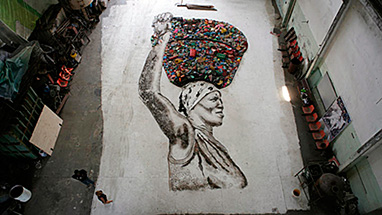
via Huffington Post
The most poignant film in [MoMA’s Premiere Brazil film] festival is Waste Land, which documents the Brazilian artist Vick Muniz as he works collaboratively with catadores (garbage pickers) in Jardim Gramacho, the world’s largest landfill, located in Rio de Janeiro. Muniz works with the catadores to produce large scale portraits of the workers. The portraits are composed of the recyclable materials they collect over a three year period. The images are later auctioned and the proceeds go to the workers and the organization that advocates on their behalf.
The journey of their process goes far beyond the traditional scenarios of victims and saviors,Waste Land chronicles the emotional evolution of all the people involved but also challenges the viewer’s perception of their own community, class, and consumption.
Trafigura fined (another) € 1m
Sunday, July 25, 2010In July 2006 the vessel Probo Koala, owned by international oil company Trafigura, dumped tonnes of hazardous trash outside Abidjan, the Ivory Coast. The cargo, made up of among other highly dangerous substances lye and oil production waste, was supposed to be exported from the Netherlands to the Ivory Coast, but as the port authorities in Abidjan deemed the cargo too dangerous to be allowed ashore, it was simply washed out into sea. Some 30,000 people fell ill and 17 died in the aftermath.
A court in the Netherlands has now fined Trafigura € 1 million (roughly US$ 1,3 million) for illegal exporting and dumping of toxic trash. The fine was about half of what prosecutors had called for, but they have stated that they see the ruling as a victory. In earlier settlements, Trafigura has paid £100 million (roughly US$ 154 million) to the Ivorian government and £30 million (roughly US$46 million).
The Beat Waste Start-Up Challenge
Thursday, July 22, 2010The Beat Waste Start-Up Challenge is offerin a 25k prize for the best idea—in the form of an elevator pitch—to reduce waste in an innovative way. Check out the finalists here. Rooting through now for future posts, there are some great ideas here. Which is your favorite?
 everydaytrash