Archive for the ‘TRA$H’ Category

Trash pickers in the news

Wednesday, August 5, 2009

The New York Times ran a don’t forget about the trash pickers op-ed yesterday written by Bharati Chaturvedi, founder and director of the Chintan Environmental Research and Action Group in New Delhi.

AMONG those suffering from the global recession are millions of workers who are not even included in the official statistics: urban recyclers — the trash pickers, sorters, traders and reprocessors who extricate paper, cardboard and plastics from garbage heaps and prepare them for reuse. Their work is both unrecorded and largely unrecognized, even though in some parts of the world they handle as much as 20 percent of all waste…

Click here for the full article.

Trashtastic Tuesday with Mai Iskander

Tuesday, August 4, 2009

Trashtastic Tuesdays return to everydaytrash.com today after a bit of a hiatus. Filmmaker Mai Iskander was kind enough to answer our questions about her powerful film, Garbage Dreams. Those of you in LA, take note,  the film is playing at the Arclight from August 14-20th with Iskander in attendance the first three nights.

Mai Iskander

Mai Iskander photo via flickr.com/photos/globians/

everydaytrash: How long did this project take you and how did you identify your main subjects?

Iskander: Garbage Dreams is a labor of love that took four years to make. By 2005, I had been working in the film business as a cinematographer for five years and decided to take the winter off and spend it in Cairo. I returned to the garbage village and started volunteering at the local neighborhood school, The Recycling School. The teachers and students really impressed me. Despite their difficult and impoverished life, they were extremely proud in their way of life and their history – and they should be.

The Zaballeen have created the world’s most effective resource recovery system, recycling 80 percent of everything they collect. They are actually saving our Earth. From out of the trash, they lifted themselves out of poverty and have a solution to the world’s most pressing crisis.

Unfortunately, in 2003, never having recognized these strikingly high recycling rates and following globalization trends, Cairo decided to hire three foreign waste companies to clean up its overpopulated mega-city of 18 million people. This Zaballeen community of 60,000 was slowly losing its livelihood.

Of course, as a filmmaker, I quickly saw potential for a story, but it was the teenagers who really drew me in. In addition to the fact that their way of life and community was in jeopardy, these kids were also facing typical teenage concerns: fashion, pop music and their workout routine, and their aspirations to be the coolest and most popular.
More after the jump

Go see Garbage Dreams

Monday, August 3, 2009

CORRECTION: In the original post, I incorrectly assumed the Laila in the film was Laila Iskandar Kamel, the award-winning advocate, because I had heard about this famous Laila who worked with the Zabaleen. As it turns out, there are two Laila’s dedicated to this valient cause. This Leila apologizes for the error.

It’s been a trash-packed weekend, kids. After an amazing afternoon at the University of Trash on Saturday, I headed down to the IFC Center today for a noon screening of Garbage Dreams, Egyptian filmmaker Mai Iskander‘s documentary about three young men growing up Zabaleen in Cairo.  New Yorkers, take note, it’s playing through Thursday as part of DocuWeeks 2009. And if you’re in LA, there’s a docuequivalent.  Here’s the trailer for those who missed it the first time we posted it.

The story follows teenagers Adham, Nabil and Osama as well as  Laila, a social worker who runs The Recycling School, a place where young community members learn about everything from safe recycling practices to how to negotiate a fair contract with local residents to collect their trash. I won’t give away the whole plot, but a lot of the conflict centers around the fact that after 100 years of depending on the Zabaleen, the city of Cairo signs contracts with foreign waste hauling companies who threaten the trash pickers’ way of life. It’s an emotionally pulling conflict. My natural instinct is to root for the Zabaleen to win out and remain the city’s trash collection system, but it’s hard to feel good about all that comes along with that profession…life in a garbage slum, generation after generation working harder for less money, dangerous contact with sharp and toxic materials…

You never hear from the Egyptian government in this film. Or from the foreign waste companies. And I was never quite sure who was buying the plastic and metal recycled by the Zabaleen. The film left me curious about many things—not the least of which is the source of the often repeated stat that Cairo recycles 80% of its waste thanks to the Zabaleen. After watching the film, I believe it, but would like to know how it was calculated. Overall, though, the film accomplishes its main objective: to put a human face on a group of invisible people. Check it out and let me know what you think.

P.S. My favorite part is when two of the boys visit Wales to observe recycling in a developed country as part of some government program or something and one says to the other: “Dude, did you see that? That car just slowed down to let someone cross the street!” Spoken like a true Caireen.

US car tra$h program to be boosted?

Friday, July 31, 2009

The US government Car Allowance Rebate System (CARS), or as its been nicknamed, Cars for Clunkers, has just lifted off, but it looks like it will be running for a lot shorter period than the posted November 1st deadline. The purpose of CARS is to “energize the economy, boost auto sales and put safer, cleaner and more fuel-efficient vehicles on the nation’s roadways,” through giving auto dealers the possibility to offer up to $4,500 discounts to people trading in an old car (which must be demolished) when buying  a new one. NPR (along with other news outlets) reports today that the program is running out of money. $1 billion is apparently small potatoes when everyone wants a hybrid. House Democrats now hope to add another $2 billion to keep this tra$hy car campaign up and running.

In Sweden, a program with similar ambitions existed up until recently, through which a $1,350 voucher was made available to those buying an “eco-car”, i.e. one of those supposedly less environmentally damaging ones. At the moment, it seems that instead of extending the program, buyers of eco-cars will be have their auto tax waived for the first five years.

Of course, the idea of eco-friendly cars is still more or less humbug. Further, scraping used cars produces a lot of metal trash (or rather, tra$h), along with lead, sulphuric acid and mercury, that needs to be taken care of. Whether this is included in the plans to energize the economy and boost the auto industry, I don’t know. Regardless,  I’d rather see another $2 billion invested in public transportation (starting with the horribly malfunctioning US railroad system).

Hamilton Avenue Marine Transfer Station

Thursday, July 30, 2009

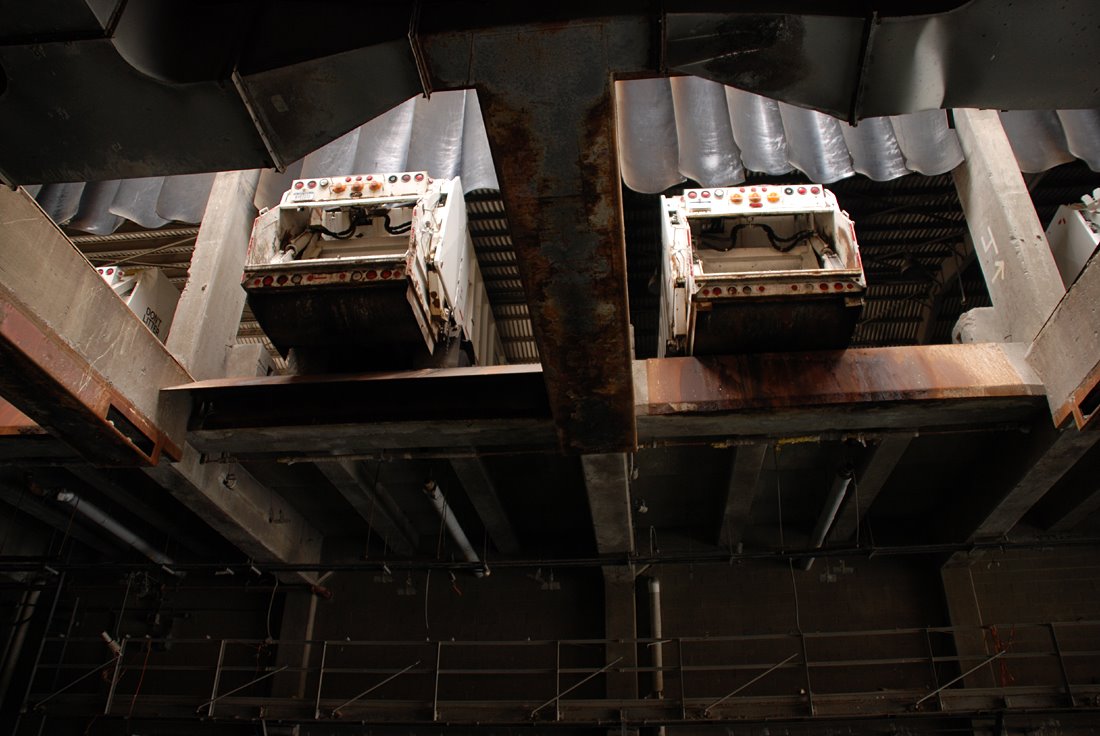
Filmmaker, photographer and location scout Nathan Kensinger publishes two photo essays per month on his blog dedicated to “the abandoned and industrial edges of New York”. In yesterday’s offering, he turned a gritty eye to the Hamilton Avenue Marine Transfer Station, which was decommissioned with the closing of the Fresh Kills landfill, but is now open for bids from solid waste management companies should any be interested in retrofitting the space.

Courtesy of Nathan Kesinger Photography

Courtesy of Nathan Kesinger Photography

As it is summertime and as I am obsessed with this shit, I have been spending a lot of time lurking about the abandoned and industrial edges of the city. Luckily, I have friends who enjoy similar pastimes.

But in addition to a general interest in the waterfronts around my home, I have a particular soft spot for marine transfer stations because they were at the heart of my entree into the world of trash and subsequent life as a garblogger. As a journalism student at Columbia,  it was following the debate over whether or not to reopen a nearby marine transfer station that opened my eyes to the fact that New York had no longterm solid waste management plan and that the impact of that absence of planning hit poor people first.

I got REALLY into that story. Once, while canoeing on the Gawanus Canal, I even tried to paddle into the Hamilton Avenue Marine Transfer Station. That was five years ago. And as Kensinger’s post points out, the thing is still standing there, useless and empty (he also brings up the whole superfund Gowanus deal, which is about the millionth reminder that I need to read up on that). Anyway, useless though it may currently be, this space sure does look nice in Kensinger’s photos. I recommend clicking through to see them all.

More on marine transfer stations and my trash as class awakening after the jump. Jump!

Update on Brazil returning UK’s trash

Tuesday, July 28, 2009

This just in from Brazil’s Secretariat for Social Communications (SECOM): The hazerdous waste found in Brazil and shipped back to the UK last week may have been labeled as recycling materials, though the containers turned out to hold diapers, animal feed packages and other nastiness. In response, Brazil is envoking international law on the matter. According to Em Questao, SECOM’s online newsletter:

The Ministry of Foreign Affairs has asked Brazil’s Permanent Delegation in Geneva to report the traffic of hazardous waste from the UK under the terms of the Basel Convention. On July 23, 2009, Minister Celso Amorim spoke with British Chancellor David Miliband, who said the subject will be given the required attention. Amorim stressed Article 9 of the Convention, which says that the exporter shall bear responsibility for returning the illegal shipment to the country of origin. The Ministry of Foreign Affairs, Ministry of the Environment and IBAMA are still evaluating the need for additional measures.


Return to sender

Sunday, July 19, 2009

Brazil is returning more than 1,400 tons of imported trash back to the UK after discovering the shipments included hazerdous waste. A bunch of Brazilian waste hauling companies may be fined as well. While Brazil allows private companies to import and store trash from other counties, the country maintains strict regulations for toxic waste.

Brazil is not a big rubbish dump of the world,”declared the head of the environmental agency.

I love it when developing countries refuse to take shit (in this case, literally) from more developed countries. In the same way Brazil has told private pharmaceutical companies where they can shove their AIDS drug patents, the environmental agency didn’t flinch before sending 65 crates of blood, syringes, condoms and food waste right back to the UK.

via The Guardian

[In solidarity with this righteous trash policy, I just booked Labor Day weekend in Rio. Ok, ok, full disclosure, my vacation planning had nothing to do with trash and everything to do with sick deals on flights to Brazil. But I’m open to garblogging tips for when I’m there. Any Brazilians in the house?]

City Harvest

Friday, July 10, 2009

Now I know a blog is no place for fundraising, but I wanted to share a free way to give money to an amazing organization whose mission is fully in line with that of everydaytrash.com. City Harvest, New York City’s premiere food rescue organization, gets $5 for every new Facebook fan to join their page by Tuesday.

Every pound of food City Harvest distributes is a pound of would-be-trash averted. Click here to help rescue food from restaurants and make sure it gets to hungry families.

Waste store opens Sunday

Monday, June 15, 2009

For one week beginning next Sunday, the Yanbukis—New York’s local trash worshipping collective— will organize a “waste store” at Bullet Space, a squat-turned-theater on the Lower East Side. This is the End of the Waste World Supermarket we heard about back in April. And these are the only details I have so far: Bullet Space is located on 3rd Street between Avenues C & D; the waste store will be open Sunday June 21st-Sunday June 28th from 1-8pm.

End of the Waste World

End of the Waste World

An after party will take place when the store closes on the 28th, from 8pm-midnight and will include banging on cans, jamming and glorifying Anuki, god of all tides. Stay tuned for updates.

Bribed trash collectors as standard

Thursday, June 11, 2009

We’ve known for quite some time now that everyday city trash attracts a lot of black market services. The most famous example is of course the mobsters who control large quantities of Italy’s trash. In Sweden, while the mob doesn’t seem to take a heavy interest, a lot of trash is collected under the eye of the municipal authorities and companies officially running business.

In an intriguing piece for Swedish weekly magazine Fokus, Nuri Kino, Petter Ljunggren and Mattias Pleijel lift the lid of the bin that is the real trash collecting economy in my hometown of Stockholm, claiming that their discoveries are valid for most of the country. A system has developed where restaurant owners don’t want to pay for collection every day of the week, but rather once or twice, and then slip Mr. Trash Collector some $100 on the side for the other days of the week. Further, there’s complimentary food and drinks to expect.

For some trash collectors, this seem to have developed in to a full blown lifestyle, with some restaurant owners having no option but to put out that free lunch, or finding out that the refuse truck is suddenly broken, oh sorry there will be no collection today as scheduled.

Would be surprised if this doesn’t spark debate back home, as us Swedes always pose happily about sharing the top spot at the Corruption Perceptions Index (where being #1 means very little bribing), currently together with Denmark and New Zealand. Now, the obvious question to the rest of the world: Where there is no trash mobster boss running things, how do these things play out? Who are the beneficiaries, who lose and what is being done about it? Everydaytrash wants to know!

Trash = Class

Friday, June 5, 2009

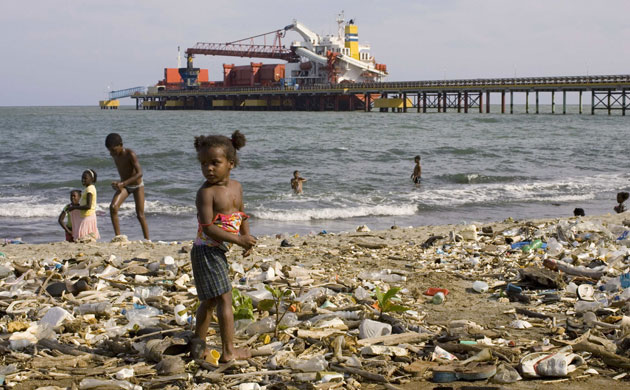
The headline to the latest Guardian UK photo series In Pictures says it all: “World’s poor overwhelmed by rubbish.”

Garbage-A-girl-stands-on--021

Photograph: Eduardo Munoz/Reuters

UPDATE: See also this horrifying slideshow in e-waste in West Africa via Waking Vixen‘s Facebook page.

Bottle bill mania and RFK Jr.

Thursday, May 28, 2009

bottled-waterBottlemania author Elizabeth Royte‘s waste and water blog has been pretty juicey lately. When it comes to single serving water packaged in plastic, the only thing more disturbing than how many plastic bottles are out there is how few people own them. That is, until they sell them to us and the problem of disposing of them becomes someone else’s problem. The question up for debate is whose problem is it? New York’s State Assembly is negociating the answer to that question now with a bottle bill that Royte points out has taken 20 years to see the light of day. But if you’ve been reading the news, you might have noticed that an unlikely pair have teamed up to sue the state over the bill: megaconglomerate Nestle and Riverkeeper Bobby Kennedy Jr. Very curious. Royte explains the drama in a recent post and subsequent update.

See also RFK Jr.’s op-ed in yesterday’s New York Times.

A world of shocking odors

Monday, May 25, 2009
Shawn Baldwin for The New York Times

Shawn Baldwin for The New York Times

Great Zabaleen article in the Times accompanied  by a short video and these stellar images by photographer Shawn Baldwin.

It is a world of shocking odors and off-putting sights. But it is their world, the world of the zabaleen, hundreds of thousands of people who have made lives and a community by collecting Cairo’s trash and transforming it into a commodity.

Flipping the flop

Tuesday, May 19, 2009

While in Kampala a few weeks ago, I stopped in at one of my favorite stores in the world, Banana Boat, and went on a semi-conflicted shopping spree among their fine upcycled crafts made by women’s collectives from all over Africa. I bought up a dozen strands of Ugandan paper beads for my girlfriends, homemade soap wrapped in homemade paper for my colleagues and a collection of small creatures fashioned out of bottle caps including this three piece band, now residing at my friend’s music studio in Brooklyn.
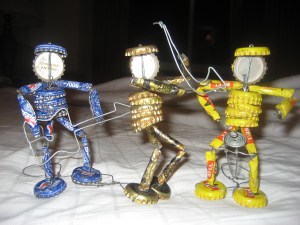
Bottlcap boogie

Bottlecap boogie

Ok, full disclosure. I went more than once and to more than one Banana Boat location during my week in Uganda. I couldn’t help it. While normally I try to buck the inner American, my desire to consume flares at the sight of trash. The the irony of upcylcing is that it makes me want to buy MORE.

The first wave of  my Banana Boat binge was stopped short by the pricetag on a string of plastic foam beads. The moment I saw them, I knew they were made of old flip flops—likely washed up on the shores of Kenya—and, because of this, I grabbed them up. But then I saw they cost roughly $30 U.S. and I looked again and decided, actually, big foam beads on a short choker strand might be a little too UN chic for my blood. So I set down the hideous necklace and made my way deliberately to the woven basket and cardboard diorama section of the store.

It was hard to walk away. Physically hard, because my urge to buy something was so strong it nearly made me twitchy. The little voices in my head debated the novelty of flip flop jewelry versus the reality of its ugliness, the feel good return of purchasing upcyled crafts from women’s collectives versus my uneasiness with the price, the uniqueness of the product versus the fancy UniquEco logo. One of the necklaces had a tag declaring “flipflop (i was)”. I took note of the confirmation that these were indeed flipped flops upcycled by Kenyan fishing communities. And I took note of the all lowercase tagline and pretentious use of parentheses. Ugh, I thought, branding.

I left the store feeling very proud of my resolve.

The next day I dropped $50 on a hot pink rhino doll/statuette from the same company. It’s adorable with a sleek and marbled hide created by a fused pile of flip flops of similar but not identical colors. This, I thought, will liven up my bookshelf. Or hip up my office. It carries a message that is both political and fun. It will make for a cool blog post and spread envy among my friends. I NEED this.

More tales to come of Kenya and consumption.

No punishment for breaking tra$h laws

Sunday, May 17, 2009

The Swedish Public Radio reports that Sweden, after two years, has yet to stipulate punishment levels for breaking the European Union imposed legislation that prohobits tra$h smuggling to developing countries. Hence, there’s no knowing what to do with a container of illegal refrigerators that was confiscated this Friday by border authorities, and no way of knowing what to do with the persons trying to send it off to Uganda. Well done, parliament.