Archive for the ‘Trash Politics’ Category

Leave the trash on the conveyor belt

Wednesday, November 15, 2006

The British environmental minister is urging his countrymen to leave excess packaging at the checkout as a statement to grocery stores that they shouldn’t stock over-wrapped products.  What I find most interesting about this story is one, how receptive the companies interviewed seem to be (I guess PC dictates compliance) but also the fact that there is a minister of environment in Britain and that he advocates civil disobedience.

This link, like so many before it, was scouted by the incomparable Kimberly.

trash hiatus II

Friday, November 3, 2006

My next nonprofiteering expedition is taking me to Burkina Faso, West Africa.  Regular posting may be difficult from now through the 11th, but I promise to bring home tales of trash from overseas and hope to post from afar.

Always a bridesmaid…

Wednesday, November 1, 2006

uglydress_1902_11609825.jpg In my quest to find a use for my small collection of bridesmaid dresses, I came across uglydress.com and just had to share. The three red dresses I’ve sported down the aisle are not that bad in the grand scheme of things one might have to buy, alter and wear in public on behalf of a friend getting married. But they aren’t exactly reusable, either.

Just what are we supposed to do with the dress when the pageant is over? I refuse to throw them away and I don’t know any little girls with dress-up boxes (and wouldn’t encourage this sort of gender-specific dress-up item anyway).

My mother, always hopeful about these things, suggested I have the skirt of my last bridesmaid dress shortened and that I wear the apple-red satin ballgown as a cocktail dress. With a triple-layer of black lacey stuff under the skirt and a halter neck, the cocktail party I wore that thing to would have to be on ice (in which case I wouldn’t have right muff for the occasion anyway).

So, I’m left with the aforementioned halter gown, a maroon seperates number (the top of which presumably could be used as the shell of a suit, if I had the sort of job that required wearing suits), a spaghetti strapped ankle-length dress that might have been reusable if it didn’t constitute the physical proof of that time my cousin joined the navy, married a stripper and forced me to be the “red” in their patriotic-themed ceremony. Also, it’s just a little too orange, which always kills a red dress.

I know there are used dress sites, but I’m looking for something bigger and badder ass to do with my collection. An installation project perhaps? A hipster crafts project? Please post any and all ideas as comments.

CFR: Grim News on Environment

Monday, October 30, 2006

The Council on Foreign Relations daily brief puts scary findings on global warming, forced migration and gobbling up of natural resources at the top of today’s agenda.  You know it’s grim news for the green when reports on the environment beat out three stories on international weapons crises to take the headline.

another tale from the road block

Thursday, October 26, 2006

tailor.jpg

This will be my last African trash post for a while, or at least the last anecdote from Malawi that I post lest you start thinking the focus of this trash blog has become way too narrow, wonky and/or new agey. Never fear. I actually didn’t return with as many trash stories as I had anticipated for two possible reasons. One, I was working the whole time in my non-trash-related capacity as a nonprofiteer and two, (to state the screamingly obvious) people don’t throw much away in Africa.

I didn’t even see a trash fire, though I looked for them. A couple of times I saw smoke in the distance, but when I asked, the people around me explained that the dry season was ending and they were burning back the fields to prepare them for the pre-rainy season planting.

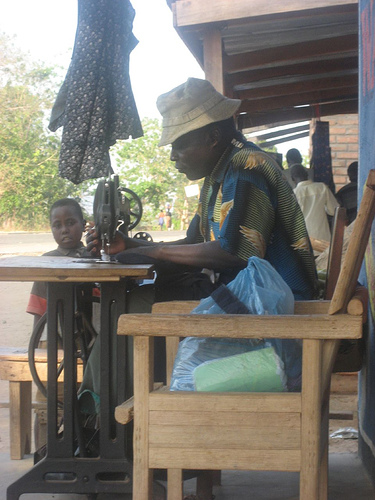
Most of what I saw were stories of zero waste and recycling. While sitting in front of Ivy’s convenience shack near the road block just south of Kande Beach, I watched a tailor appear out of nowhere and set up his sewing machine on the porch. He pulled out a bag of rags and started piecing them together, remaking old shirts into patchwork swaths of fabric to become new clothing or mending smaller tears in blouses and pants to make them good as new.

The whir of the tailor’s machine lay a pleasant track of ambiant sound beneath the layered murmors of children playing in the dirt road, women chatting while shopping for maize, men gossiping with the tailor and chatting up the women and the forestry worker from the road block coming by to charge his cell phone. I was reading Garbage Land, starting it really, and had just come to the part where the author is describing her quest to produce less waste than the average American.  In this chapter, she guiltily throws away old clothes because she already has too many rags and has no other use for the battered cloth.

And then I had one of those useless Western moments that feel like epiphanies, but are really just recognizing the obvious for the first time.

Yes, I thought, we do throw too much away and that would never happen here. What I should do about this sad fact, remains a mystery. Or rather a challenge. One I hope to explore tangibly here–back amidst the excess of America–with this blog.

sanitation ticket blitz caught on tape

Wednesday, October 25, 2006

Check out Gothamist’s coverage of Gotham’s latest trash scandal.  Thanks for the heads up, Kimberly.

recycling a glass bottle in Malawi

Wednesday, October 25, 2006

img_1661.JPG

On my recent trip to Africa, I found myself at a road block in northern Malawi, five hours before the overnight bus to the city of Blantyre was expected to roll by. I had been advised to flag down the bus there, because it would have to stop at the road block anyway.

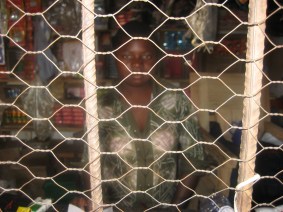
Since I had some time to kill, the forestry official at the road block pointed out one of a row of shacks fifty yards away as a place where one might find a drink on a blisteringly hot African afternoon. So, I rolled my suitcase through the red dirt and asked the young woman behind the wire-fenced counter for a coke. She handed me a warm glass bottle and opened it for me. As is the custom in countries that still serve coke out of glass bottles, I drank it there.

Of course, given the hours of free time I had to kill, I drank slowly, sitting on the shack porch for a couple of hours using my suitcase as a bench. The porch didn’t offer much shade, none in fact due to the sharp angle of the sun. I reapplied sunscreen several times and still felt my arms browning and nose pinkening under the direct rays. Local children approached with the usual “howareyou, howareyou” and giggles when I asked them their names and ages. Women in plastic sandals with babies strapped to their backs in printed-cotton slings came up to the shack to do their shopping. Most of them came to buy ground maize, I imagine to make it into blobs of mashed potato consistency that the locals call nseema (the n is silent) and which they eat with kidney bean sauce and fish from Lake Malawi. When they asked for maize, the young woman behind the counter would come out of the shack and scoop the meal into plastic bags from a large burlap sack on the porch and weigh it on a scale hanging from the beam.

Neither she nor any of the women spoke to me. But when I handed her back the glass bottle, through the slot in the wire fence protecting her little convenience store, she handed me a note:

hello, my name is Ivy ______

i am 15 y o

will you be my pen friend?

my address is

XXX

XXX

Campus Sustainability Day

Wednesday, October 25, 2006

csd-logo-2006.jpg From the president of Columbia University:
Dear fellow members of the Columbia community:

On Wednesday, Oct. 25, Columbia joins other colleges and universities around the country in marking Campus Sustainability Day–an event designed to spark discussion and action to reduce the environmental footprint of college campuses. Columbia’s students, faculty, and staff have a long-standing commitment to responsible environmental stewardship–and this day is an opportunity not only to reflect on our accomplishments to date, but to build on them for the future.

The event will take place from 11:00 a.m. to 4:00 p.m. on Low Plaza and will feature information tables, sustainability kits, and a live Webcast from 12:30 p.m. to 2:30 p.m. linking us with campuses nationwide.

Columbia researchers have led the way on environmental issues worldwide–from El Nino to asthma in urban neighborhoods, climate change, and environmental policy making. Locally, Mayor Bloomberg recently announced an expansion of Columbia’s efforts to advance environmental protection–New York City’s engagement of the Earth Institute to advise its new Office of Long-Term Planning and Sustainability.

This semester, working together as a community, we are taking a fresh approach to thinking about and managing our own environmental impact, with the establishment of the Office of Environmental Stewardship, under the direction of Nilda Mesa. We have a number of new initiatives getting underway. Among these are:

* Examining ways to reduce our energy consumption, limit our greenhouse gas emissions, and obtain power from renewable energy sources in the future;

* Incorporating environmental and energy enhancements in new construction projects at Columbia;

* Improving our recycling practices and establishing composting programs;

* Launching a Sustainability Advisory Council that will include academic, administrative, and student members;

* Expanding the Environmental Stewardship Web site to serve as a virtual forum for exchanging ideas and tips related to the environment and our daily lives.

The address of the site is www.columbia.edu/cu/environment. I invite you to join our celebration of Campus Sustainability Day. It is a good step toward working together as a University to help preserve and enhance the environment of our campus, our community, and our planet.

Sincerely, Lee C. Bollinger

unloading a barge on the Thames

Monday, October 23, 2006

thames1.JPG

Photo sent in by my friend Ann from her recent visit to London. Thanks, Ann!

trash coincidence and continuing violence in Northern Uganda

Thursday, October 19, 2006

beaders.jpg I forgot to tell you that on my way to Amersterdam (leg one of a long journey to Malawi), I was sitting next to a member of the Ugandan parliament who represents a northern district. She had been in New York trying to raise awareness at the UN about the violent crisis in her region, which she claimed was worse than Darfur. I raised my wrist to show her that I was wearing a couple Bead for Life bracelets. It turns out, she knows the group and is one of their biggest supporters. She lifted her chin to show me she had on one of their necklaces. This little encounter has inspired me to do several things, one of which is host a bead party.

trash politics in the keystone state

Thursday, September 28, 2006

station1.gif  Trash will be a deciding factor in Pennsylvania’s 6th district race.  And according to the Philadelphia Inquirer, it all comes down to one county.  It appears that good ol’ Reading, Pennsylvania—known for that one railroad in the game of Monopoly and, if you’ve ever been there, for its mafia-owned and migrant-operated mushroom farms—is at the eye of a trash storm these days.

The Humanure Handbook

Thursday, September 28, 2006

humanurecover.jpg  After writing here about composting toilets, I felt a little guilty about dismissing them as yuppy outhouses so I decided to look just a little more into home and office use.  After contemplating a place to begin research, I found the answer right here on the sidebar: howtocompost.org.  In the comments, I also found a link to The Humanure Handbook by Joseph C. Jenkins, a catch-all volume with punny chapter titles with tons of information about the ecological, practical and spiritual benefits of turning human feces into soil fuel (I recommend the section entitled “Deep Sh*t” in which he speaks to a humble nunnery).

But are these composting toilets practical?

In a later chapter, Jenkins predicts:  “The toilets of the future will also be collection devices rather than waste disposal devices. The collected organic material will be hauled away from homes and composted under the responsibility of municipal authorities, perhaps under contract with a private sector composting facility.”

Until then, we city dwellers might have trouble fitting  a bulky toilet with a composting chamber into our tiny apartments and anyone without a serious compost pile will have some serious problem solving to do when it comes time to empty the john (you farm people, however, had best get to it setting a green example).  Advocacy step one includes community composting and adding human waste in municipal recycling collection. 

Weekly Compactor

Wednesday, September 27, 2006

swine.jpg    This week in trash news:

  • Moved by Bill Clinton, Wal-Mart promises to cut down on packaging over the next five years;
  • Also linked to the Clinton Global Initiative, a green knight pledges $3 billion to make fuel from corn;
  • An equity firm in Chicago buys a piece of Waste Management;
  • Jamaica’s fraud investigation of its solid waste authority gets so tense, some officials are offered body guards for thier own protection;
  • The Big Apple gets its first green building (and Rosebud was the sled);
  • In an ironique twist of fate, the toxic sludge that sent thousands of Ivorians to the hospital will be shipped to France for treatment; meanwhile the men responsible for the illegal dumps plot their escape; and
  • Indiana creates a “swine zone” hoping to harness the power of the hog.

bullshit and libertarianism

Wednesday, September 27, 2006

pennteller.jpg  The Justice Talking trash special got me thinking about the recycling episode of Penn and Teller’s Showtime series Bullsh*t.  In it, the comic magicians make an argument similar to the one the Adrian Moore of the Reason Foundation made on the radio this week.  Essentially, they think recycling is too complicated, costly and inefficient and the only way to make it worthwhile would be to follow the money.  Either offer cash incentives for recycling by buying back reusable trash or charge people for the amount of trash they generate (thereby offering a cash disincentive to create waste in the first place). 

While I’m all for big government, mandated recycling and corporate responsibility, the bottom line is the bottom line: money talks.  The most effective arguments for recycling aren’t that we’re running out of space for trash or that gasses and other polution will harm the environment.  These are longer-term issues most are happy to pass on to our grandchildren.  Proving that reusing products saves money, on the other hand, or that recycling can generate income or threatening to charge big wasters their fair share of trash hauling costs are arguments more likely to resonate with the mighty.  And the frugal.  One cost-benefit analysis is worth a thousand soapbox speeches. 

just trash

Tuesday, September 26, 2006

radio.jpg The folks at Justice Talking, the NPR news magazine that examines global issues through a legal lens, took a long, hard look at trash this week. Of particular note are a liberal-Libertarian debate on whether to mandate or pay people to recycle and commentary from a trash lawyer. Check out the program’s website for an interview with trashie author Elizabeth Royte on exporting and reducing trash, lessons from Colorado on defining and building a “zero waste” community and a fantastic sidebar of recommended reading.