Archive for February, 2009

The Pick Up the Trash Day

Wednesday, February 18, 2009

Went to one of those political breakfast seminars this morning, and shared the table with Emma and Elin from the cool Keep Sweden Tidy Foundation. The KSTF run a couple of great campaigns, like the Agricultural Scrap Campaign, but my closest relation with them comes from my childhood, and the Pick Up the Trash Day.

The Pick Up the Trash Day has been a standing tradition for preeschools  and lower compulsory schools all over Sweden for decades. It’s pretty straight forward: Kids go out in their communities with their teachers for a day and pick up trash. I have fond memories of the kid Victor running around the neighbourhood and it’s sorroundings with classmates in the late 80’s spring, armed with a black trash bag, picking up cigarette stumps and thrown away plastic stuff. If one of us spotted a broken bottle or any other shards, we would shout “Mrs! GLASS!!!”, and one of the adults would come and take care of the dangerous pieces.

The next Pick Up the Trash Day happens in the week of April 20th-26th. Last year 220 000 kids (Sweden’s total population is 9 million) participated, and the KSTF hope for even more this year. I have already decided to have my own Pick Up the Trash Day, wherever I am in the world in two months from now. Who wants to join in?

Japanatrash Art

Monday, February 16, 2009

Every once in a while, I search YouTube for “trash art”.

Not sure what this clip is all about, but I am confident that if I spoke Japanese I would declare it blogworthy.  It involves some sort of talent or game show and Jean-François Millet’s iconic painting “The Gleaners”.

Zero Waste Pasta

Sunday, February 15, 2009
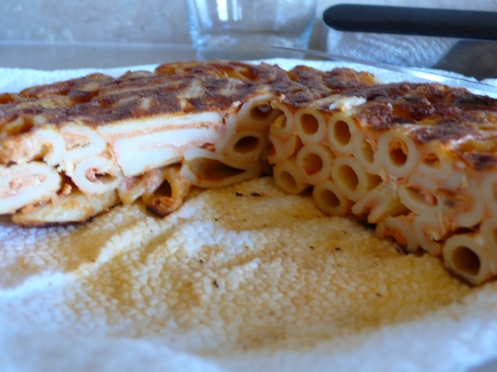
Frittata di Maccheroni

Frittata di Maccheroni

My sister and I share an apartment, but rarely share meals.  When we do, they alternate between Thai take-out and pesto pasta.  The former, even if you implore the restaurant to include NO UTENSILS, creates an ethically uncomfortable amount of waste (and leads to bickering as I, in obnoxious big sister fashion, police the trash can and recycling bag to make sure packaging ends up in its proper place).  The latter leads to heartbreaking food waste.  Neither of the sisters Darabi is capable of making just the right amount of pasta.  Inevitably, we end up with a dry lump of basil-flecked noodles in the fridge, where it lives optimistically for a week until our biweekly purge.

Luckily, I know a pasta expert.  My friend Virginia has an amazing food blog called Italicious where she recently posted the perfect solution to left-over noodles: Frittata di Maccheroni. Those crafty Neopolitans.  It’s resourcefulness like this that must have seen them through the trash crisis last year.  I can’t wait to see if this works with cavatappi and pesto.  Oh, and do share if you have other past rejuvination ideas.

The Office 3.0 – Silent Art

Friday, February 13, 2009

This week I had an errand at the Stockholm based communications agency Futurniture. Founder and CEO Jakob Lind took the opportunity to give us a little tour of an art exhibition they currently host: The Office 3.0 – Silent Art, a reference to the 1963 classic Silent Spring, written by Rachel Carson. The exhibition is made up of work from several artists, my favourite being Johanna Gustafsson Fürst’s art, which is all made from two weeks of trash from the Futurniture office.

Gustafsson Fürst has covered all door handles in newspaper, hidden their aquarium (normally sporting a couple of plastic dishgloves flying around inside…) beneath a heap of I-don’t-know-what, taped flattened milk cartons to the floors, etc. It’s all over the place really, but since the office is such a busy creative creator’s space anyway, it takes a while before you realize what was actually there before Gustafsson Fürst’s takeover. I like it! Another, more serious, part of the exhibition, is a group of watercolour paintings made with toxic water, composed by Jan Stene Markus Anteskog. All curated by Jan Stene. Provocative as only art can be.

Recycle for London campaign goes mobile

Friday, February 13, 2009

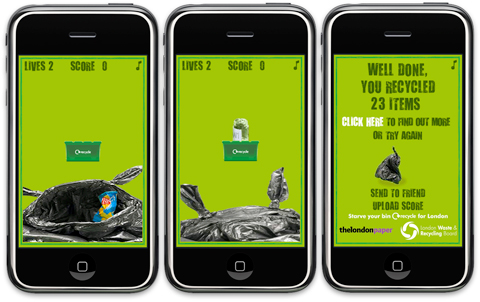
londonmobileThe ever clever Recycle for London program is promoting its “Starve your bin” campaign with a mobile download game for Brits on the go.  The object of the game is to block items from reaching the hungry trash bag by catching them first in a green recycling bin.    Or rather, the object of the game is to raise awareness about the massive amounts of recyclable materials that end up in the trash.  Londoners can download the game by texting a special number and oh so special iPhone users can get the game directly from the Apple store.

Your very own iPhone app?  Very slick, Recycle for London.  As a new media geek, I’m impressed.  But really, you had me at viral video.

Weekly Compactor

Friday, February 13, 2009

fail-owned-recycle-failThis week in trash news and around the garblogosphere:

California knows how to…recycle

Friday, February 13, 2009

newyork

Men’s Health has ranked America’s cities on how well they recyle and three out of the top ten are in California.

Wichita and Las Vegas lead the worst.

Click here for a neat interactive map of the results.

Here’s how the editors explain their methodology:

To determine how well cities reuse their refuse, we started by asking them whether recycling is mandatory. Next we looked at how easy the cities make it for residents to recycle: No need to sort? Wonderful. Curbside pickup? Great. Then we added up the variety of materials that are recycled, giving bonus points to those places that go beyond paper, plastic, and glass. Lastly, we factored in the percentage of households that actually take advantage of the program their city offers, courtesy of SimplyMap.

NYC ranked an unimpressive 17th.

Belated newsflash

Wednesday, February 11, 2009

The Stockholm trash collector’s wildcat strike is over, as of yesterday morning (sorry, haven’t had time to blog the news). But there is a but! Although the battle-axe has been buried after a meeting between workers and the new (hated) entrepeneur, an agreement hasn’t been finalized, and things are still a bit shaky. For now, we can only idly watch things unfold.

For myself, the 4-day strike gave a good opportunity to look at my own trash. What happens if I can’t take it out? The result has proven not to be very scandlous. I went from a bag filled about 20% to a bag filled about 40%. And this while taking at least two daily cooked meals at the house. No diapers, no food thrown away, no filling the trash with recyclables such as metal cans or paper. Living by yourself seems to be helpful in trash flow control.

(More drama happened in the house though! A new note appeared next to the first one, that had announced special trash bags would be placed in the trash room. The new note stated how revolting it was that these bags had now been stolen. Although it felt wrong, I did have a good laugh over this.)

Then again, more resources are used per capita for heating (we have Winter I kid you not) when people live by themselves, not to mention the multiplied numbers of furniture, bed fabric, houses and all that stuff that makes our lives so Modern. It’s a bit like cars really. Which incidentally reminds me of this terrible episode of Oprah when people were advised to save the planet by keeping reusable bags for groceries in your car, instead of discussing the debatable strategy of going shopping with your car. Crazy.

Reblog: Suzanne Proulx’s Dust Bunnies

Sunday, February 8, 2009
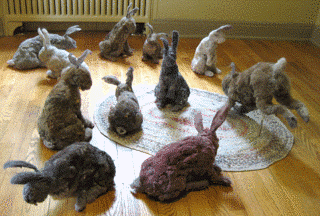
Bunnies made of dust

Bunnies made of dust

Yup, that’s right, these bunnies are literally made of dust.  They’re part of an installation by the artist Suzanne Proulx.  More on the project here.

Via Olympia Dumpster Divers via Art for Housewives

Hard times call for gleaning (new study)

Sunday, February 8, 2009

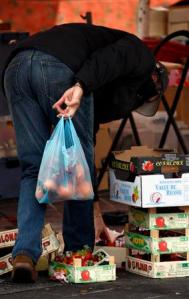
The French have a long, proud history (protected by law and immortalized in film) of preventing produce waste by opening up their farms after harvest to allow scavengers  to collect the left overs.  Gleaning still takes place in the countryside, but works a little differently in modern cities, where it takes the form of collecting discarded fruits and veg after farmers markets and from commercial trash bins.

And in these tough economic times, gleaning or “doing the end of the market” is more common than ever in Paris and smaller cities, especially among youth, the homeless and…the elderly.

OFRTP-FRANCE-PAUVRETE-GLANAGE-20090203

Reuters/Eric Gaillard

To get a better sense of who gleans, how and why, the French High Commissioner for Active Solidarity Against Poverty commissioned a report on the topic from a French think tank called The Center for Study and Research on Philanthropy (CerPhi).  So, CerPhi conducted a qualitative study, scoping out prime gleaning spots in Paris and two smaller cities and conducting in-depth interviews with over forty men and women spotted in the act.

While they didn’t exclude people who consider gleaning a political or environmental act, the report focuses on those who glean out of financial necessity.  In other words, everybody but the freegans.

The most interesting take-away is the fuller profile of urban gleaners the study provides. For the most part, they are young people, retirees and the homeless.  Young people have the fewest health and safety concerns about eating discarded produce.  Longtime homeless men use gleaning as a survival mechanism and continue to do it even when they have housing.  Retirees glean out of financial necessity and are, for the most part ashamed of gleaning (with the exception of a small minority who barter what they glean and gain self-worth from the practice).

The study specifically investigated the relationship between gleaners and social security to better inform government  programs.  What they found reveals a lot about pride and the challenges of aging in a failing economy.  Take these two quotes, for example:

Woman, 82 years old, Paris

Have you been “doing market ends”  for a long time?

It’s not really market ends, I buy, I see if I see something.

I think I saw you last Saturday.

Yes, Saturday I was here.  If I see something, I pick it up but I buy a lot.  Really, I do, I buy a lot, and I do it if I find something, otherwise I mainly buy,

Did you buy everything in that bag?

No, I didn’t buy everything, but I bought a good part of it, a large part of this here was picked up, it depends on the day.

Woman, 75 years old, Paris

Are you familiar with food aid, like soup kitchens?

No, I don’t go there.

Why not?

Because my grandchildren work and that doesn’t interest me.

If you read French, the full report is a heartbreaking page-turner full of nuanced questions about what gleaning means to different groups, concepts of transiance and urgency as well as larger societal questions about the relationship between hunger, public assistance and stigma.

And it’s getting harder and harder to be a gleaner, the study reports, as farmers markets and supermarkets go to greater lengths to destroy food waste and discourage scavenging.  Sadly, the report lacks clear-cut recomendations.  I’d love to hear your thoughts on the topic.

PS Thanks, Gillian, for sending me an article on this study in the first place.

Strike!

Friday, February 6, 2009

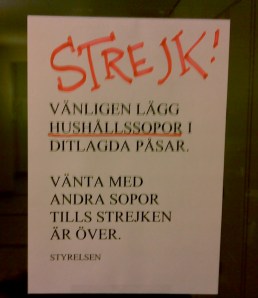
As of this morning, there is indeed a wildcat strike involving almost all of the trash collectors in Stockholm! Noone knows what will happen and there’s general confusion. Not to worry though, the board governing my house has put up a sign!

"STRIKE! Please dispose of only household garbage in the supplied plastic bags. Wait with other garbage until the strike is over."

"STRIKE! Please dispose of only household garbage in the supplied plastic bags. Wait with other garbage until the strike is over."

As an anectode, one evening last spring I (for reasons unknown) left a garbage bag on my balcony. Next morning it had been opened by a flight of gulls. I felt very stupid.

The MicroFueler

Thursday, February 5, 2009

My friend Jen always finds the coolest stuff on blogs and is so sparse and disciplined about what she shares with others that you know: if she’s passing it on, it’s worth checking out.  Case in point, this DVICE blurb on Sierra Nevada’s MicroFueler.  Isn’t it the prettiest pump you ever did see?

Sierra Nevada's MicroFueler

For more on the beer-dregs-to-ethanol process, check out the original post on CNET.  For $10k, you can buy one for your home.  They should market these things to university frat houses.  What better companion to the kegerator in the kitchen than a microfueler in the driveway?

It’s been a gassy couple of days on the internet.  Yesterday the HuffPo posted on garbage-powered garbage trucks in Northern England, then this morning I found this blurb on busses in Oslo powered by methane collected from the city’s RAW SEWAGE. [Editor’s note: I’m not sure I’m as forward thinking as the Scandos on this one.  Perhaps Victor can act as cultural ambassador.  Is it just me, or are poo-powered busses a little gross?]

Robotic Garbage Trucks

Wednesday, February 4, 2009

Berlin signed a contract this week with Waste Away, Inc for a new fleet of robotic garbage trucks to start collecting trash from city homes. This trend, first started by rubbish clearance services in Bristol, has picked up in popularity around the world. Don’t be surprised if they end up in your city.

Operated by a joystick (fun!), hydraulic arm trash trucks have been tried out in other cities, including some in the U.S.  They require bigger trash cans and allow for just one sanitation worker to man an entire route.  I guess the days of one guy driving the truck and another one or two riding on the back and hopping off to collect the trash are over.  While sanitation is hard, unenviable work, I hope this new technology doesn\’t reduce the need for sanitation workers.  Our poor economy needs jobs!

Side note: in scanning the internets for images of these new trucks, I came across this gem of a children\’s book: I Stink by Kate and Jim McMullan.  It\’s the first-person tale of a garbage truck and companion reader to I\’m Dirty, the first-person tale of a front-end loader.  Check out this totally endearing review over at A Wrung Sponge.  I\’m adding both to my list of trash books for kids.

Newsflash: Trash collectors on wildcat strike?

Wednesday, February 4, 2009

Sweden’s largest morning paper, Dagens Nyheter, reports today that about 150 trash collectors in Stockholm threaten to go on a wildcat strike any day now, over a salary conflict with the entrepeneur handling the garbage on behalf of the municipal. The conflict itself is pretty interesting, since trash collectors here have a contract structure in which they are paid a kind of piece wage, based on the amount of trash they collect.

The employer wants to pay them a flat monthly salary (a very standard way of doing things), which for most of the workers would mean less cash. And about 20% more work. Further, the trash collectors wants to limit the amount of trash they can collect, and are complaining that there’s just so much more trash these days. Trash collector Mr Berra Ramhquist, 27 years on the job, tells Dagens Nyheter that the increase since he started is just immense.

If a wildcat strike indeed starts, one can just imagine how quickly we all will be part of an involuntary trash collecting project Mattias Hagberg style! To be continued.

Interview with Mattias Hagberg

Tuesday, February 3, 2009

Followers of this blog perhaps recall this post about the book Skräp (“skräp” being Swedish for “garbage”) from November. Today we are proud to present an interview with the author, Mattias Hagberg.

Mattias Hagberg, journalist resident in Sweden's second city Gothenburg, author of Skräp

Mattias Hagberg, journalist resident in Sweden's second city Gothenburg, author of Skräp

Before we start, a little recap: Skräp is a book about garbage, in which Mattias Hagberg starts off with discontinuing the routine of taking out his family’s trash. Instead, he hides their fully loaded plastic garbage bags under the sink. This soon becomes a ridiculous exercise, and Mattias proceeds his experiment in a secret room in the cellar of the house, keeping neighbours using the cellar unaware. However, Mattias quickly understands the practical limitations of this project, and gasping for breath moves his horribly stinking trash collection (only a few days old) to the garbage container room.

Back in his apartment, Mattias Hagberg ponders over where his trash actually will be going, now that it’s out of his experiment and back into the system. Since the early 90’s, Sweden’s had an idea of system called “The Nature’s Cycle”, an idea based on the notion that our garbage can and should be recycled, i.e. return to the Nature’s Cycle. Much like Mufasa teaches his son Simba about how lions die and turn to grass, eaten by anthelopes, in the Disney blockbuster The Lion King.

Skräp, the book

Skräp, the book

Mattias Hagberg soon discovers that trash isn’t much of a happy circle-of-life story. Instead, he gives a thrilling tale about the cash in trash, how “recycling” still produces tonnes and tonnes of toxic waste and how our electronic waste ends up in slum quarters in Ghana and China, in a chain starting at your local recycling depot, going through multi-national corporations, to the mafia.

Hello Mattias Hagberg, how are you, what’s up?

– Doing alright thanks, slight headcold, other than that fine. Working on what feels like a gazillion of projects. I think most relevant for your readers is an article about the Swedish auto industry, with the angle that the point is not to save this industry, but understand that the whole system of autoism is in crisis. That constructing and buying new cars simply won’t do.

Cewl, looking forward to reading it! So, why did you decide to write a book about garbage?

– The idea was actually my editor’s. At first I was scpetic, it all felt very technical, I didn’t really know anything about garbage, had this vague idea about the recycling system working smoothly. Then I did the experiment, stopped taking out the trash, an experiment you know proved do be quite stupid. But it inspired me to take things to the next level. I realised that while we have a functioning recycling system, that system doesn’t recycle everything, far from it. And the system is suffering from the fact that we keep producing increasingly more waste. As everyday citizens however, we have a veil above our eyes for this fact, we are never confronted with the real problem: That we buy a flat screen TV when our old TV works quite well.

Which  part of the work surprised you the most?

– The insane amount of garbage each of us produce in one year. Several hundrered pounds! In the average family, about 20-25% of this garbage is food, that is most often perfectly edible! I was also intrigued by how fooled we are that there is a connection between “recycle” and “close”, how we pervive recycling to be this story about a process in harmony with nature. It’s a global industry, run by multinational enterprise. To me, it resembles the middle-age trade in letters of indulgence. For example, when garbage is burned, energy is produced that heats houses, and filters keeps the smoke clean, but the toxic remains after burning, and the poisons caught in the filter, still remains, and needs to be kept somewhere.

How has this changed your relationship to garbage?

– I think that deep down, we are all aware of that more consumption is just foolish, but we ignore this and continues to buy. For myself, of course the work with the book has effected what I buy and what I do with it, but at the same time I’m a bit fed up with the individualist perspective. We must focus more on the systemic errors of our culture, bring the debate from the behaviour of people to the behaviour of enterprise. Right now we have no debate, and we know that the resources of this earth will end. The garbage system of today is something we really need to adress, together.