Archive for the ‘Intellectual Trash’ Category

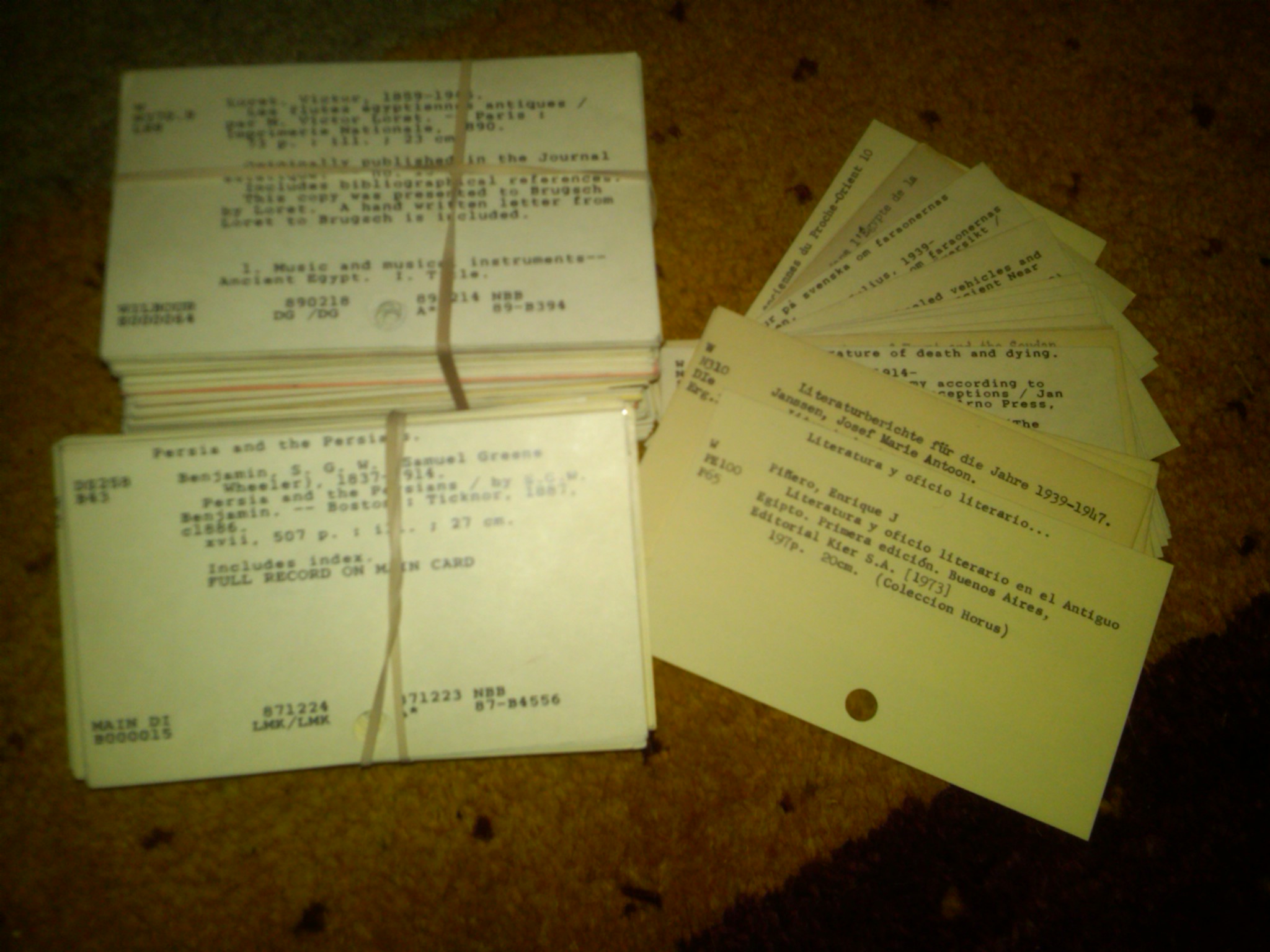
Card catalog cards!

Friday, January 28, 2011

The library at the Brooklyn Museum switched over to an online book archiving system and thus have no more use for the cards in their old card catalog. So they’ve been giving them away to artists, art of the book design students and, more recently, anyone who let’s them know what they plan to do with the cards. I wrote in and requested a bunch and arranged an appointment to pick them up. Stay tuned for literary upcycling updates.

Cards

I tried to pick cards that had some personal significance, which was not as hard as I’d imagined it would me. More on that later. In the meantime, when’s the last time you watched Party Girl?

The intellectual properties of a plastic bag

Tuesday, December 14, 2010

Does it count as idea theft if the rip off is for an environmental PSA? This interesting post by Michael Tully for Hammer to Nail asks this very question. Case in point: Rahmin Bahrani‘s Plastic Bag as jacked by The Magestic Plastic Bag, A Mocumentary. The original is narrated by Werner Herzog, the knock off  by Jeremy Irons. No contest. And while imitation is the sincerest form of flattery, this particular imitation has been selected to play at Sundance.

The Twist-Ties that Bind

Tuesday, November 30, 2010

On Wednesday, December 8th, Dr. Robin Nagle, New York’s Department of Sanitation anthropologist in residence, is giving  a talk entitled “The Twist-Ties that Bind” as part of an ongoing series of Freshkills Park talks. Here’s the description:

Join Dr. Robin Nagle to learn (almost) everything you ever wanted to know about garbage in New York. Discover how profoundly it connects us to each other, to history, to politics, to infrastructure and technology. Hear stories and reflections from people who shoulder its burdens. Glimpse some of its surprising secrets. Consider why we need to ignore it, and ponder the consequences of its invisibility. The insights you glean migh…t just change forever the way you see your city.

Dr. Nagle is the anthropologist-in-residence for the Department of Sanitation. She is also director of the John W. Draper Interdisciplinary Master’s Program in Humanities and Social Thought at New York University, where she teaches anthropology and urban studies. Her book Picking Up, about what it is to be a sanitation worker in New York and why you should care, will be published by Farrar, Straus and Giroux.

This lecture is co-sponsored by the New York City Department of Sanitation and the John W. Draper Interdisciplinary Master’s Program in Humanities and Social Thought at New York University.

I highly recommend checking out this event if you’re in or near NYC. Freshkills Park has created a Facebook event so you don’t forget. And even if you can’t make it, check out Dr. Nagle’s garblog, Discard Studies. As we’ve mentioned before, it’s rad.

TEDx Great Pacific Garbage Patch

Tuesday, November 9, 2010

The green blogs are abuzz. Did you virtually attend the TEDx Great Garbage Patch—an independently organized TED conference focused on plastic—this weekend? If not, here’s a link to everything that went down. And Beth Terry of FakePlasticFish has a great overview of Van Jones‘ presentation here. Knock yourself out, plasticheads. There’s a LOT of good stuff here. The video gallery alone could consume an afternoon. I’m still catching up, more to come.

Andy Mulligan’s Trash

Friday, October 15, 2010


Book cover by Richard Collingridge


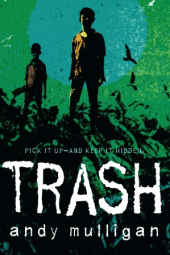
Andy Mulligan’s trash picker coming of age novel came out in the U.S. this week. Above is the whimsical British edition cover. The U.S. cover is a bit different.


Random House cover


Whatever the packaging, it sounds like a good read.

Here’s a description from Random House:

In an unnamed Third World country, in the not-so-distant future, three “dumpsite boys” make a living picking through the mountains of garbage on the outskirts of a large city.

One unlucky-lucky day, Raphael finds something very special and very mysterious. So mysterious that he decides to keep it, even when the city police offer a handsome reward for its return. That decision brings with it terrifying consequences, and soon the dumpsite boys must use all of their cunning and courage to stay ahead of their pursuers. It’s up to Raphael, Gardo, and Rat—boys who have no education, no parents, no homes, and no money—to solve the mystery and right a terrible wrong.

The publisher is hosting some sort of confusing Twitter scavenger hunt that offers the chance to win a free copy. Anyway, the kids book reviewers seem to think it’s worth reading.

American Wasteland

Wednesday, October 6, 2010

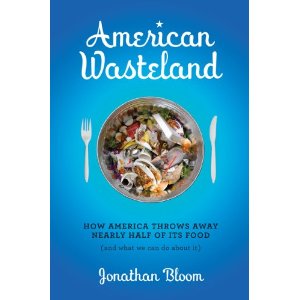
Jonathan Bloom of Wasted Food has a book out called American Wasteland. I want to read it.

American Wasteland

Radiolab: Detective Stories

Tuesday, September 28, 2010

I heart podcasts, especially since moving a bit further into Brooklyn and changing offices to one a bit further into Manhattan. As my commute has grown, so has my digital subscription list. Lately, I’ve been getting into RadioLab, which is awesome because despite numerous recommendations I had never really listened to any episodes before. Thus, the online archive of free downloads is an absolute treasure trove of straphanger distraction.


This morning, for example, I listened to a vintage episode called Detective Stories. It opened with producer Jad Abumrad standing on top of Fresh Kills landfill after it was closed but before conversion had begun to turn the site into a park—my kind of intro! The point being that landfills house a wealth anthropological stories that, inevitably, will one day be dug up. Then, to my delight, the first main chunk of the program features an ancient Egyptian dump where scientists have recouped fragments of paper from 2000 years ago that add to and throw into question everything we know about Jesus. That’s right, Jesus. Check it out for yourself here.

Encyclopedia of Consumption and Waste

Monday, July 26, 2010

This intriguing CALL FOR ACADEMIC TRASH is making its way around the internets…

Greetings,

We are inviting academic editorial contributors to a new reference work on consumption and waste, or the social science of garbage.

Archaeologists and anthropologists have long studied artifacts of refuse from the distant past as a portal into ancient civilizations, but examining what we throw away today tells a story in real time and becomes an important and useful tool for academic study. Trash is studied by behavioral scientists who use data compiled from the exploration of dumpsters to better understand our modern society and culture. Why does the average American household send 470 pounds of uneaten food to the garbage can on an annual basis? How do different societies around the world cope with their garbage in these troubled environmental times? How does our trash give insight into our attitudes about gender, class, religion, and art? The Encyclopedia of Consumption and Waste explores the topic across multiple disciplines within the social sciences and ranges further to include business, consumerism, environmentalism, and marketing. Each article ranges from 600 to 3,000 words. We are now making assignments due October 1, 2010.

This comprehensive project will be published by SAGE Reference and will be marketed to academic and public libraries as a print and digital product available to students via the library’s electronic services. The General Editor, who will be reviewing each submission to the project, is Dr. William Rathje, emeritus University of Arizona, the top scholar in the field.

If you are interested in contributing to this cutting-edge reference, it is a unique opportunity to contribute to the contemporary literature, redefining sociological issues in today’s terms. Moreover, it can be a notable publication addition to your CV/resume and broaden your publishing credits. SAGE Publications offers an honorarium ranging from SAGE book credits for smaller articles up to a free set of the printed product or access to the online product for contributions totaling 10,000 words or more.

The list of available articles is already prepared, and as a next step we will e-mail you the Article List (Excel file) from which you can select topics that best fit your expertise and interests. Additionally, Style and Submission Guidelines will be provided that detail article specifications.

If you would like to contribute to building a truly outstanding reference with the Encyclopedia of Consumption and Waste: The Social Science of Garbage, please contact me by the e-mail information below. Please provide a brief summary of your academic/publishing credentials in related issues.

Thanks very much.

Joseph K. Golson

consumption@golsonmedia.com
Rant of the month

Sunday, July 25, 2010

Apparently, someone came up with the idea to turn the Great Pacific Garbage Patch into an “eco island“. Blogger Anders Sandberg has a fabulous and well-informed rant on why that is a rather stupid idea. Recommended reading.

The upcycling college

Tuesday, March 30, 2010

Don’t know what to do with your career come August? Why not sign up to a 1-year program in upcycling design? Can’t believe I haven’t seen this before:

In the fall of 2008, Eskilstuna College started a course on sustainable development and recycling technologies. The course runs over two semesters and is intended for students who wants to work both theoretically and practically with the creation of new products from recycled materials.

You will have to work with practically everything from furniture restoration to the jewelry manufacture and use your imagination and creativity and you will certainly gain new insights into what sustainability really means.

This is really as cool as one thinks. [Apply here.] The work of this years trashtastic students can be followed at their blog, and their flickr. Personally, I’ve got my eyes on this vinyl record fruit bowl:

Vinyl record fruit bowl

The student will stage an end-of-the-year exhibition, open 27 May-20 August, at the college in Eskilstuna, so if you pass through Sweden, be sure to make a detour. In Stockholm, creations can be purchased at swop:art.

London poo

Wednesday, February 24, 2010

Swedish Television (those lovely public service guys) have correspondents here and there, reporting back to the motherland on the big events that shape our world. Tonight, they will report on our favourite human trash, that no one escapes: poo.

In a glimpse of tonight’s programming, we learn that in November 2009 (due to heavy rains) a fantastic 12,75 million cubic metres, or the equivalent of “3 401 Olympic swimming pools”, of sewage water ran straight in to the famous river Themes. The first to know when this occurs are the rowing teams using the Themes as practise ground, as they sometimes come down with heavy vomiting after a run on the river. Also, it smells.

In a larger perspective, the overflow of human trash is a problem in many major cities, including Paris and New York. I’ll be watching tonight.

E-waste boom around the corner

Monday, February 22, 2010

In 2006, 896 million new cell phones were put on the global market. With such an incredibly high input, a good guess is that there is a lot of people using a second-hand cell phone out there, but also that a lot of old cell phones are gathering dust in drawers. What we know is that far too many end up as non recycled trash, or are “recycled” by people working for a tiny income under terrible conditions.

In a new report released today, the United Nations Environment Programme draw attention to electronic and electric waste, pointing out that official data is scarce and that metals in themselves are trashy not only post cell phone life, but that mining is indeed a wasteful business. Electronic and electric waste contains a lot of metal, such as aluminum, copper, palladium and gold.

The report is an intriguing technical guide on how to properly recycle electronic and electric waste, but it also provides estimates on how volumes of electronic and electric waste will increase in so-called developing countries over the coming years. In Uganda, for example, quantities will increase by a factor between 6 and 8 by 2020. Challenges are, as per usual, complex and correspondingly huge. There is need for legislation and policing of such legislation, but legal recycling can’t happen without proper smelting facilities and dismembering factories.

In a comment to the Guardian, Ruediger Kuehr, United Nations University, points out that with increasing demand follows a surge in illegal import of what the global North considers trash.

It’s definitely in the countries which have substantial increase in consumption – countries like China and India, which are still substantial targets for illegal imports of e-waste. The same applies for countries like Nigeria.

With the risk of being repetitive, the background problem is our collective obsession with consuming new products and a world more and more characterized by electronic consumer products, while insufficient attention is given to recycling and upcycling.

Dustbins calling the mother white elephant

Monday, February 1, 2010

Swedish Radio reported earlier this week that Västra Götaland County are about to test the next generation of dustbins. The dustbins, using ultrasound, will be calling in to some sort of central command mother computer when they are ready to be emptied. This mother computer will transfer the information to trash collectors before they go out to do their business, but not before calculating the most efficient way to wheel the white elephant* on that particular day, taking into account weather effects on roads.

Freight costs are expected to drop by 25%, as only necessary stops will be made. More importantly, this is just too cool!

*refuse [collection] lorry; us eng. garbage [removal] truck, sanitation truck

WTF, Borders?

Tuesday, January 19, 2010

Dear corporate bookstore owners: you do not trade in trash.

Doomed bookstore

From the HuffPo:

Last month, corporate parent Borders announced they will soon be closing 200 Waldenbooks book stores in communities nationwide. Current Waldenbooks employees have come forward to alert the public that the company plans to dispose of many unsold books in the cheapest, easiest, least responsible way possible – by trashing them.

Read more here. First H&M, now this. Clearly we aren’t doing a good enough job communicating the simple reality that throwing things away is never the cheaper solution. Not in the long run. Ideas on how to better message through the thick skulls of corporate America?

Thanks for the tip, Robin.

George Orwell in void of thaw

Tuesday, January 19, 2010

One of my favourite blogs is The Orwell Diaries; a complete reprint of the diaries of legendary writer George Orwell. A new post is added as long as there was an entry in the diary 60 years ago. Hence, today we learn what Orwell wrote on the 19th of January 1940. It was apparently cold in the UK at the time (as it is now). Orwell had a bit of a conundrum around what to do with his trash:

No thaw. A little more snow last night. Cannot unfreeze kitchen tap but unfroze the waste pipe by pouring boiling water down the straight part & hanging hot water bottle over the bend. Tried to dig a hole to bury some refuse but found it impossible even with the pick. Even at 6” depth the ground is like a stone.

9 eggs.