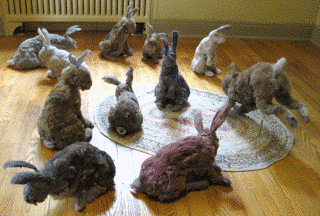
Bunnies made of dust
Yup, that’s right, these bunnies are literally made of dust. They’re part of an installation by the artist Suzanne Proulx. More on the project here.
Bunnies made of dust
Yup, that’s right, these bunnies are literally made of dust. They’re part of an installation by the artist Suzanne Proulx. More on the project here.
The French have a long, proud history (protected by law and immortalized in film) of preventing produce waste by opening up their farms after harvest to allow scavengers to collect the left overs. Gleaning still takes place in the countryside, but works a little differently in modern cities, where it takes the form of collecting discarded fruits and veg after farmers markets and from commercial trash bins.
And in these tough economic times, gleaning or “doing the end of the market” is more common than ever in Paris and smaller cities, especially among youth, the homeless and…the elderly.

Reuters/Eric Gaillard
To get a better sense of who gleans, how and why, the French High Commissioner for Active Solidarity Against Poverty commissioned a report on the topic from a French think tank called The Center for Study and Research on Philanthropy (CerPhi). So, CerPhi conducted a qualitative study, scoping out prime gleaning spots in Paris and two smaller cities and conducting in-depth interviews with over forty men and women spotted in the act.
While they didn’t exclude people who consider gleaning a political or environmental act, the report focuses on those who glean out of financial necessity. In other words, everybody but the freegans.
The most interesting take-away is the fuller profile of urban gleaners the study provides. For the most part, they are young people, retirees and the homeless. Young people have the fewest health and safety concerns about eating discarded produce. Longtime homeless men use gleaning as a survival mechanism and continue to do it even when they have housing. Retirees glean out of financial necessity and are, for the most part ashamed of gleaning (with the exception of a small minority who barter what they glean and gain self-worth from the practice).
The study specifically investigated the relationship between gleaners and social security to better inform government programs. What they found reveals a lot about pride and the challenges of aging in a failing economy. Take these two quotes, for example:
Woman, 82 years old, Paris
Have you been “doing market ends” for a long time?
It’s not really market ends, I buy, I see if I see something.
I think I saw you last Saturday.
Yes, Saturday I was here. If I see something, I pick it up but I buy a lot. Really, I do, I buy a lot, and I do it if I find something, otherwise I mainly buy,
Did you buy everything in that bag?
No, I didn’t buy everything, but I bought a good part of it, a large part of this here was picked up, it depends on the day.
Woman, 75 years old, Paris
Are you familiar with food aid, like soup kitchens?
No, I don’t go there.
Why not?
Because my grandchildren work and that doesn’t interest me.
If you read French, the full report is a heartbreaking page-turner full of nuanced questions about what gleaning means to different groups, concepts of transiance and urgency as well as larger societal questions about the relationship between hunger, public assistance and stigma.
And it’s getting harder and harder to be a gleaner, the study reports, as farmers markets and supermarkets go to greater lengths to destroy food waste and discourage scavenging. Sadly, the report lacks clear-cut recomendations. I’d love to hear your thoughts on the topic.
PS Thanks, Gillian, for sending me an article on this study in the first place.
As of this morning, there is indeed a wildcat strike involving almost all of the trash collectors in Stockholm! Noone knows what will happen and there’s general confusion. Not to worry though, the board governing my house has put up a sign!

"STRIKE! Please dispose of only household garbage in the supplied plastic bags. Wait with other garbage until the strike is over."
As an anectode, one evening last spring I (for reasons unknown) left a garbage bag on my balcony. Next morning it had been opened by a flight of gulls. I felt very stupid.
My friend Jen always finds the coolest stuff on blogs and is so sparse and disciplined about what she shares with others that you know: if she’s passing it on, it’s worth checking out. Case in point, this DVICE blurb on Sierra Nevada’s MicroFueler. Isn’t it the prettiest pump you ever did see?

For more on the beer-dregs-to-ethanol process, check out the original post on CNET. For $10k, you can buy one for your home. They should market these things to university frat houses. What better companion to the kegerator in the kitchen than a microfueler in the driveway?
It’s been a gassy couple of days on the internet. Yesterday the HuffPo posted on garbage-powered garbage trucks in Northern England, then this morning I found this blurb on busses in Oslo powered by methane collected from the city’s RAW SEWAGE. [Editor’s note: I’m not sure I’m as forward thinking as the Scandos on this one. Perhaps Victor can act as cultural ambassador. Is it just me, or are poo-powered busses a little gross?]
Berlin signed a contract this week with Waste Away, Inc for a new fleet of robotic garbage trucks to start collecting trash from city homes. This trend, first started by rubbish clearance services in Bristol, has picked up in popularity around the world. Don’t be surprised if they end up in your city.
Operated by a joystick (fun!), hydraulic arm trash trucks have been tried out in other cities, including some in the U.S. They require bigger trash cans and allow for just one sanitation worker to man an entire route. I guess the days of one guy driving the truck and another one or two riding on the back and hopping off to collect the trash are over. While sanitation is hard, unenviable work, I hope this new technology doesn\’t reduce the need for sanitation workers. Our poor economy needs jobs!
Side note: in scanning the internets for images of these new trucks, I came across this gem of a children\’s book: I Stink by Kate and Jim McMullan. It\’s the first-person tale of a garbage truck and companion reader to I\’m Dirty, the first-person tale of a front-end loader. Check out this totally endearing review over at A Wrung Sponge. I\’m adding both to my list of trash books for kids.
Sweden’s largest morning paper, Dagens Nyheter, reports today that about 150 trash collectors in Stockholm threaten to go on a wildcat strike any day now, over a salary conflict with the entrepeneur handling the garbage on behalf of the municipal. The conflict itself is pretty interesting, since trash collectors here have a contract structure in which they are paid a kind of piece wage, based on the amount of trash they collect.
The employer wants to pay them a flat monthly salary (a very standard way of doing things), which for most of the workers would mean less cash. And about 20% more work. Further, the trash collectors wants to limit the amount of trash they can collect, and are complaining that there’s just so much more trash these days. Trash collector Mr Berra Ramhquist, 27 years on the job, tells Dagens Nyheter that the increase since he started is just immense.
If a wildcat strike indeed starts, one can just imagine how quickly we all will be part of an involuntary trash collecting project Mattias Hagberg style! To be continued.
Followers of this blog perhaps recall this post about the book Skräp (“skräp” being Swedish for “garbage”) from November. Today we are proud to present an interview with the author, Mattias Hagberg.

Mattias Hagberg, journalist resident in Sweden's second city Gothenburg, author of Skräp
Before we start, a little recap: Skräp is a book about garbage, in which Mattias Hagberg starts off with discontinuing the routine of taking out his family’s trash. Instead, he hides their fully loaded plastic garbage bags under the sink. This soon becomes a ridiculous exercise, and Mattias proceeds his experiment in a secret room in the cellar of the house, keeping neighbours using the cellar unaware. However, Mattias quickly understands the practical limitations of this project, and gasping for breath moves his horribly stinking trash collection (only a few days old) to the garbage container room.
Back in his apartment, Mattias Hagberg ponders over where his trash actually will be going, now that it’s out of his experiment and back into the system. Since the early 90’s, Sweden’s had an idea of system called “The Nature’s Cycle”, an idea based on the notion that our garbage can and should be recycled, i.e. return to the Nature’s Cycle. Much like Mufasa teaches his son Simba about how lions die and turn to grass, eaten by anthelopes, in the Disney blockbuster The Lion King.

Skräp, the book
Mattias Hagberg soon discovers that trash isn’t much of a happy circle-of-life story. Instead, he gives a thrilling tale about the cash in trash, how “recycling” still produces tonnes and tonnes of toxic waste and how our electronic waste ends up in slum quarters in Ghana and China, in a chain starting at your local recycling depot, going through multi-national corporations, to the mafia.
Hello Mattias Hagberg, how are you, what’s up?
– Doing alright thanks, slight headcold, other than that fine. Working on what feels like a gazillion of projects. I think most relevant for your readers is an article about the Swedish auto industry, with the angle that the point is not to save this industry, but understand that the whole system of autoism is in crisis. That constructing and buying new cars simply won’t do.
Cewl, looking forward to reading it! So, why did you decide to write a book about garbage?
– The idea was actually my editor’s. At first I was scpetic, it all felt very technical, I didn’t really know anything about garbage, had this vague idea about the recycling system working smoothly. Then I did the experiment, stopped taking out the trash, an experiment you know proved do be quite stupid. But it inspired me to take things to the next level. I realised that while we have a functioning recycling system, that system doesn’t recycle everything, far from it. And the system is suffering from the fact that we keep producing increasingly more waste. As everyday citizens however, we have a veil above our eyes for this fact, we are never confronted with the real problem: That we buy a flat screen TV when our old TV works quite well.
Which part of the work surprised you the most?
– The insane amount of garbage each of us produce in one year. Several hundrered pounds! In the average family, about 20-25% of this garbage is food, that is most often perfectly edible! I was also intrigued by how fooled we are that there is a connection between “recycle” and “close”, how we pervive recycling to be this story about a process in harmony with nature. It’s a global industry, run by multinational enterprise. To me, it resembles the middle-age trade in letters of indulgence. For example, when garbage is burned, energy is produced that heats houses, and filters keeps the smoke clean, but the toxic remains after burning, and the poisons caught in the filter, still remains, and needs to be kept somewhere.
How has this changed your relationship to garbage?
– I think that deep down, we are all aware of that more consumption is just foolish, but we ignore this and continues to buy. For myself, of course the work with the book has effected what I buy and what I do with it, but at the same time I’m a bit fed up with the individualist perspective. We must focus more on the systemic errors of our culture, bring the debate from the behaviour of people to the behaviour of enterprise. Right now we have no debate, and we know that the resources of this earth will end. The garbage system of today is something we really need to adress, together.
dumpstertaoist made a great point in a comment to my former post, and I have the fantastic Swedish holier-than-thou reply! This should probably have gone in the original post, but I actually forgot about it. When one takes things for granted…
Anyways, here goes: Back in Sweden, manufacturers are governed by what’s called “the Producer responsibility”. It essentially means that companies selling products that will end up as garbage are responsible for the collection and disposal of their discarded products. The producer responsibility law stipulates companies obligations in five areas:
You can read more, in english, at the web of the Swedish Environmental Protection Agency! Among other things, check out the Waste Council.
Upcycling. It’s all the rage. Want proof? Just take a click through the internet this week.
Curbly posted on recycled kitchenware lighting, via the fantastic garblog Green Upgader.

Colander lamp by French designer "Garbage"
The Temas Blog did a video roundup of Brazilian trashion. This clip of looks fashioned from drink can tabs is my favorite.
Wooster Collective found not one, but two posts worth of fur coat upcycling by street artist Neozoon.

Upcycling ala Neozoon
And the crafty mavens of Etsy shared all kinds of DIY upcycling for Valentine’s. I love this men’s shirt turned party dress.

Upcycled shirt dress
Also, the heart jean skirt is literally badass.
If you haven’t yet, you should really read Joseph Huff-Hannon’s fabulous piece about an order of nuns on a faith-driven mission to live the greenest life possible. Go ahead and click through now, the rest of this post is just me gushing.

Photo by Josh Haner for The New York Times
The story centers around the sisters’ efforts to build an eco-friendly convent and is full of fun scenes, like nuns sitting around a table covered in BlackBerries negociating local food deliveries.
I love this article for a bunch of different reasons. First of all, it is told respectfully. It would be really easy for a piece about city nuns going green to feel expoitative or snarky. This doesn’t.
Second, it takes place in Morningside Heights, my childhood neighborhood and home to the country’s finest journalism school (which I also attended). The farmer’s market cited in the article is just in front of the University gate closest to the J school—a building teeming with ambitious young reporters and veteren journalists alike, all of whom are among the most news-infomed humans on the planet. I love that this reporter—a J schooler himself—lifted a rock so close to home and revealed a world we never knew existed.
Third, it dresses dull waste politics up in compelling details.
Fourth, it covers faith in a fresh way.
Fifth and finally, it was sent to me directly by the author, allowing for a lazy Sunday of blogging from bed, thinking about the old hood and researching green building materials such as concrete visually and structurally enhanced by recycled glass (which the nuns hope to use for thier new HQ).
Thanks, Huff-Hannon. I’ll be looking out for your byline.

Victor, perhaps blogging
Dear Trashies,
Today is an exciting day for everydaytrash.com. The keen observer may have already noticed that the last post boasts an unfamiliar byline. Please welcome Victor Bernhardtz, eurotipster extraordinaire turned contributing editor extraoridinaire. Based in Stockholm, Sweden, Victor wears many hats: broadcast journalist, blogger, activist, all-around rockstar. He also shares my passion for looking more closely at what we throw away—as evidenced by his stellar first post on recycling crimes in Sweden. I am thrilled to have a partner in crime and proud that with Victor’s occasional contributions the blog will be even more international.
xoxo
Leila
Living in Sweden, one gets used to recycling. “To not recycle” is one of the things you just don’t_do, should you want to be able to blend in with your average crowd of people. We take it very seriously. A few years ago, municipal authorities brought a 77-year old woman to court for failing to recycle a frying pan in the correct manner, and last year a police candidate was fined for placing a cat litter box outside the plastic recycling container, instead of inside. [The links are in Swedish, so most of the readers will have to take my word for it.]
There are many examples like this, all made possible by a system of Garbage Spies, who stand guard at public recycling stations (undercover), and document wrongdoings. The Garbage Spies however, claim that highlighting the 77-year old woman makes them look stupid (yathink?), and that their work is focused on finding people who dump big things, say 20 gallons of frying oil without permission.
I myself find this highly amusing, but at the same time I’m a staunch supporter of Garbage Spies. Abusing your recycling systems should cost you! Inspired by their great deeds I did some private investigations today, at the recycling station in my house. Noted that several people have put non-coloured glass in the container for coloured glass and that there’s lots of plastic in the wrong places. Scandalous! I will be filing a report.
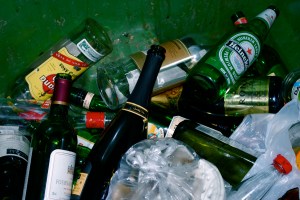
Supposed to be for coloured glass only
In the electronics bin, I found a vacuum cleaner, a television and a pair of speakers. Clearly someone’s been upgrading their gear. Was probably necessary, the dumped television wasn’t even flat screen… And to finish off this first proper own post of mine, I’m most curious about other recycling cultures? Tell us in the comments section please!
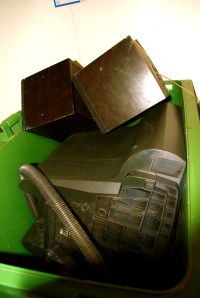
Discarded television et. al.
Regardless of the nuances of international debates, I think all sides can agree it sucks to live in Gaza.
Remeber the sewage floods a couple years ago? Or that story about the Red Cross having so much trouble bringing contstruction materials into the area that they turned to recycling rubble?
Ever-resourceful, the people of Gaza are no strangers to recycling, reusing and selling scrap. The Arab Times reports that since the latest violence, Gazans are increasingly turning to trash picking for much needed cash.
Shaaban, 27, walks by, his head down looking for a bottle or better still a container that he could sell on.
‘I used to work in construction before. But since I was wounded, my hand has been paralysed,’ says the father of three, showing a large scar on the arm from the Hamas-Fatah battle of 2007.
Today he relies on UN handouts, including several kilos of rice and flour every three months.
‘It’s nowhere near enough,’ he says.
‘Rubbish is our life. You might as well say we don’t have a life.’
I just saw this amazing reggae recycling video on Visible Trash. Little Shiva always finds the quirkiest stuff. And why does everything sound better in a Caribbean accent??

Brazilian nonprofit makes furniture from scrap tires
Keith R. over at The Temas blog sent me this link to photos he’s posted from a Brazilian organization called Vida Amiga whose members take old tires and fashion them into furniture, then sell the furniture. Recycling plus skills building = double sustainable. I love stories that involve selling things made of trash. Thanks for the link, Keith!
P.S. The post includes a fantastic roundup of past Temas posts on creative recycling.
 everydaytrash