There are indeed dumpster divers everywhere. The Norwegian Brodcasting Corporation (NRK, who provide both public radio and TV in Norway) last weekend ran a piece on freegan Børge Roum, who brought viewers to take part in his dumpster diving late at night. Roum is ten years in the business of protesting against excessive consumption, and takes home more or less everything, even though he’s careful about dairy products.
The piece also provided facts on thrown away food in Norway, which stand at 100 kilos (220 pounds) per person per year, making it a nationwide total of 50,000 tonnes per year.
At the moment, the thing is parked at 125th Street and Riverside park, which is what caught my eye about the project in the CENYC email newsletter I received yesterday. Growing up on Riverside Drive at 125th Street, I observed many half-assed attempts to class up the waterfront at this location. It appears that with the West Harlem Piers Park, we’ve come a long way from the sketchy strip of my childhood when—to the extent living things populated this area—you would only see stray cats, hookers, johns, junkies and lunatic fishermen willing to eat from the (pre-Riverkeeper) Hudson.
This new park connects Riverside Park with Riverbank State Park (built on top of the sewage treatment plant at 135th Street) and encompasses the old marine transfer station between the two points where, once upon a time, my trash was tipped out of a dump truck and onto a ferry to be floated down to the Freshkills landfill (now also a park).
Anyway, the Waterpod sounds amazing. Sadly, the recycling and composting workshops being offered are during my workday. Regardless, I will try to get up there to check out the pod and waterfront renovations. Stay tuned.
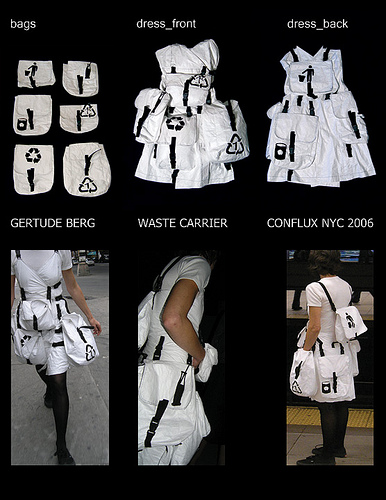
Austrian-born, Boston-trained trash artist Gertrude Berg made this video of a woman picking up trash with high heels on the streets of Bushwick, Brooklyn as a comment on the hypocrisy of gentrification: outsiders descend on an industrial neighborhood, gut and polish the insides of buildings while the streets remain as trash-strewn as ever.
This project reminds me of a similar venture my friend Myra designed in college called “Trash Bellies”. She has been promising since the beginning of this blog to dig up photos of that work. Myra, are you reading this? Send me pictures!
Note: Conflux 2009 will be held this September. And it’s not too late for artists to get involved. Sumbissions are due Agusut 15. I wonder what urban and trashy wonders the next event will hold!
This post was made possible by a tip from a supercool attendee of the NYC Repro Health Happy Hour. Thanks, tipster!
Reading this lovely New York Times piece on secret dumpster pool parties in Brooklyn, I wonder why everydaytrash.com didn’t merit an invitation (yet)? We’re locals dammit!
Bitterness aside, here we have yet another example of how something goes from trashy to trashtastic. Makes me think of how “the future” will be, with thoughts wandering to Mad Max. In a desolate and post-apocalyptic Brooklyn, we’ll be sitting there in our pool dumpsters, growing tomatoes in oil barrels and spend a lot of time walking. That is, if everthing goes wrong. Let’s hope not.
To commemorate the 60th anniversary of the Universal Declaration of Human Rights last year, the office of the High Commissioner of Human Rights at the UN collaborated on an Art for the World project to make a series of videos inspired by that document. This environmentally-themed clip highlights the reuse of plastic bags in Africa to create traditional Djembe drums: 2,000 drums = 20 tons of recycled plastic and offsets 20 tons of wood, which would otherwise have been used to make the instruments.
Last night, while waiting out service changes and delays on a very muggy Subway platform, my friend Linda and I got to talking about historical muckrackers, specifically, Jane Addams.
Jane Addams
It turns out Addams, in addition to Nobel-prize winning social justice work (including founding the Settlement House movement), was so concerned with the unsanitary conditions of trash piling up on the streets of Chicago’s 19th Ward that she applied to be a garbage collector. The mayor turned her down, but after pestering appointed her to the role of neighborhood garbage inspector overseeing trash collection. Details of this feminist trash story and many other anecdotes from Addams’ life can be found between the covers of Jane Addams: Champion of Democracy by Judith Bloom Fradin.
Brazil is returning more than 1,400 tons of imported trash back to the UK after discovering the shipments included hazerdous waste. A bunch of Brazilian waste hauling companies may be fined as well. While Brazil allows private companies to import and store trash from other counties, the country maintains strict regulations for toxic waste.
I love it when developing countries refuse to take shit (in this case, literally) from more developed countries. In the same way Brazil has told private pharmaceutical companies where they can shove their AIDS drug patents, the environmental agency didn’t flinch before sending 65 crates of blood, syringes, condoms and food waste right back to the UK.
via The Guardian
[In solidarity with this righteous trash policy, I just booked Labor Day weekend in Rio. Ok, ok, full disclosure, my vacation planning had nothing to do with trash and everything to do with sick deals on flights to Brazil. But I’m open to garblogging tips for when I’m there. Any Brazilians in the house?]
Today I begin informal training in sound recording from an audio engineer friend. My hope is that in exchange for helping him with some projects, I’ll walk away with the skills to record and edit little interviews, thus putting the Trashtastic back in Tuesdays. Stay tuned and feel free to submit trash cast topic ideas.
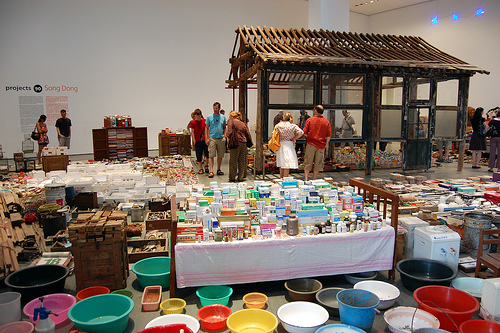
Chinese artist Song Dong takes the concept of pack rat to the extreme in a new exhibit up at the Museum of Modern Art in New York City.
Projects 90: Song Dong, via 16 Miles of String on Flickr
From the MoMA site:
A collaboration first conceived of with the artist’s mother, the installation consists of the complete contents of her home, amassed over fifty years during which the Chinese concept of wu jin qi yong, or “waste not,” was a prerequisite for survival. The assembled materials, ranging from pots and basins to blankets, oil flasks, and legless dolls, form a miniature cityscape that viewers can navigate around and through.
A group of MIT researchers launched a new project called “Trash Track” today, which will enlist volunteers from New York and Seattle to have their trash tagged with specially-coded wireless markers and tracked through the various waste streams.
Visualization mock-up (simulated) By E Roon Kang at SENSEable City Lab
The project is part of the SENSable City Lab (whose past work includes other sweet visualizations like this map of New Yorkers’ phone calls to the rest of the world). Apparently, we’ll be able to follow along with the migration of trash online. And in September, the Architectural League in New York City and the Seattle Public Library will host exhibits.
The ultimate project goal is thus to encourage us to take a closer look at what we throw away in the hopes that being kept aware of our waste after it leaves our hands motivates us to create less of it in the first place. Neat idea. Let’s see if it works.
Trash is terrible, really. Sometimes though, there are ways of finding beauty in it. Or it might just be me being very post-apocalyptic-aesthetics-loving. Anyhow, check out these five pix from South Africa, and see if you agree.
South African trash removal lorries
Pix come from “the Green Campus Initative”, whom I can’t find online (or rather, thousands of initiatives with that name can be found).
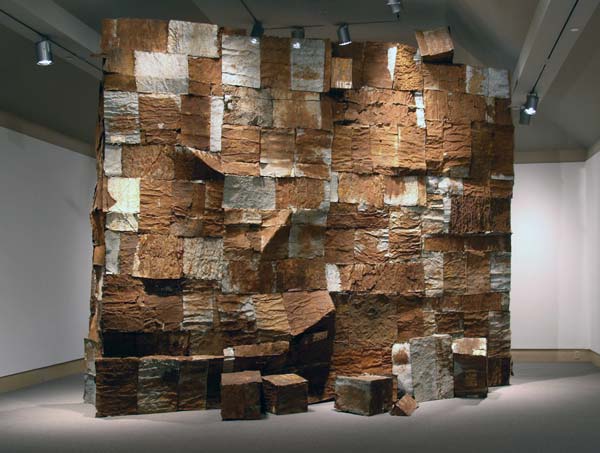
Ghanaian-born/Nigerian-dwelling artist El Anatsui uses all kinds of cool trash in his work: from would-be discarded casava graters to the caps used to top off local home brew, to milk tins and so on. Check out the National Museum of African Art Web site for more images and to hear the artist himself describe his work, such as the Crumbling Wall pictured here.
Crumbling Wall
T Magazine also did a pretty good piece back in February detailing the “pop recycling” and overall “Africanness” to El Anatsui’s deceptively simple pieces that fuse everyday materials into works of art. Thanks to art historian Media Farzin for the tip.




 everydaytrash