Travelling for a couple of days, the weekly compactor will be posted over the weekend. Excuse the delay!
Trash Hiatus
Friday, June 8, 2007Trash City
Wednesday, June 6, 2007 As someone who reads a lot of garbage headlines, I can say with authority that Toronto is way into trash. Media stories about how to green a community, waste export policy debates and grassroots organizing around reducing waste quite often carry Toronto datelines. So, I wasn’t that surprised to see the local weekly, Eye Weekly focus on trash for an Earth Day special in a stellar compilation of blogworthy articles (thanks for the link, mom).
My favorite piece is an overview of the publications recent design challenge to build a better trash can. Check out what the judges had to say about the three most innovative contenders. The idea behind the contest was to build a vessel that would allow consumers to separate their waste, recognizing the diversity of what we throw away and the various places it should go. Too cool.
I’m torn between the “JUSTDESIGN” and “TRASHIE” models.
Trashtastic Tuesday with the Composting Crew
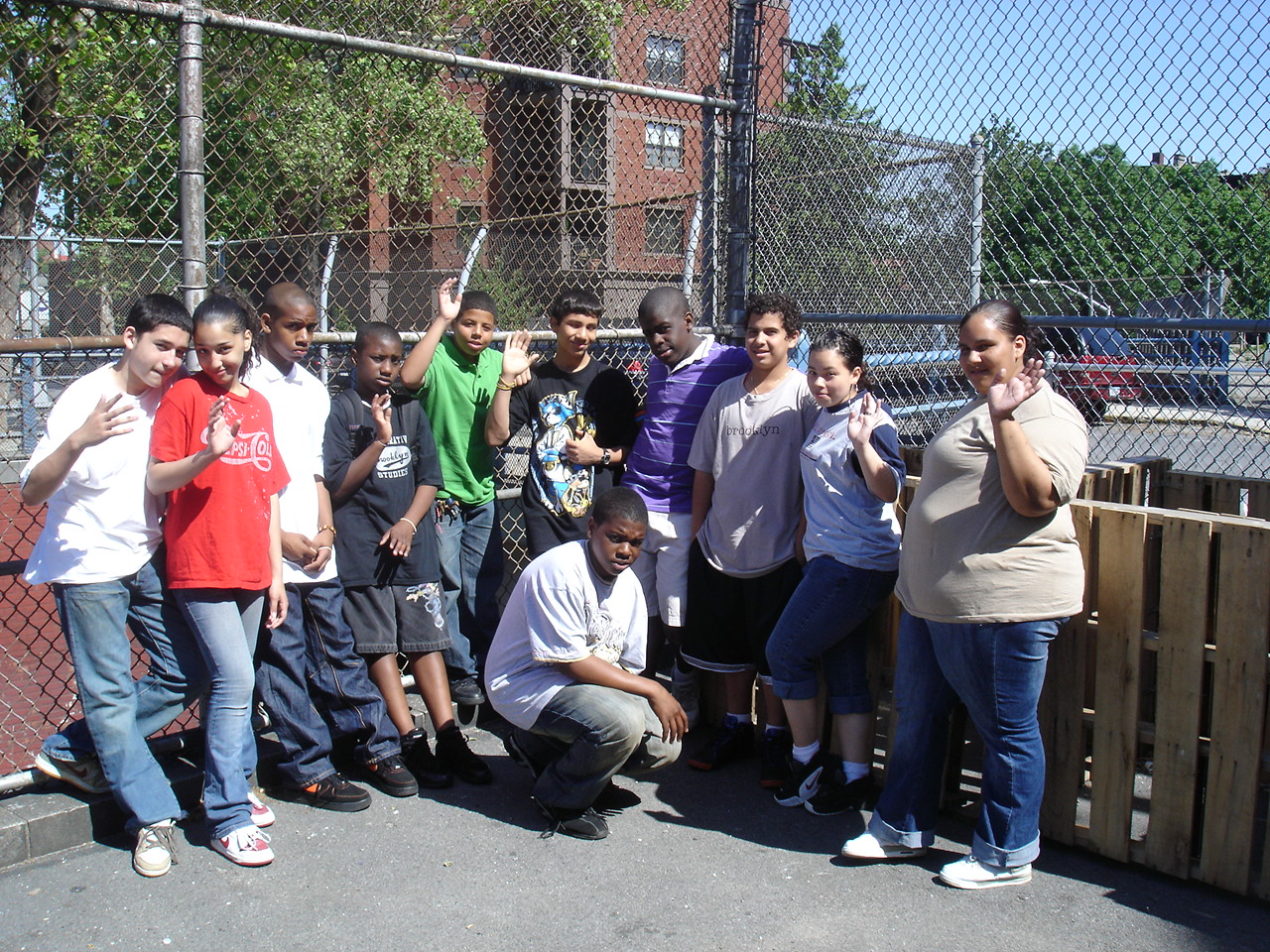
Tuesday, June 5, 2007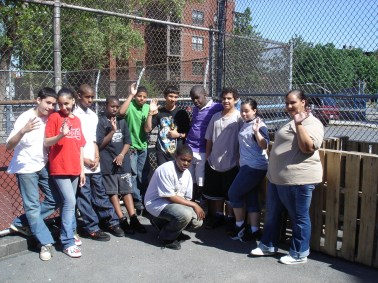 This week on Trashtastic Tuesday, we check in with some Middle Schoolers at the Brooklyn School for Collaborative Studies. This year, the students are taking part in a “Cafeteria Expedition,” an interactive project to improve and better understand school cafeterias. Alex Perez, Stephanie Rodriguez, Steven Ruiz, Grabriella Bobe and T.J. Bodden—members of the 8th grade composting crew—were nice enough to take the time to answer a few questions for everydaytrash.
—
everydaytrash: Why should a school like yours have a composting program?
Composting Crew: The reason why all schools should have a composting program is because we generate a lot of waste and composting can reduce that amount.

everydaytrash: How does reducing waste help your school?
Composting Crew: Because we are making it into something useful.
everydaytrash: How did you choose what kind of composting system to use?
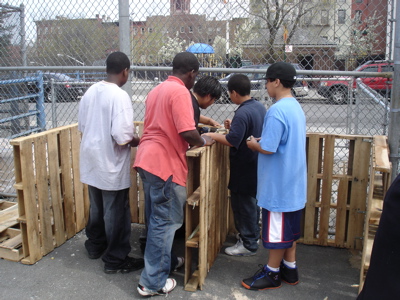
Composting Crew: We went to the Botanic Gardens and saw what different kinds of composting bins that they had and choose which one we liked and would be best for our needs.
everydaytrash: What kinds of materials did you need to get started?
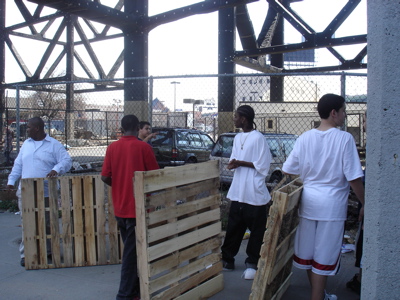
Composting Crew: We needed pallets, screws, nails, buckets, and waste. We had the pallets donated by Lowe’s and we carried them back to school.
everydaytrash: Who uses the composting soil you create?
Composting Crew: Every single person in our school will be able to use it. The first will be the grade school kids who will use it for their planters. After that we will donate it to locals for their gardens. Thank you for showing interest in our project. We learned a lot from this Cafeteria Expedition.
###
Photos courtesy of the incomparable Peter Hoppmann—friend, neighbor and middle school teacher extraordinaire.
Trash TV
Sunday, June 3, 2007 Check out this hip little video from Current TV. Episode “World of Trash” takes a closer look at what we throw away, where it goes and what can be done to reduce the flow. Sound familiar?
It’s great to see trash out there as a hot topic in an ever greener world. This is a great 101 to share with friends new to the wonky fascination.
Weekly Compactor
Friday, June 1, 2007 This week in trash news:
- In ever-dirtier Fort Portal, Uganda, the city can only collect 3 out of the 5 tons of garbage generated by residents each day;
- Eco-friendly trash trucks roll out in Mumbai;
- Mayor Bloomberg pimps the SWAMP around town;
- Giant yellow recyling trucks drive around Swindon, UK, collecting recycling; and
- Six arrested in Spain’s “Operation Brugal” trash scandal.
Sta’en I-lund
Thursday, May 31, 2007 On Monday of this fabulous long weekend just past, I made the long overdue journey out to Staten Island to visit my aunt. I took the ferry and, for the first time in many moons, sat upstairs and outside to enjoy the views as I floated on. It was such a beautiful day that I didn’t even mind the throngs of tourists and fleet week sailors crowding the decks.
On my way to Whitehall terminal to catch the boat, I bought an iced tea and drank it on the Subway platform. I took my last sip as my train rolled in and, smiling to myself, decided to hang on to the bottle so that I could deposit it in the brand new recycling bins at the ferry terminal, then blog and boast about it here.
I did, and here it is. The bins, as promised, were easy to spot as I entered the ferry terminal, neatly color coded to separate paper from plastic and glass. On the way home, however, it occurred to me that there are no bins ON the boat, or upstairs in the terminal—meaning that anything purchased on the ferry or while waiting for it to arrive is much less convenient to recycle. You would have to know they’re there.
Baby steps, I know. Next time I take a ride, I’ll ask whether the concession stand recycles any of those beer bottles.
Tips from a hardcore treehugger
Wednesday, May 30, 2007 Tuesday wasn’t as trashtastic as one might have hoped this week. I’m hanging on to this week’s interview until it’s good and ready. I hope, with the long weekend and still-fading buzz of the first weekend of summer (sort of), you’ll cut me some slack.
And speaking of slack, Alina over at Closet Environmentalist has been picking it up on the garblogging front. Check out her freshly posted guide to recycling, including tips on when NOT to recycle.
Ken Noguchi and mountain trash
Monday, May 28, 2007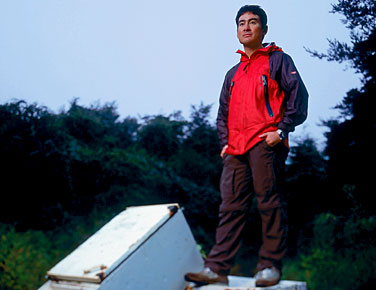 Japanese mountaineer Ken Nagouchi leads clean-up climbs of Mt. Everest. The latest such trip yielded 1,100 pounds of trash discarded by expidetioners along the way to legendary heights.
For more on the project, check out this Time Asia profile (photo from Time.com);
Or this conversation with marine ecologist and longtime resident of Japan, Jack Moyer.
Weekly Compactor
Friday, May 25, 2007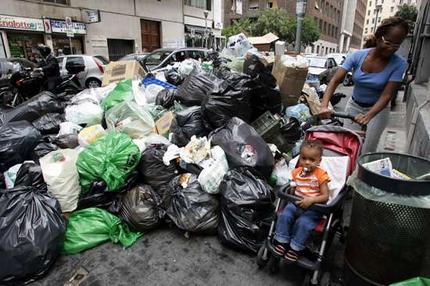
This week in trash news:
- Southern Italy reaches trash crises (photo via the AP);
- Chicago adds big bellies to the beach;
- Baltimore residents love them too;
- Beijing sets aside 30% of its trash to make energy; and
- Garbage pile saves a young Czech.
Recycle your junk mail
Thursday, May 24, 2007 Yesterday, the Direct Marketing Association launched a campaign to encourage people to recycle their junk mail, including this new “Recycle Please” Web site. From the Web site, companies can download a logo reading “recycle please” and attach it to their direct mail campaigns and mail catalogs.
Nowhere on the site does the DMA suggest that companies replace unsolicited paper mailings with electronic mailings or that they allow customers to opt to receive the same information via email.
And why should they? The DMA’s press release includes several bulleted stats, including these factoids that suggest that though Americans are bombarded by letters and catalogs they never asked for, many of us flip through them before tossing:
– The average US household gets 18.5 pieces of advertising mail per week,
a figure that has held steady during the past five years. (US Postal
Service, 2005 Household Diary Study)
– Consumers do read their mail. According to the US Postal Service,
85 percent of US households usually read some or all of the advertising
mail they receive. (US Postal Service, 2005 Household Diary Study)
A campaign truly geared at helping the environment—and not just out to polish the image of marketers and fundraisers—would include a downloadable logo promoting paper-free options.
Some suggestions from everydaytrash:
“Let Us Know if You Prefer Email”
“This Catalog Available Online”
“Spam Over Junk Mail”
For helpful tips on actually reducing junk mail, check out: Ecosource; Ecofuture; and Privacy Rights.
Photo from the Government of Westchester web site.
High Court Trash
Wednesday, May 23, 2007 If only blogs had budgets!
Man do I wish I could afford the SWANA special e-session breaking down the implications of United Haulers Association v. Oneida-Herkimer Solid Waste Management Authority! While it doesn’t have a historically punchy name like Roe v. Wade, Brown v. the Board of Education or Griswold v. Connecticut, Oneida-Herkimer is one for the trash textbooks. The decision ruled that it’s ok for communities to insist that trash collected locally be directed to nearby dumps in an effort to encourage recycling and reduce truck trips and traffic.
Solid waste export companies claim such local laws unfairly discriminate against interstate trade and their right to make a dime. In an earlier case involving a private local dump, the Court had ruled that it was unfair for cities to insist that trash be dumped in one spot over another. This latest case involved a public dump, which may have been the necessary difference in opening the Justices eyes to the environmental side of the argument. I say ‘may have’ because I’m not sure. The analysis is locked, beyond my reach on an expensive site. Sit tight my budget readers, I’ll try to find us some free legal advice.
Trashtastic Tuesday with Robin Worley
Tuesday, May 22, 2007 I connected with designer Robin Worley, one of the founders of the trash to fashion movement in America, over email after she noticed some of my posts and I noticed her organizaiton’s Web site. She kindly agreed to share the origin story of trash to fashion as subject #3 in our ongoing series of Trashtastic Tuesdays.
—
everydaytrash: How did you become involved in the trash fashion world?
Robin Worley: It all began in Nevada City, Californiain 1983 with a woman named Susan Lamela, a.k.a. Polly Ethelina, and a show called “On the Cutting Edge”. It was a social science experiment. I modeled for Polly in the second show she did which took place in 1986 and featured the work of three designers, Polly E., Mr. Perception and Mary X. This was the humble beginnings of Haute Trash & eventually the Haute Trash Artist’s Collaborative, a Non-Profit Organization of which I am currently V.P.
everydaytrash: What was the first show you took part in or organized?
Worley: I modeled in [On the Cutting Edge] and then was a designer for the first time in next show called Hot Trash 8-8-88 (it was on Aug. 8th, 1988) and then Trash Tech in 1989 and Haute Trash, Objet Trouvé Fashion in 1990. With each show the number of designers increased…In 1988 I moved to the Big Island of Hawaii, commuting back and forth to do the shows in California when I connected with Trash Artist Ira Ono and the beginnings of a Trash Art movement in the Hawaiian Islands. The first show I produced was a runway show of seven of my own pieces at the East Hawaii Cultural Center in Hilo for the very first Art of Trash Gala Opening in September 1991.

everydaytrash: How has the community of designers evolved and expanded over the years?
Worley: Over the time that we have been at this we’ve seen a lot of evolution! It was a popular theme in the “Techno-Era” that we started in, but now it really seems like an idea whose time has come. We didn’t really know anyone else who was doing what we do back then. Now we discover new trash fashion designers all over the world all the time thanks to the internet. That is, or they find us. We have a website it’s www.hautetrash.org. There is a competition in New Zealand [and others in Portland, Seattle and Ontario, Canada]…just by our experiences this past year I can say Trash Fashion is everywhere we look these days, the community of trash fashion designers is now nation wide. All these competitions and group shows attract new designers or designers working with trash as a new medium, so it’s only going to grow.

everydaytrash: Do runway shows of novelty trash outfits have an impact on the fashion industry or the environment?
Worley: I’d like to think so. Our fashion show seems to have quite an impact on everyone who sees it. So I hope the industry will take notice soon! We make an impact on the people, and they make an impact on the industry and the environment. I think this is especially true when we go into the schools and meet with the next generation. We learn as much as we share usually, if not more. The kids today are living in a whole different world than the computer-free one I grew up in. I recently taught Trash Fashion to a group of Fashion Design and Marketing students at an occupational high school near Seattle. We took a tour of the local recycling plant and then they all created beautiful and thoughtful pieces that were shown at a Fashion Show for the Washington D.E.C.A. marketing club convention which had about 3,800 kids in the audience. I could tell by the response that these students agreed with the idea of using green marketing as a tool for social change. As the emcee I gave examples in my intro like the GAP’s red clothing marketing campaign to raise money and awareness to the global AIDS crisis, or the Pink Ribbon Campaign against Breast Cancer.
There’s a definite shift happening. The fashion industry is considering the environment now too. But whether or not we are of any influence, it’s great to see how much of the fashion magazines are filled with green thinking. What was once alternative is now turning mainstream. Green Marketing is the in thing. Safeway has its own line of Organics. Barney’s has a line of organic cottons. What the people buy is what really affects the industry. Pretty simple…Recycling is all good and well, but what about just never using all that packaging and disposable convenience stuff in the first place? In Europe manufacturers are held accountable for the amount of waste that will be generated by the packaging around their products. In America 94% of the materials extracted for use in manufacturing durable products become waste before the product is even manufactured. And then, 80% of what we manufacture is thrown away within six months of production…That’s embarrassing if nothing else.

everydaytrash: Who are some of your favorite trash designers?
Worley: Polly Ethelina of course. She had the vision. Elvira Mental Werks because of the detail they put into their designs, Prima Debris because of her “trash purist” approach to design, Redussa d’Trash, Racey Garbaj, Redeema Debris, Mr. Trashwell, Wayward Girls Productions, Eve and the House of Original Sin, Chacko, Ruby Reusable, the designers of Troupe de Trash….there are so many it’s hard to list them all. Nancy Judd of Pulp Fashion is amazing. All the designers at the Junk to Funk Competition were quite excellent. The Waitakere competition is outrageous! John Galliano does some amazing stuff. I wish I had his budget. But then it wouldn’t be trash fashion if I bought materials.
###
Photos curtosey of Robin Worley. The Orange Construction Fence Gown designed by Elvira Mental Werks and Modeled by Rayona Visqueen (Robin Worley); Fashion on a Budget (shower curtain, torn parachute and red caution tape) Modeled by Jeanne and designed by Rayona Visqueen; River Raft Rendevous (strapless Ball gown created from a destroyed 2 man river raft with inflatable baffle hem) designed and modeled by Rayona Visqueen; and New York Times Bags Cocktail Dress and Tuxedo with Blueprint paper pants Designed by Prima and Redeema Debris and modeled by Val and Redeema.
Carnival of the Green # 78
Monday, May 21, 2007 This week, everydaytrash is proud to host Carnival of the Green, a roving roundup of the very best in green blog posts designed to amaze, delight and drive Web traffic. Last week’s edition appeared on Natural Collection. Next week Sustainablog will do the compiling.
Please enjoy the show:
First up, we have the inquisitive Ollie Moore of olliesplace who asks: Are Organic farmers just in it for the money?
Next, Harlan of Greener Magazine loads us up with tips to prepare our families for the National Wildlife Federation’s Great American Campout.
On Veggie Revolution this week, Sally looks at the disproportionate burden of environmental exploitation borne by North Carolina and the growing local resistance that is proving the power of grass roots activism.
Over at the Evangelical Ecologist, Don Bosch compiles a list of “10 things that make climate models hard to build (and understand),” a handy resource for watchdogs of the International Panel on Climate Change.
David of The Good Human examines the ethics of ethanol, wondering “With all the starving and malnourished people in this world, is it terribly irresponsible to use a perfectly good food source just so we can drive our cars?”
John of hell’s handmaiden ruminates over global warming and whether or not humans are to blame in a post entitled “Gambling With Our Lives.”
Way out in the south-western Pacific Ocean, Idiot/Savant of No Right Turn crunches the numbers on the New Zealand National Party’s proposal to halve greenhouse emissions by 2050.
And right here at everydaytrash, professor Joshua Goldstein answered questions about the historical and political role of trash pickers in China.
Happy reading, and don’t forget to check out Sustainablog for next week’s jamboree.
Bead for Life on TV Tonight
Friday, May 18, 2007 Tune into NBC Nightly News this evening for a short but sweet segment on my favorite repurposed trash team, Bead for Life.
Photo from the Beader’s newsletter.
Only 51 weeks until Mother’s Day
Friday, May 18, 2007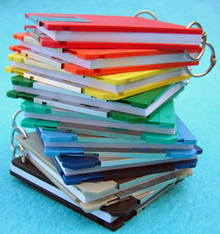 I read that line on a yard sale sign this afternoon on Fulton Street in downtown Manhattan, which, if you’re not familiar with the area, is nowhere near a yard. The guy was selling crap, but you gotta respect the panache.
Speaking of gumption, Nicola of Acorn Studios wrote to me tonight asking me to share her latest repurposed trash creations with you folks. In contrast to the senior citizen of this afternoon and his cheeky placard, Nicola peddles only quality geekware. My favorite are the keyboard cuff links, but the floppy disk notebooks are also quite nice, and more colorful than I remembered storage devices of the past to be.
Oh, and for mom, check out the earrings.
 everydaytrash